Home
Class 11
PHYSICS
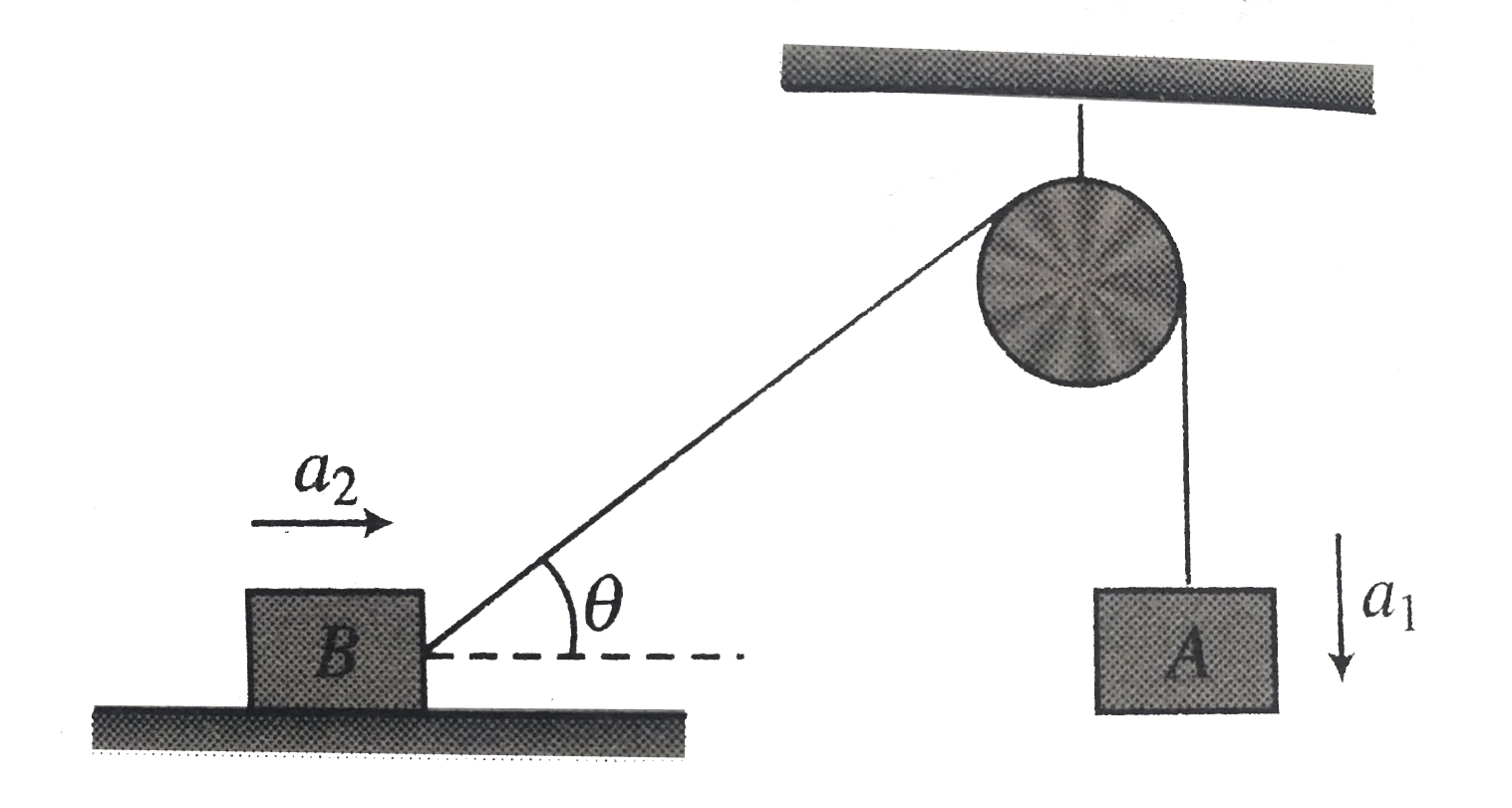
Figure shows two blocks each of mass m s...

Figure shows two blocks each of mass m system is released from rest. If acceleration of blocks A and B at any instant (not initially) are `a_(1)` and `a_(2)`, respectively. Then

A

`a_(1)=a_(2) costheta`

B

`a_(2)=a_(1) costheta`

C

`a_(1)=a_(2)`

D

None of these

Text Solution

Verified by Experts

The correct Answer is:

D

Let at any time, their velocites are `v_(1)` and `v_(2)`, respectively. Then `v_(1)=v_(2) cos theta`
Differentiating: `a_(1)=a_(2) cos theta =v_(2) sin theta (d theta)/(dt)`
Hance, none of them is correct.
[Note: Option (a) is correct initially, because initially `v_(2) = 0`].
Promotional Banner

Topper's Solved these Questions

  • NEWTON'S LAWS OF MOTION 1

    CENGAGE PHYSICS ENGLISH|Exercise Multiple Correct|11 Videos
  • NEWTON'S LAWS OF MOTION 1

    CENGAGE PHYSICS ENGLISH|Exercise Assertion-reasoning|15 Videos
  • NEWTON'S LAWS OF MOTION 1

    CENGAGE PHYSICS ENGLISH|Exercise Subjective|15 Videos
  • MISCELLANEOUS VOLUME 2

    CENGAGE PHYSICS ENGLISH|Exercise INTEGER_TYPE|10 Videos
  • NEWTON'S LAWS OF MOTION 2

    CENGAGE PHYSICS ENGLISH|Exercise Integer type|1 Videos

Similar Questions

Explore conceptually related problems

In figure there are two particles A and B each of mass m . A is connected to ceiling by a light inextensible thread OA and B is connected to A by light inextensible thread AB . Initially line OB is vertical. System is released from rest. Initial acceleration of A and B are a_(1) and a_(2) respectively. Find the value of 5a_(1)//2a_(2)

In the arrangement shown in fig., all pulleys are smooth and massless. When the system is released from the rest, acceleration of block 2 and 3 relative to 1 are 1 ms^(-2) downwards and 5ms^(-2) downwards, respectively. Acceleration of block 3 relative to 4 is zero. Find the absolute acceleration of block 1.

In the arrangement shown in fig., all pulleys are smooth and massless. When the system is released from the rest, acceleration of block 2 and 3 relative to 1 are 1 ms^(-2) downwards and 5ms^(-2) downwards, respectively. Acceleration of block 3 relative to 4 is zero. Find the absoulte acceleration of block 2.

In the arrangement shown in fig., all pulleys are smooth and massless. When the system is released from the rest, acceleration of block 2 and 3 relative to 1 are 1 ms^(-2) downwards and 5ms^(-2) downwards, respectively. Acceleration of block 3 relative to 4 is zero. Find the absoulte acceleration of block 4.

In given system a_(1) and a_(2) are the accelerations of blocks 1 and 2. Then constraint relation is

Figure shows a block of mass 2m sliding on a block of mass m. Find the acceleration of each block . ( All surface are smoth )

Find the relation between acceleration of blocks a_(1), a_(2) and a_(3) .

In Fig. a pulley is shown which is frictionless and a ring of mass m can slide on the string without any friction. One end of the string is attached to point B and to the other end, a block 'P' of mass m is attached. The whole system lies in vertical plane. Now another block 'C' of same mass m is attached to the block 'P' and system is released from rest. If a_(1) and a_(2) are the magnitudes of initial accelerations of ring and blocks, respectively, then

All the blocks are attached to an ideal rope which passes over an ideal pulley. If acceleration of blocks m_(1),m_(2),m_(3) and m_(4) and a_(1),a_(2),a_(3) and a_(4) respectively then choose the correct option.

The system shown in figure is released is released from rest . Find acceleration of different string blocks and tenson in different strings.

CENGAGE PHYSICS ENGLISH-NEWTON'S LAWS OF MOTION 1-Single Correct
  1. Which is the defect represented by the given figure ?

    Text Solution

    |

  2. A small, light pulley is attached with a block C of mass 4 kg as shown...

    Text Solution

    |

  3. A particle is moving in the x-y plane. At certain instant of time, the...

    Text Solution

    |

  4. Figure shows two blocks each of mass m system is released from rest. I...

    Text Solution

    |

  5. If block A is moving horizontally with velocity v(A), then find the ve...

    Text Solution

    |

  6. A small block of mass m rests on a smooth wedge of angle theta. With w...

    Text Solution

    |

  7. In fig. man A is standing on a movable plank while man B is standing o...

    Text Solution

    |

  8. Two trolley 1 and 2 are moving with acceleration a(1) and a(2) respect...

    Text Solution

    |

  9. In the system shown all the surfaces are frictionless while pulley and...

    Text Solution

    |

  10. Two masses are connected by a string which passes over a pulley accele...

    Text Solution

    |

  11. In fig, the acceleration of A is vec(a)(A)=15hat(i)+15hat(j). Then the...

    Text Solution

    |

  12. Two blocks A and B of masses m and 2m, respectively , are held at rest...

    Text Solution

    |

  13. A bob is hanging over a pulley inside a car through a string. The seco...

    Text Solution

    |

  14. Inside a horizontal moving box, an experimenter finds that when an obj...

    Text Solution

    |

  15. Two blocks A and B each of mass m are placed on a smooth horizontal su...

    Text Solution

    |

  16. A system is shown in fig. Assume that the cylinder remains in contact ...

    Text Solution

    |

  17. A plank is held at an angle alpha to the horizontal on two fixed suppo...

    Text Solution

    |

  18. A pendulum of mass m hangs from a support fixed to a trolley. The dire...

    Text Solution

    |

  19. The acceleration of the block B in fig. Assuming the surfaces and the ...

    Text Solution

    |

  20. In the arrangement shown in fig. the block of mass m=2kg lies on the w...

    Text Solution

    |
