Home
Class 11
PHYSICS
A block of mass m is placed on a wedge T...

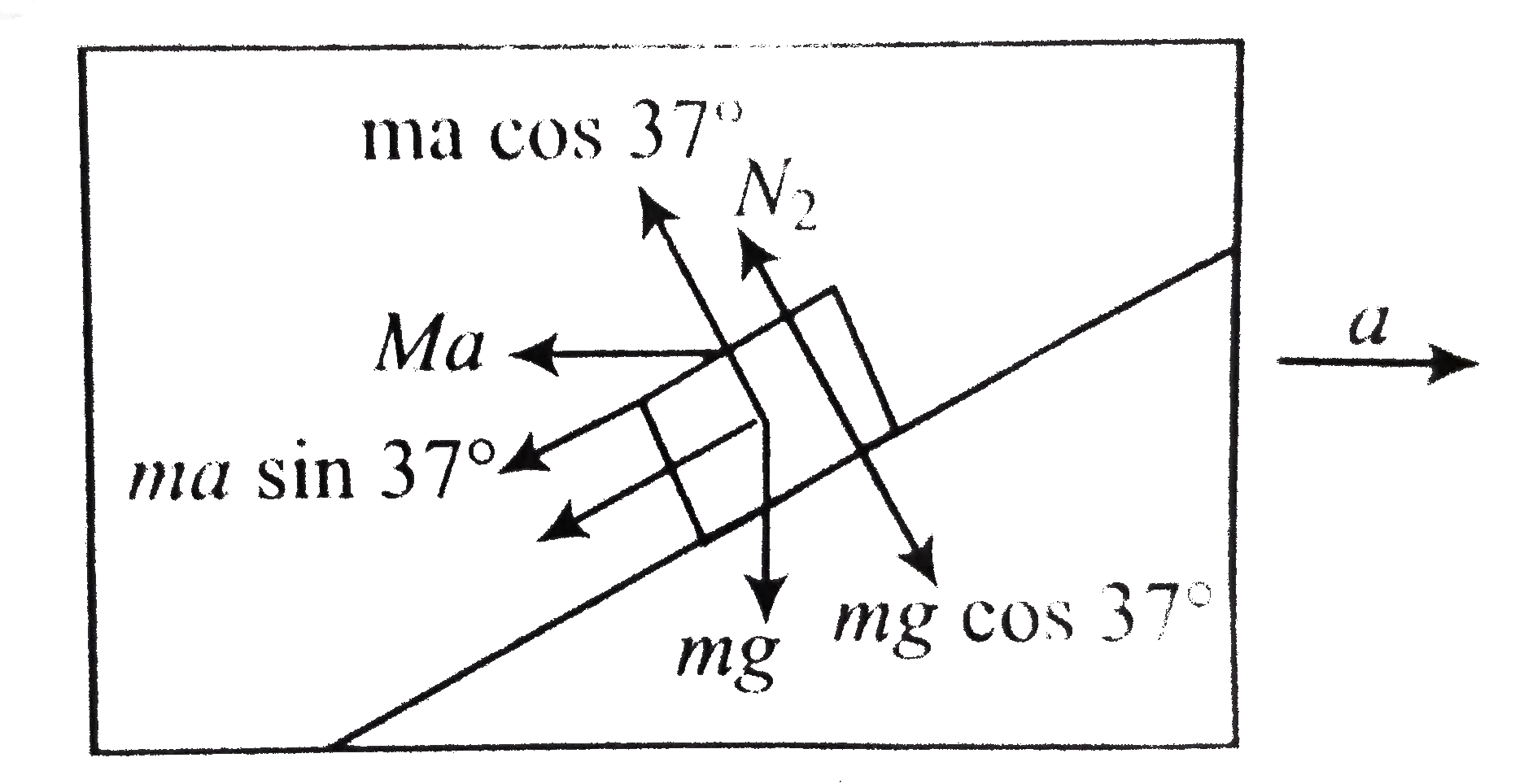
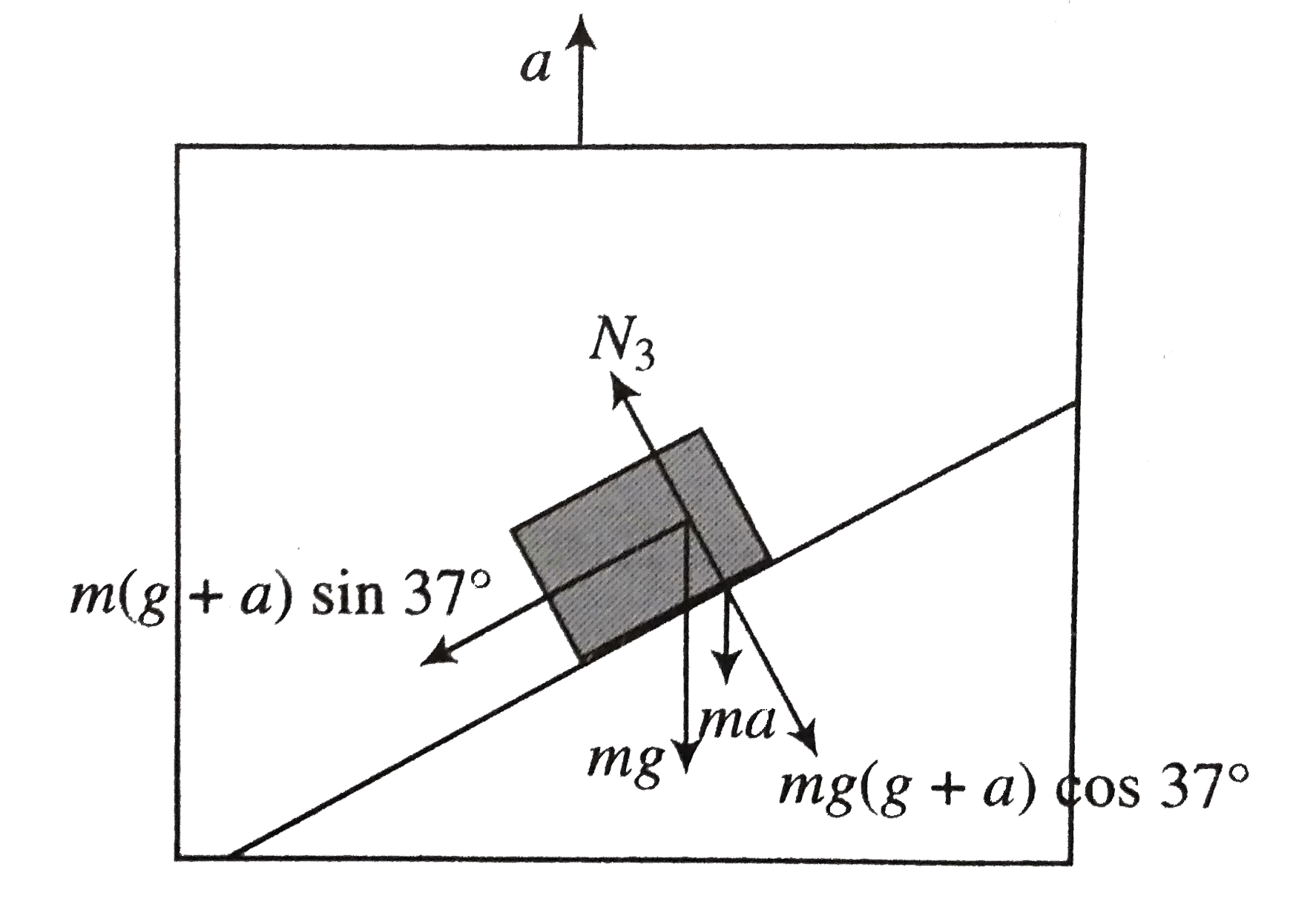
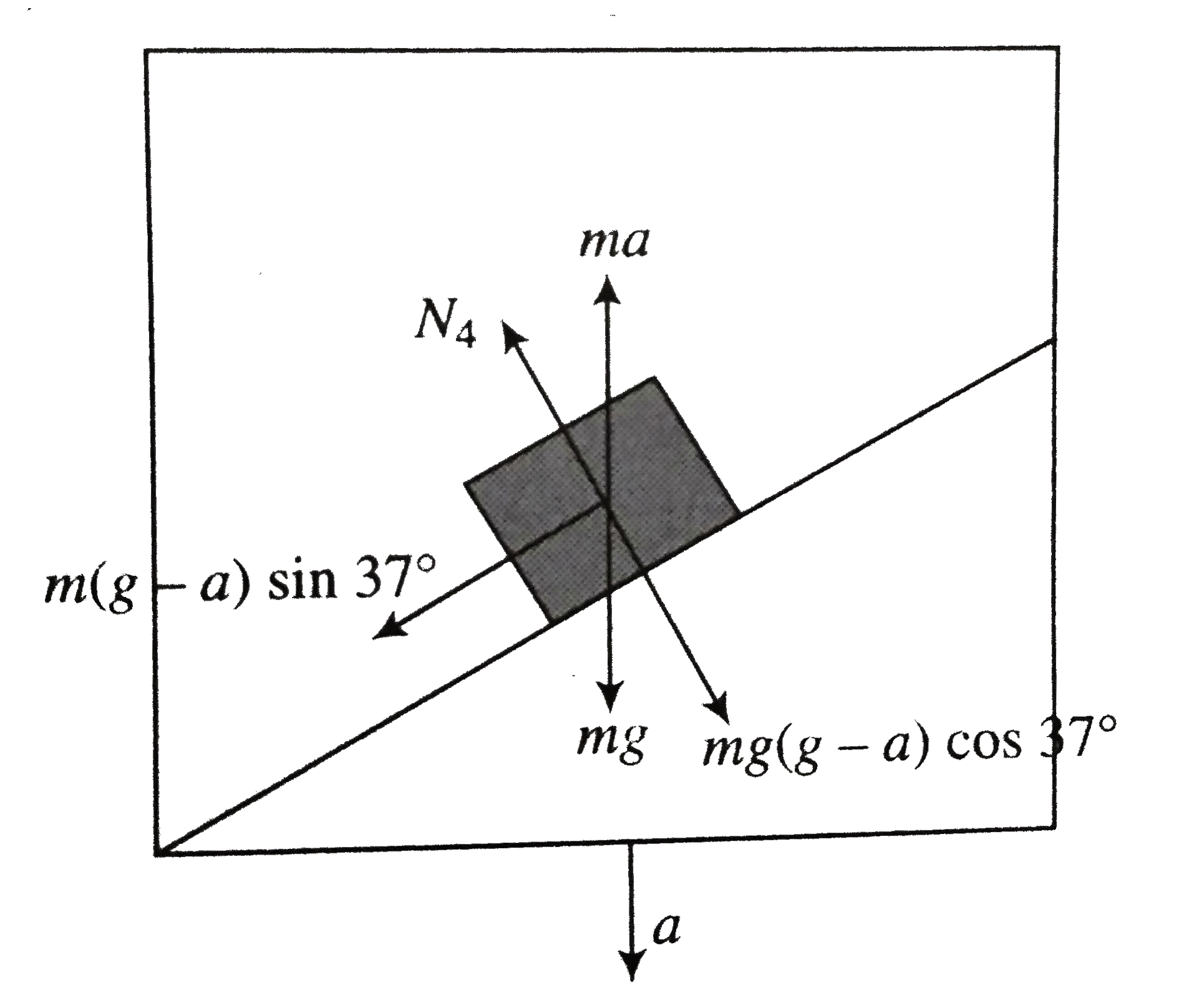
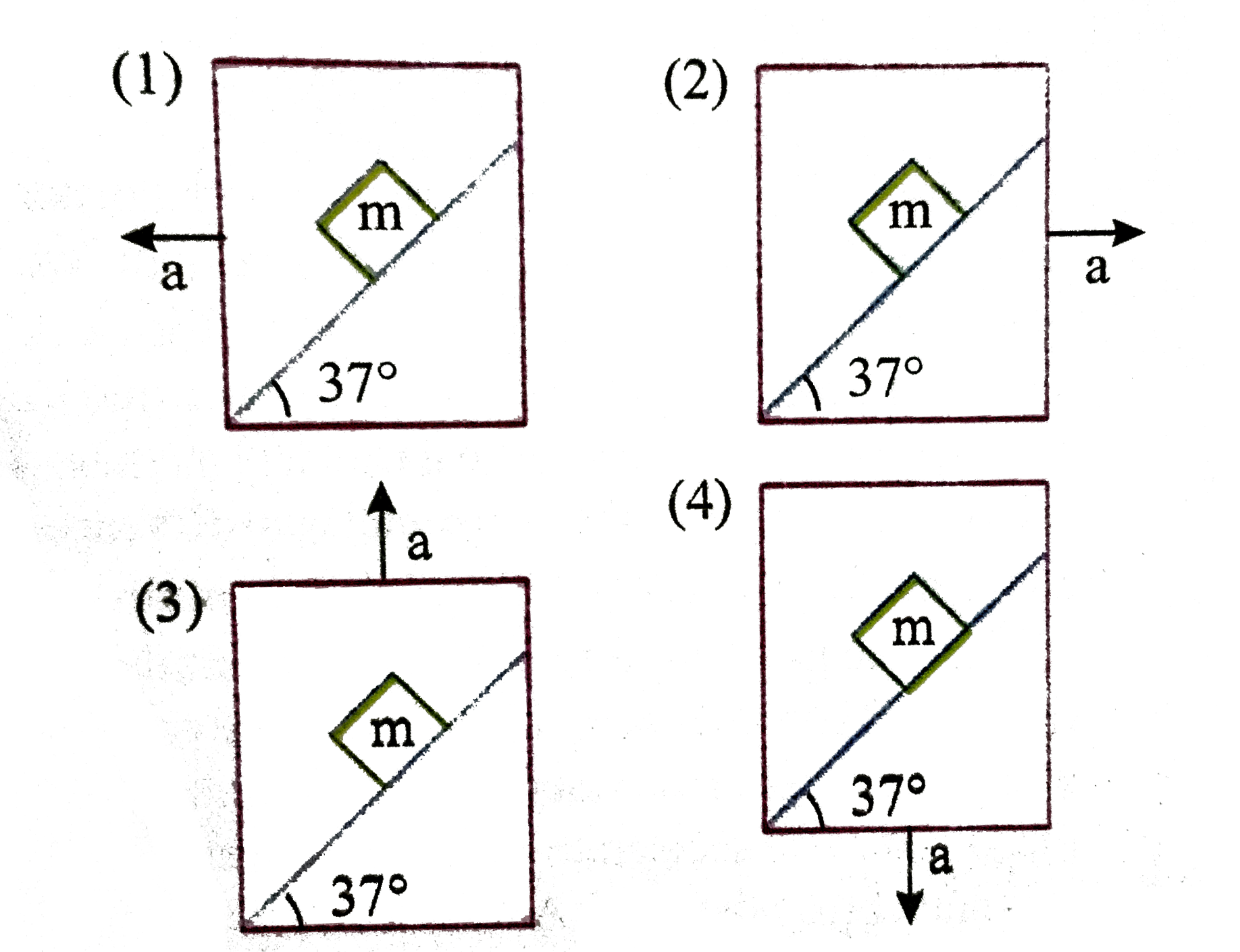
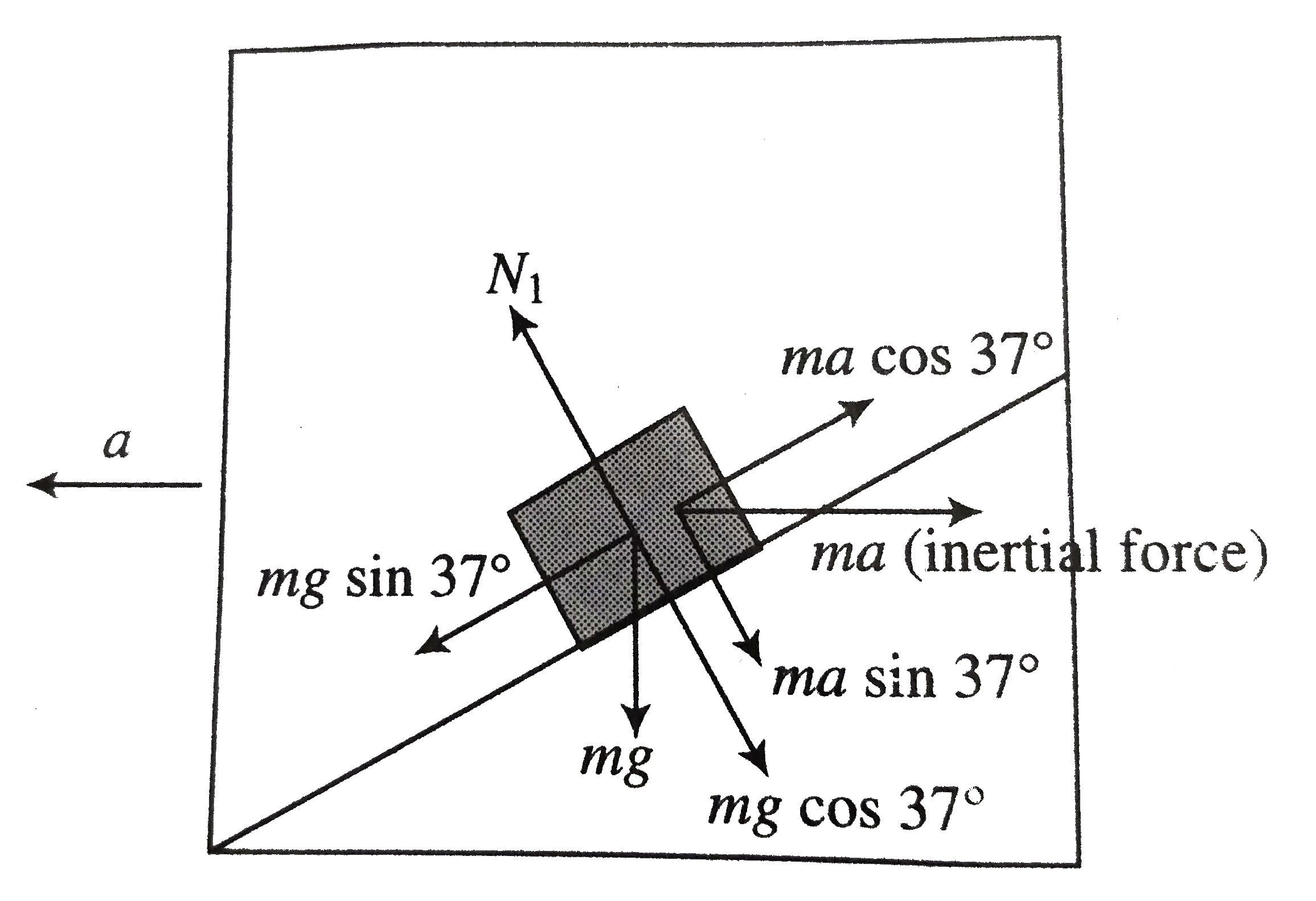
A block of mass m is placed on a wedge The wedge can be accelerated in four manners marked as `(1),(2),(3)` and (4) as shown. If the normal reactions in situation `(1),(2),(3)` and (4) are `N_(1),N_(2),N_(3)` and `N_(4)` respectively and acceleration with which the block slides on the wedge in situation are `b_(1),b_(2),b_(3)` and `b_(4)` respectively then

A

`N_(3) gt N_(1) gt N_(2) gtN_(4)`

B

`N_(4) gt N_(3) gt N_(1) gtN_(2)`

C

`b_(2) gt b_(3) gt b_(4) gtb_(1)`

D

`b_(2) gt b_(3) gt b_(1) gtb_(4)`

Text Solution

Verified by Experts

The correct Answer is:
A, C


Balancing force perpendicular to incline
`N_(1) = mg cos 37^(@)+ma sin 37^(@)`
`N_(1)=4/5 mg +3/5ma`
And along incline

`mg sin 37^(@)-ma cos 37^(@) =mb_(1)`
`b_(1)=3/5g-4/5 a`
Similarly, for this case, we get

`N_(2)=4/5 mg-3/5 ma`
and `b_(2)=3/5 g +4/5 a`
similary for this case we get

`N_(3)=4/5 mg +4/5 ma`
`b_(3)=3/5 g+ 3/5 a`
Similarly for this case, we get
`N_(4)=4/5 mg -4/5 ma`
and `b_(4)=3/5 g-3/5 a`.
Promotional Banner

Topper's Solved these Questions

  • NEWTON'S LAWS OF MOTION 1

    CENGAGE PHYSICS ENGLISH|Exercise Assertion-reasoning|15 Videos
  • NEWTON'S LAWS OF MOTION 1

    CENGAGE PHYSICS ENGLISH|Exercise Linked Comperhension|46 Videos
  • NEWTON'S LAWS OF MOTION 1

    CENGAGE PHYSICS ENGLISH|Exercise Single Correct|75 Videos
  • MISCELLANEOUS VOLUME 2

    CENGAGE PHYSICS ENGLISH|Exercise INTEGER_TYPE|10 Videos
  • NEWTON'S LAWS OF MOTION 2

    CENGAGE PHYSICS ENGLISH|Exercise Integer type|1 Videos

Similar Questions

Explore conceptually related problems

In each case m_(1) = 4 kg and m_(2) = 3 kg . If a_(1) and a_(2) and a_(3) are the respective acceleration of the block m_(1) in given situation, then

The situations are shown in fig(a) & (b), in each case, m_1 =3kg and m_2 =4 kg. If a_1 , a_2 are the respective accelerations of the blocks in these situations, then the values of a_1 and a_2 are respectively [g=10 ms^(-2) ]

Three blocks are placed as shown in figure. Mass of A, B and C are m_(1), m_(2),"and "m_(3) respectively. The force exerted by block 'C' on 'B' is :-

A block of mass m is at rest on wedge as shown in figure. Let N be the normal reaction between two and f the force of friction, then choose the wrong option.

Three blocks A, B, and C of masses 3M, 2M , and M are suspended vertically with the help of spring PQ and TU, and a string RS as shown in fig. If the acceleration of blocks A, B and C is a_(1), a_(2) and a_(3) , respectively, then The value of acceleration a_(1) at the moment string RS is cut is

Three blocks A, B, and C of masses 3M, 2M , and M are suspended vertically with the help of spring PQ and TU, and a string RS as shown in fig. If the acceleration of blocks A, B and C is a_(1), a_(2) and a_(3) , respectively, then The value of acceleration a_(3) at the moment spring PQ is cut is

Three blocks A, B, and C of masses 3M, 2M , and M are suspended vertically with the help of spring PQ and TU, and a string RS as shown in fig. If the acceleration of blocks A, B and C is a_(1), a_(2) and a_(3) , respectively, then The value of acceleration a_(2) at the moment spring TU is cut is

A block of mass 1 kg is at rest relative to a smooth wedge moving leftwards with constant acceleration a=5m//s^(2) Let N be the normal reaction between block and the wedge .Then (g=10m//s^(2) )

A block of mass 1 kg is at rest relative to a smooth wedge moving leftwards with constant acceleration a = 5 m//s^(-2) .Let N be the normal reation between the block and the wedge . Then (g = 10 m//s^(-2))

wedge^(@)._(aq) of BaCl_(2), H_(2)SO_(4) , and HCl(aq) solutions are x_(1), x_(2), and x_(3), respectively . wedge^(@)._(m(BaSO_(4))) is :