Home
Class 11
PHYSICS
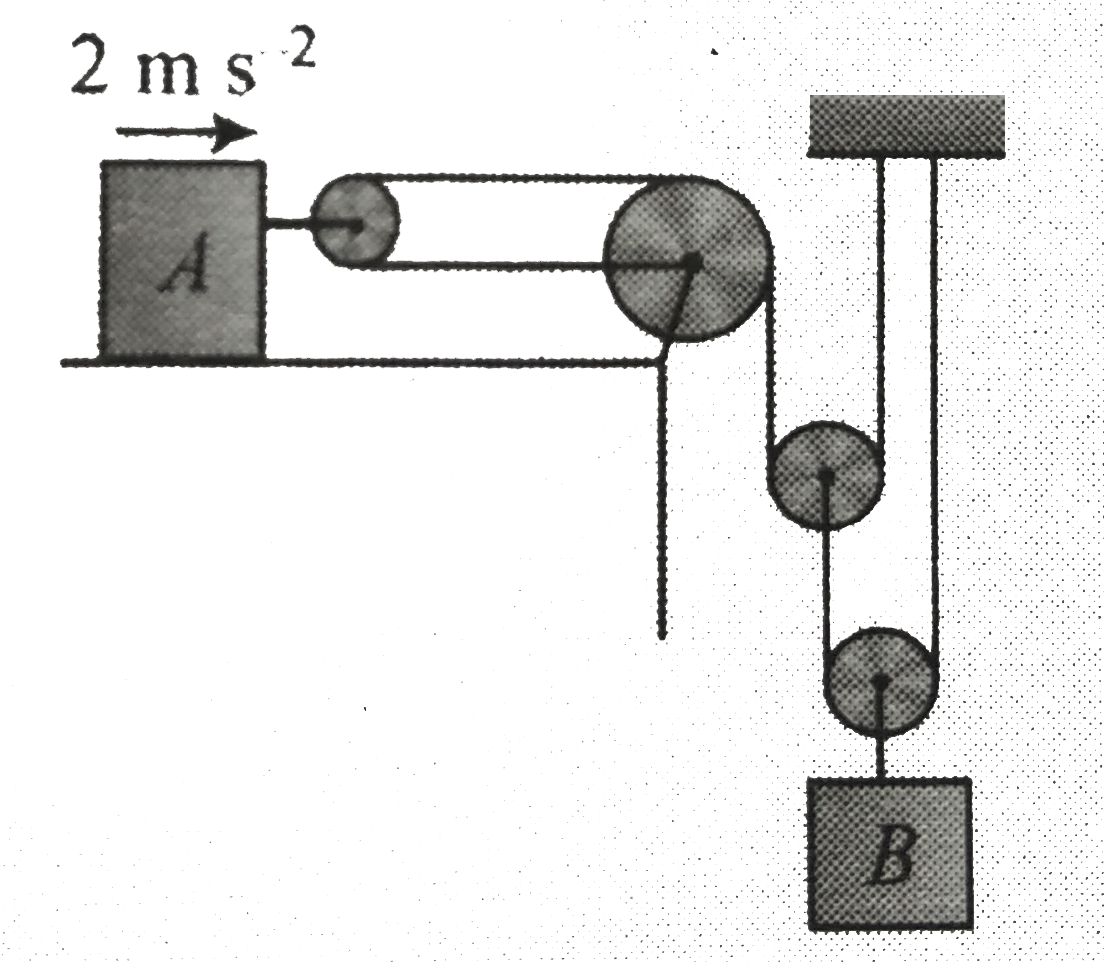
In fig. find the acceleration of B if ac...

In fig. find the acceleration of B if acceleration of A is `2ms^(-2)`.

Text Solution

Verified by Experts

The correct Answer is:
2

`l_(1)+l_(2) = C implies l_(1)^('')+l_(2)^('')=0`

`=-a_(p)+(12-a_(P))=0 implies a_(p)=6ms^(-2)`
`l_(3)+l_(4)+l_(5)+l_(6)=C`
`l_(3)^('')+l_(4)^('')+l_(5)^('')+l_(6)^('')=0`
`a_(P)-a_(B)-a_(B)-a_(B=0`
`impliesa_(p)=3a_(B) implies a_(B)=2ms^(-1)`.
Promotional Banner

Topper's Solved these Questions

  • NEWTON'S LAWS OF MOTION 1

    CENGAGE PHYSICS ENGLISH|Exercise Linked Comperhension|46 Videos
  • MISCELLANEOUS VOLUME 2

    CENGAGE PHYSICS ENGLISH|Exercise INTEGER_TYPE|10 Videos
  • NEWTON'S LAWS OF MOTION 2

    CENGAGE PHYSICS ENGLISH|Exercise Integer type|1 Videos

Similar Questions

Explore conceptually related problems

For the system as shown in fig. find the acceleration of C. the accelerations of A and B with respect to ground are marked.

Find the acceleration of 3kg mass when acceleration of 2kg mass is ms^(-2) as shwon in fig.

Find the acceleration of 3 kg mass when acceleration of 2 kg mass is 2ms^(-2) as shown in figure-2.140

A person in an elevator accelerating upwards with an acceleration of 2ms^(-2) , tosses a coin vertically upwards with a speed of 20 ms^(-1) . After how much time will the coin fall back into his hand ? (g = 10 ms^(-2) )

A person in an elevator accelerating upwards with an acceleration of 2ms^(-2) , tosses a coin vertically upwards with a speed of 20 ms^(-1) . After how much time will the coin fall back into his hand ? (g = 10 ms^(-2) )

A person in an elevator accelerating upwards with an acceleration of 2ms^(-2) , tosses a coin vertically upwards with a speed of 20 ms^(-1) . After how much time will the coin fall back into his hand ? (g = 10 ms^(-2) )

As shown in fig, if acceleration of M with respect to ground is 2ms^(-2) , then

In the arrangement shown in fig., if the acceleration of B is vec(a) . Then find the acceleration of A.

In the situation as shown in the figure if acceleration of B is a, then find the acceleration of A ( B always remain horizintal),

The fricition coefficient between the table and block shown in fig. is 0.2 find the acceleration of the system (Take g=10 m//s^(2) )

