Home
Class 11
PHYSICS
A block of mass m is placed on the block...

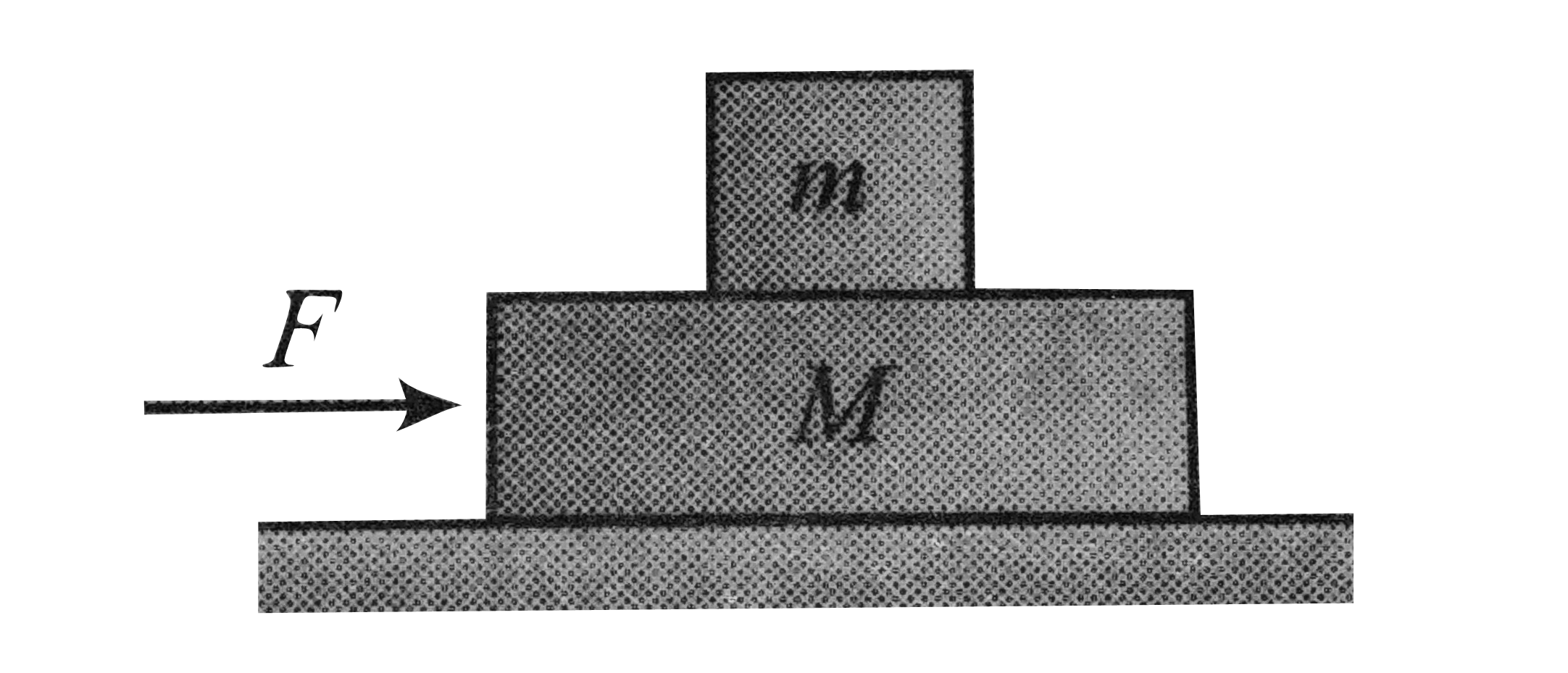
A block of mass m is placed on the block of mass M as shown in figure. The horizontal force `vecF` acts on M during time interval t. If the horizontal surface is smooth, assuming no relative sliding between the blocks, find the
a. work done by friction on the blocks
b. work done by `vecF` on the lower block

Text Solution

Verified by Experts
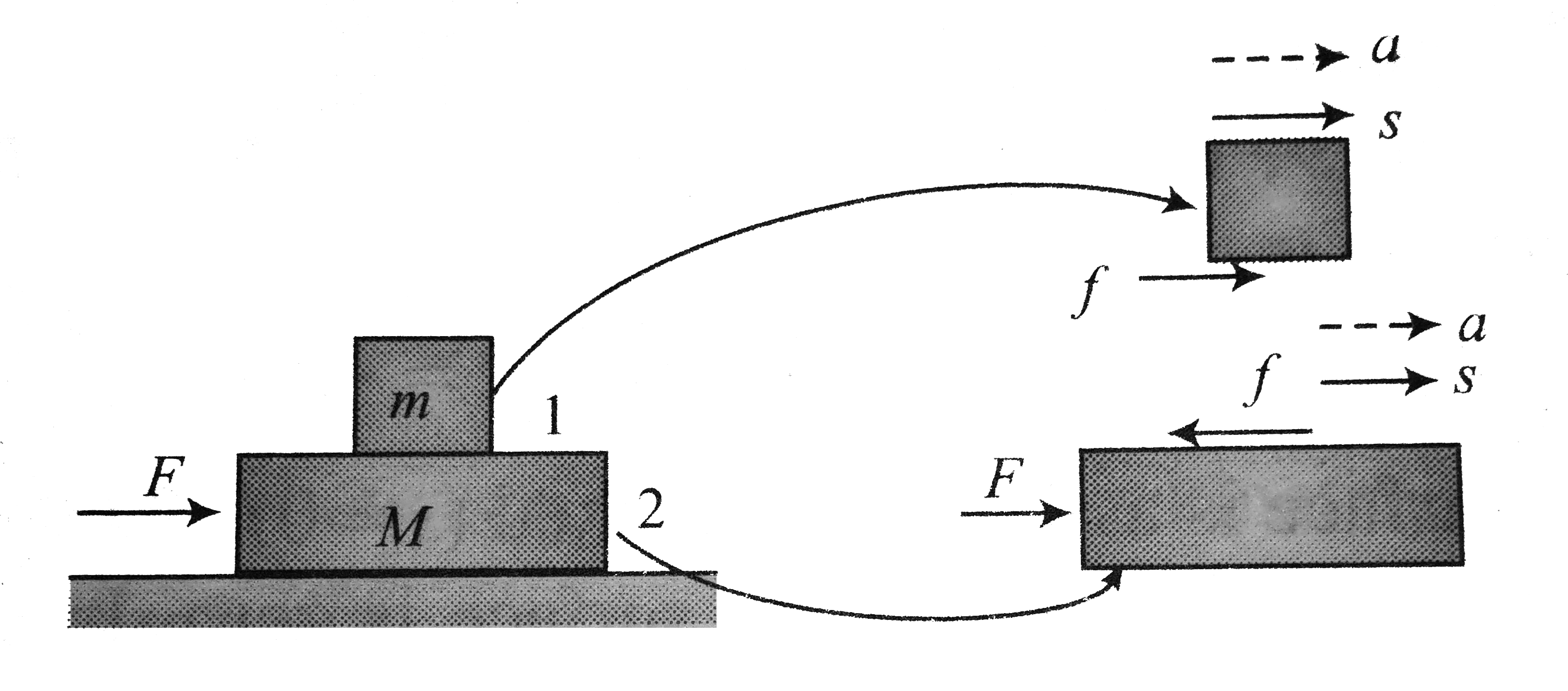

a. As there is no relative sliding between the blocks, they move with a common acceleration,
`a=(F)/(M+m)`
Then the static frictional force on the block m is
`f=ma`, where `a=(F)/(M+m)`. Then
`f=m(F)/(M+m)`
Work done by static frictional force on the block m
Since `(W_f)_m=vecf.vecs=fscos0^@=fs`
where `s=1/2at^2`
We have `(W_f)_m=f(1/2at^2)`
Substituting `f=(mF)/(M+m)` and `a=(F)/(M+m)`
We have `(W_f)_m=(mF^2t^2)/(2(M+m))`
As no relative sliding between m and M, hence, net work done by static friction is zero.
Since `(W_f)_m+(W_f)_M=0`
Hence, the work done by the static frictional force on the block m
We have `(W_f)_m=(mF^2t^2)/(2(M+m))`
b. The displacement of lower block during time t,
`impliess=1/2((F)/(M+m))t^2`
Hence, work done by F, `W_F=vecF.vecs`
`W_F=F*s=F[1/2((F)/(M+m))t^2]=(F^2t^2)/(2(M+m))`
Promotional Banner

Topper's Solved these Questions

  • WORK, POWER & ENERGY

    CENGAGE PHYSICS ENGLISH|Exercise Solved Examples|15 Videos
  • WORK, POWER & ENERGY

    CENGAGE PHYSICS ENGLISH|Exercise Exercise 8.1|25 Videos
  • VECTORS

    CENGAGE PHYSICS ENGLISH|Exercise Exercise Multiple Correct|5 Videos

Similar Questions

Explore conceptually related problems

Two blocks of masses 'M' and 'm' are placed on one another on a smooth horizontal surface as shown in the figure. The force 'F' is acting on the mass 'M' horizontally during time interval 't'. Assumings no relative sliding between the blocks, The work done by friction on the blocks is

A block of mass m is kept over another block of mass 2 m and the system rests on a smooth horizontal surface. The coefficient of friction between the blocks is 0.50. Find the work done by the force of friction on the smaller block by the bigger block during a displacement d of the system, when a force mg is applied to the lower block.

A small block B of mass m_2 is placed on another block A of mass m_1 A constant horizontal force F is applied to the block A. All the surfaces are assumed to be frictionless. Find the acceleration of center of mass of the system

In fig Block m_(2) is loaded on block m_(1) . If there is no relative sliding between the block and the inclined plane is smooth , find the friction force between the block

A wooden block of mass M resting on a rough horizontal surface is pulled with a force T at an angle q to the horizontal. If m is coefficient of kinetic friction between the block and the surface, the acceleration of the block is

A bullet of mass 'm' moving with velocity 'u' passes through a wooden block of mass M = nm as shown in figure. The block is resting on a smooth horizontal floor. After passing through the block, velocity relative to the block is .

A block of mass m is placed at rest on a smooth wedge of mass M placed at rest on a smooth horizontal surface. As the system is released

A block of mass m is placed on another block of mass M lying on a smooth horizontal surface as shown in the figure. The co-efficient of friction between the blocks is mu . Find the maximum horizontal force F (in Newton) that can be applied to the block M so that the blocks together with same acceleration? (M=3kg, m=2kg, mu=0.1, g=10m//s^(2))

A block of mass m is pulled by a force of constant power P placed on a rough horizontal plane. The friction coefficient between the block and the surface is mu . Then

A block of mass m is placed on a wedge of mass M and a force F is acting on its as shown . If all surfaces are smooth , find the force F such that, there is no relative motion between m and M.

