Home
Class 11
PHYSICS
A plank of mass M and length L is placed...

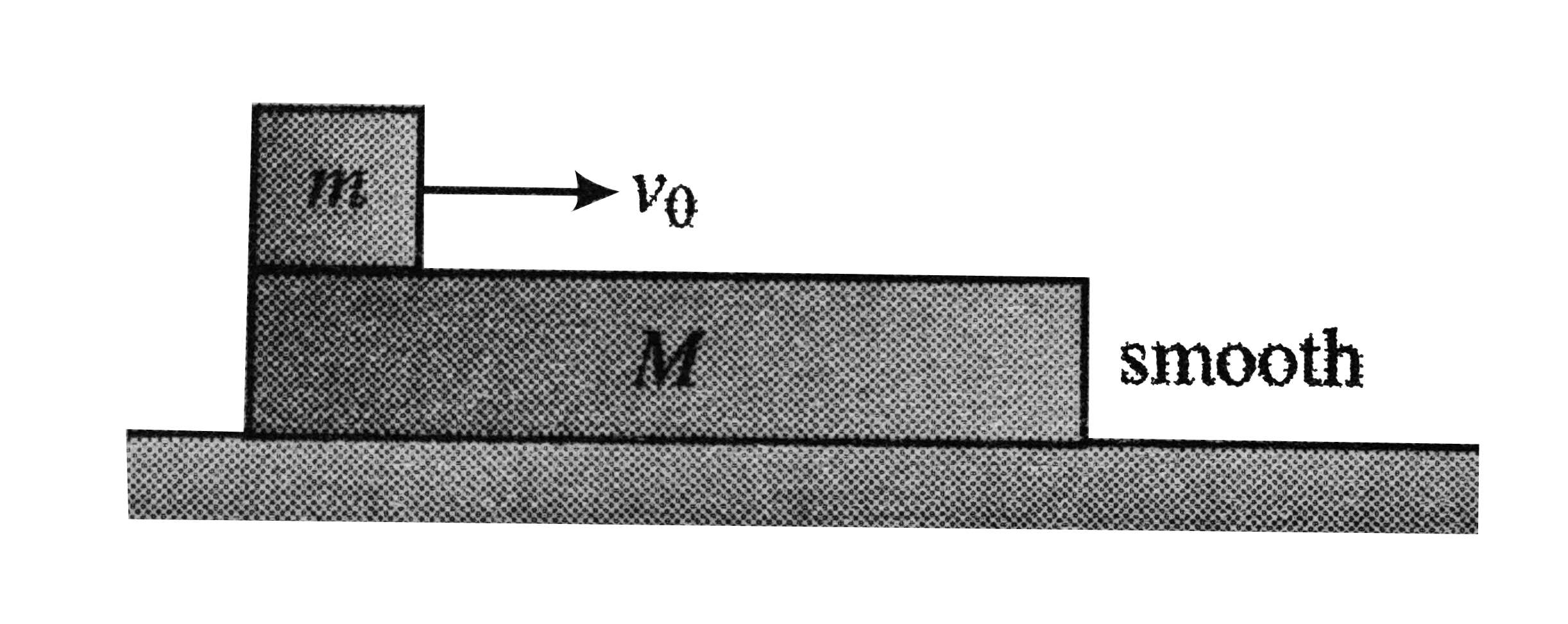
A plank of mass M and length L is placed at rest on a smooth horizontal surface. A small block of mass m is projected with a velocity `v_0` from the left end of it as shown in figure. The coefficient of friction between the block and the plank is m, and its value is such that the block becomes stationary with respect to the plank before it reaches the other end.

a. Find the time and common velocity when relative sliding between the block and the plank stops.
b. Find the work done by the friction force on the block during the period it slides on the plank. Is the work positive or negative?
c. Calculate the work done on the plank during the same period. Is the work positive or negative?
d. Also, determine the net work done by friction, Is it positive or negative?

Text Solution

Verified by Experts

Displacement of block in `1s`
`s=1/2xx10xx1^2=5m`

The work done by the applied force in the first second,
`W_F=vecF*vecs=F*scostheta=20xx5=100J`
The work done by the weight of th block in the first
Promotional Banner

Topper's Solved these Questions

  • WORK, POWER & ENERGY

    CENGAGE PHYSICS ENGLISH|Exercise Solved Examples|15 Videos
  • WORK, POWER & ENERGY

    CENGAGE PHYSICS ENGLISH|Exercise Exercise 8.1|25 Videos
  • VECTORS

    CENGAGE PHYSICS ENGLISH|Exercise Exercise Multiple Correct|5 Videos

Similar Questions

Explore conceptually related problems

The block of mass m is kept on plank of mass M. The block is given velocity V_(0) as shown. The coefficient of friction between the block of mass m and plank of mass M is mu and its value is such that block becomes stationary with respect to plank before it reaches the other end. Then:

A long block A is at rest on a smooth horizontal surface. A small block B whose mass is half of mass of A is placed on A at one end and is given an initial velocity u as shown in figure. The coefficient of friction between the blocks is mu .

A long block A is at rest on a smooth horizontal surface. A small block B, whose mass is half of A, is placed on A at one end and projected along A with some velocity u. The coefficient of friction between the blocks is mu :

A block of mass m is placed at rest on a smooth wedge of mass M placed at rest on a smooth horizontal surface. As the system is released

A long block A of mass M is at rest on a smooth horizontal surface.A small block B of mass M//2 is placed on A at one end and projected along A with some veklocity v.The coefficient of friction between the block is mu then , the accelerations of blocks A and B before reaching a common velocity will be respectively

A smooth wedge of mass M rests on a smooth horizontal surface. A block of mass m is projected from its lowermost point with velocity v_(0) . What is the maximum height reached by the block?

A smooth wedge of mass M rests on a smooth horizontal surface. A block of mass m is projected from its lowermost point with velocity v_(0) . What is the maximum height reached by the block?

A long plank of mass M is initially at rest on a frictionless surface. A small block with mass m and initial speed u_(0) slides on top of the larger plank. The coefficient of friction between the block and plank is mu Net work done by friction if the top block falls off the plank after sliding over its length L is

A wedge shaped block A' of mass M is at rest on a smooth horizontal surface. A small block 'B' of mass 'm' placed at the top edge of inclined plane of length 'l' as shown in the figure. By the time, the block 'B' reaches the bottom end, the wedge A moves a distance of:

Two block of masses m1 and m2 are connected with a massless unstretched spring and placed over a plank moving with an acceleration 'a' as shown in figure. The coefficient of friction between the blocks and platform is mu

