Home
Class 11
PHYSICS
A small ball is placed at the top of a s...

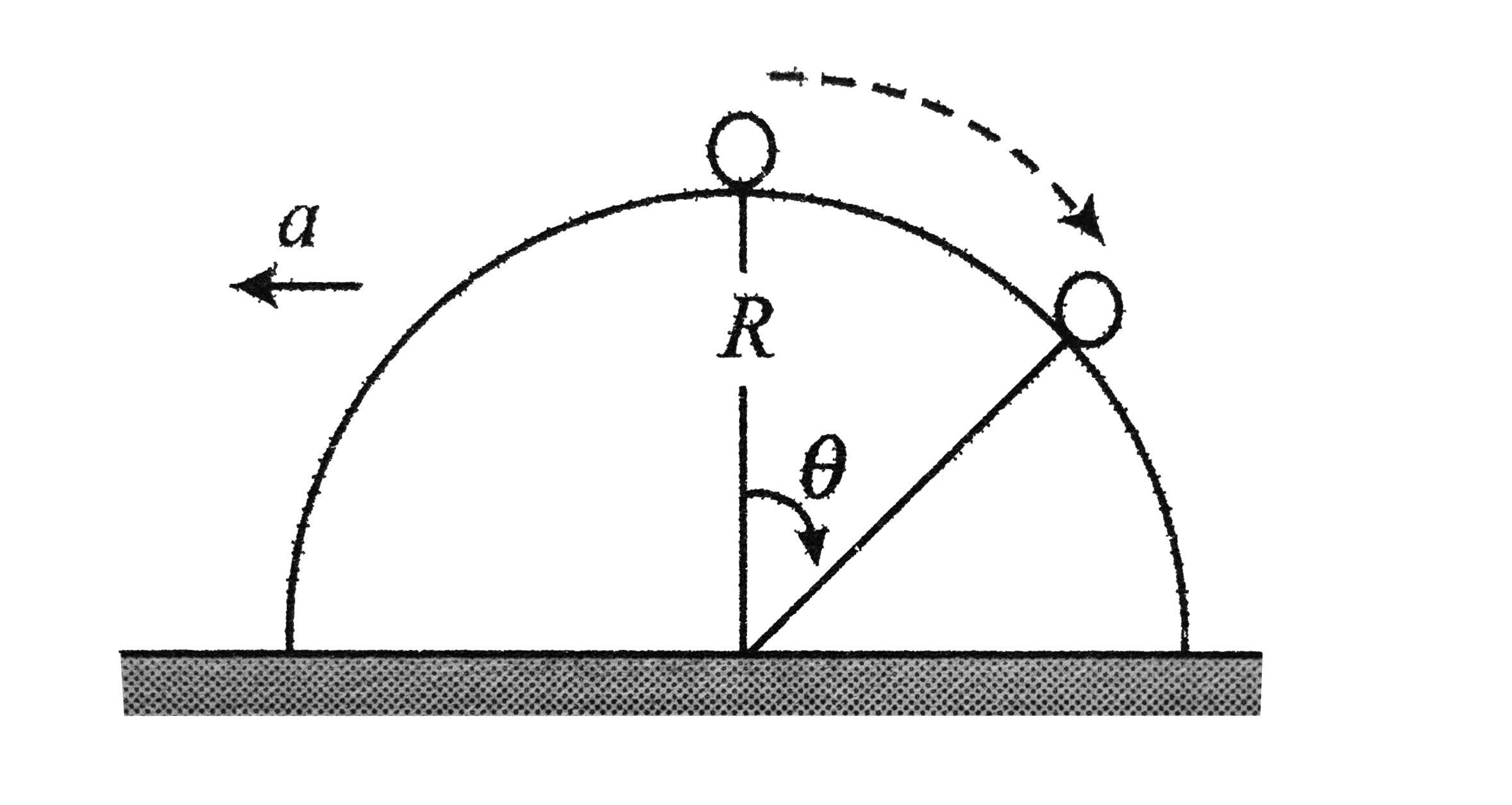
A small ball is placed at the top of a smooth hemispherical wedge of radius R. If the wedge is accelerated with an acceleration a, find the velocity of the ball relative to wedge as a function of `theta`.

Text Solution

Verified by Experts
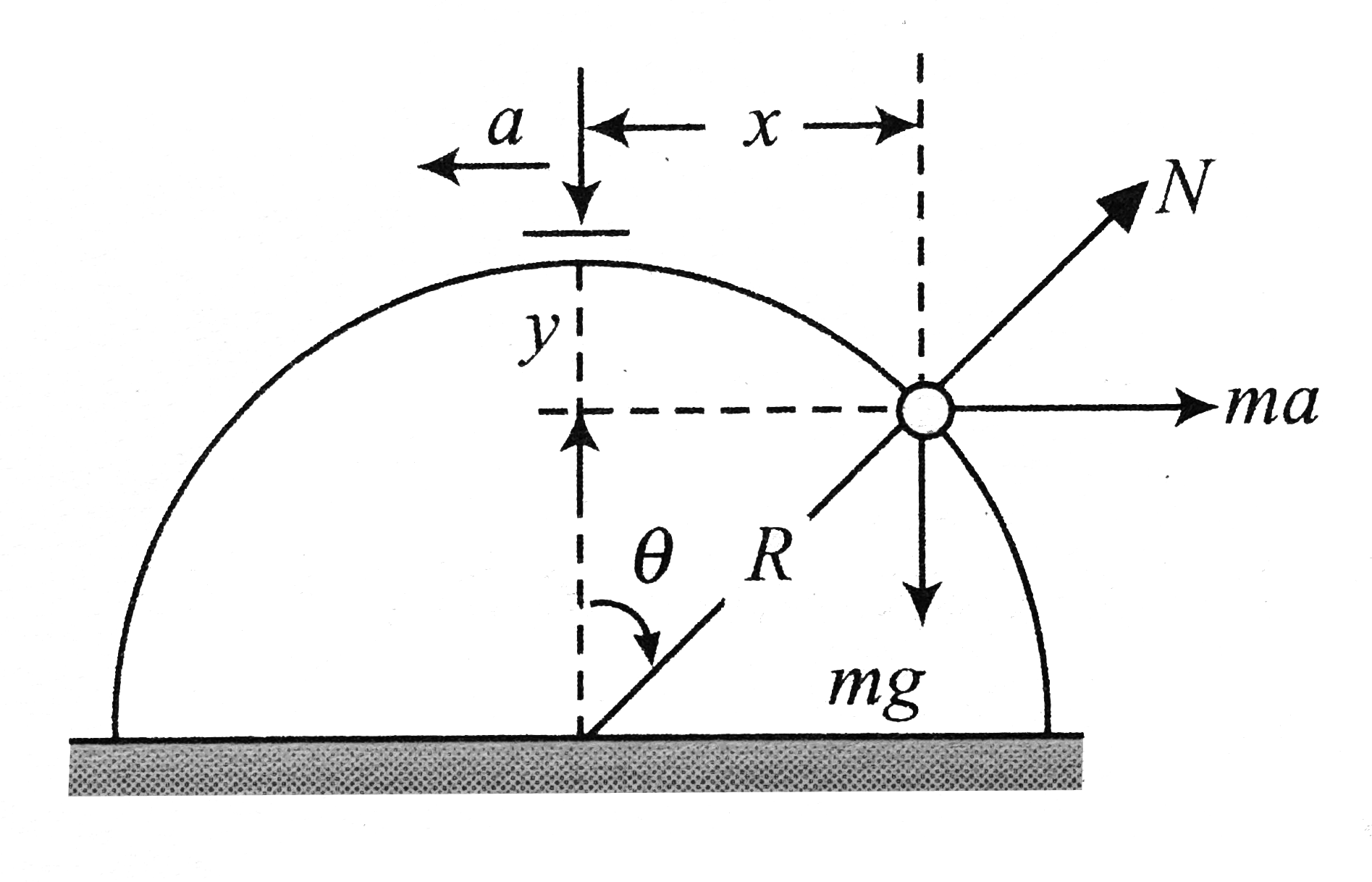
Here we analyze the motion of ball with respect to wedge. As we are analyzing the motion of the ball from accelerating wedge, we impose a pseudo force `mararron` the ball.
The work done by the pseudo force is

`W_(ps)=max`
The work done by gravity is `W_(gr)=mgy`
The work done by normal reaction force is zero as there is no relative sliding between the ball and the wedge in the direction of normal reaction.
Then, the total work done is
`W=max+mgy` (i)
KE: The change in kinetic energy of the ball relative to wedge is
`K=1/2mv^2` (ii)
where v is the velocity of the ball relative to wedge.
W-E theorem relative to wedge:
`W=DeltaK` (iii)
From Eqs (i), (ii), and (iii), we have
`max+mgy=1/2mv^2`
Substituting `x=R sin theta` and `y=R(1-cos theta)`, we have
`v=sqrt(2{gR(1-costheta)+aRsintheta})`
Promotional Banner

Topper's Solved these Questions

  • WORK, POWER & ENERGY

    CENGAGE PHYSICS ENGLISH|Exercise Solved Examples|15 Videos
  • WORK, POWER & ENERGY

    CENGAGE PHYSICS ENGLISH|Exercise Exercise 8.1|25 Videos
  • VECTORS

    CENGAGE PHYSICS ENGLISH|Exercise Exercise Multiple Correct|5 Videos

Similar Questions

Explore conceptually related problems

A wedge with a rough groove in the shape of a quarter of a circle is kept on a smooth table (see figure). A small block is placed in the groove with a small clearance. The wedge is moved with an acceleration sqrt(3)g . If the block is to remain stationary relative to groove in the position shown, the coefficient of friction required can be:

Figure shows a block A constrained to slide along the inclined plane of the wedge B shown. Block A is attached with a string which passes through three ideal pulleys and connected to the wedge B. If wedge is pulled toward right with an acceleration a, find (a) the acceleration of the block with respect to wedge (b) the acceleration of the block with respect to ground.

A block of mass 'm' is kept on a smooth moving wedge. If the acceleration of the wedge is 'a'

A block of mass m is placed on a smooth inclined wedge ABC of inclination theta as shown in the figure. The wedge is given an acceleration a towards the right. The relation between a and theta for the block to remain stationary on the wedge is.

A small block of mass m is placed at rest on the top of a smooth wedge of mass M, which in turn is placed at rest on a smooth horizontal surface as shown in figure. If h be the height of wedge and theta is the inclination, then the distance moved by the wedge as the block reaches the foot of the wedge is

A block of mass 2kg released from the top of a smooth fixed wedge inside the elevator which is moving downward with an acceleration a = 5 m/s^2 as shown in the figure.The value of acceleration of the block w.r.t wedge will be (g = 10 m/s^2)

All surface are smooth. Find the acceleration of mass m relative to wedge when wedge is moving with acceleration 'a'

All the surfaces are smooth as shown in figure. The acceleration of mass m relative to wedge is :

In fig. mass m is being pulled on the incline of a wedge of mass M. All the surfaces are smooth. Find the acceleration of the wedge.

A particle of mass m is placed at rest on the top of a smooth wedge of mass M, which in turn is placed at rest on a smooth horizontal surface as shown in figure. Then the distance moved by the wedge as the particle reaches the foot of the wedge is :

