Home
Class 11
PHYSICS
A particle tide to the end of a string o...

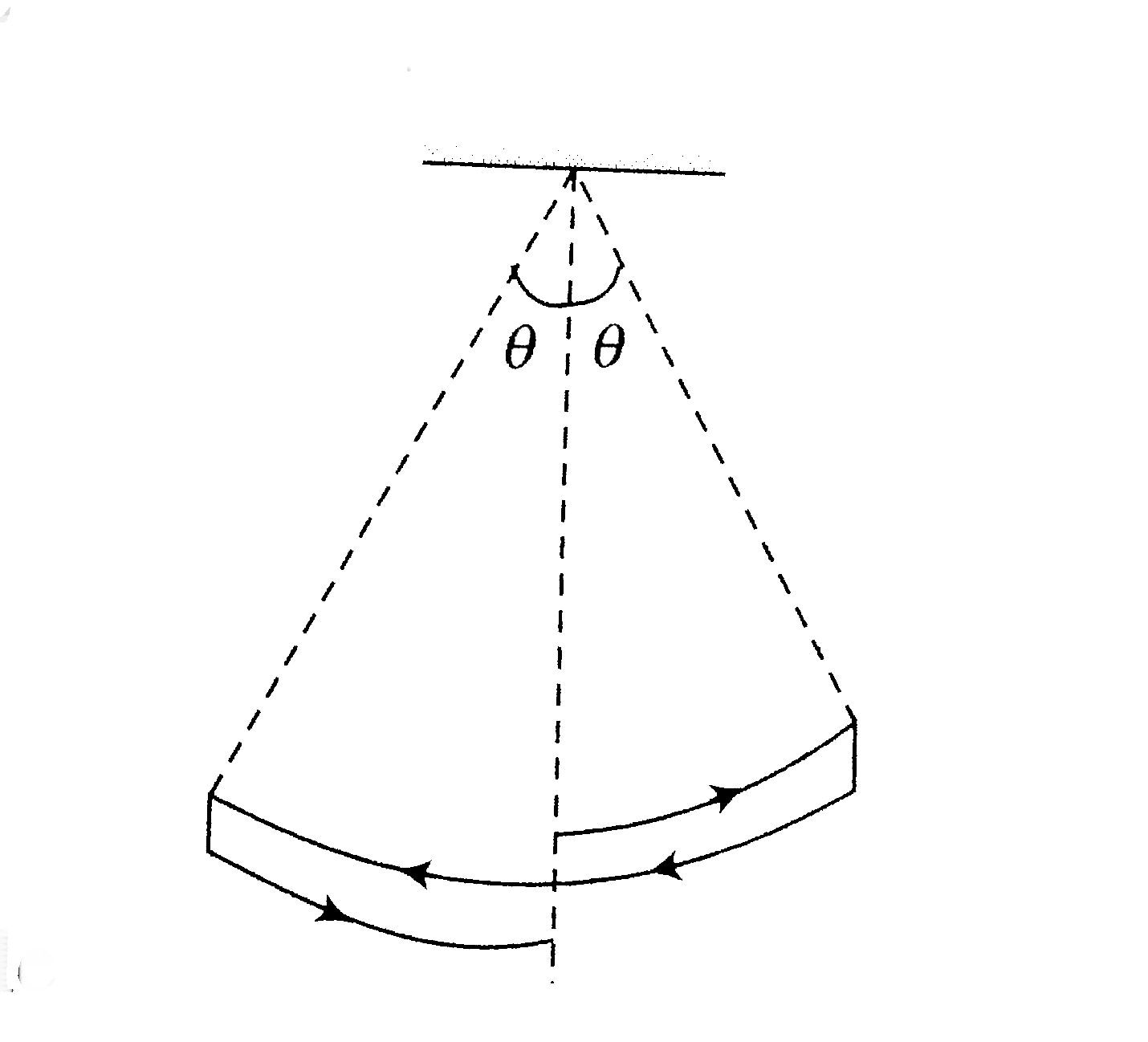
A particle tide to the end of a string oscillates along a circular arc in a vertical plane. The other end of the string is fixed at the center of the circle. If the string has a breaking strength of twice the weight of the particles,
a. find the maximum distance that the particle can cover in one cycle of oscillation. The length of the string is `50cm`.
b. Find the tension in the extreme position.
c. Find the acceleration of the particle at bottom and extreme position.

Text Solution

Verified by Experts
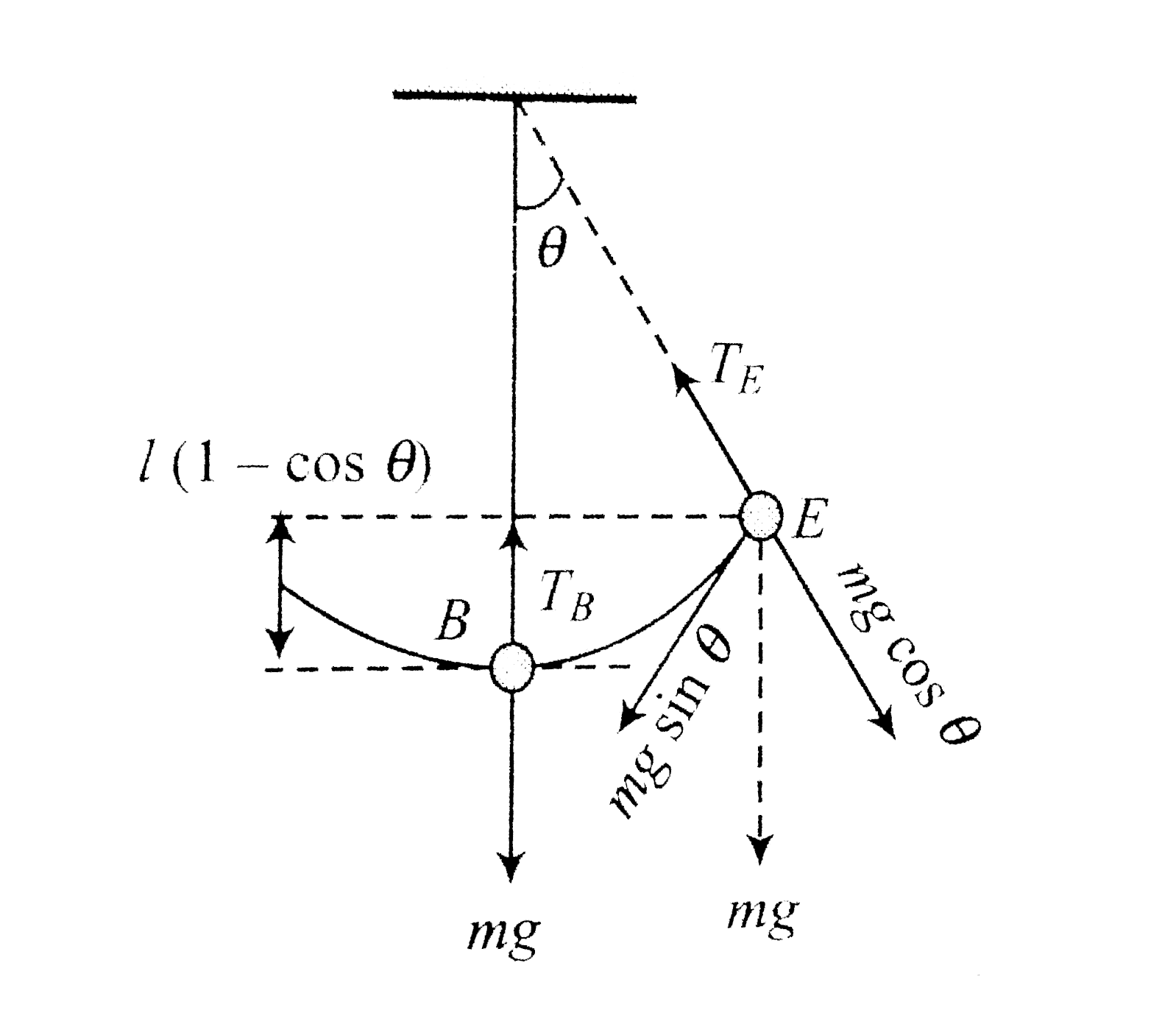
As the maximum tension occurs at the lowest position, tension at the bottom can be `2mg`. Let u be the velocity at bottom.
Considering forces on the particle at the bottom:

`T-mg=(mu^2)/(l)`
`2mg-mg=(m u^2)/(l)impliesu=sqrt(lg)`.
a. Let `theta`=angular amplitude from bottom to te extreme,
using conservation of mechanical energy `DeltaK+DeltaU=0`
`implies` Loss in KE=Gain in GPE
`1/12m u^2=mg(l-l cos theta)`
`implies 1/2 mlg=mg(l-lcostheta)`
`(1-costheta)=1/2impliestheta=60^@`
Length of arc covered in one cycle
`=4(l theta)`
`=4(1/2pi/3)=(2pi)/(3)m`

b. At extremes, the speed is zero.
`T_E-mgcostheta=(mv^2)/(l)=0`
Balancing radial forces we get: `T_E=mgcostheta=mg//2`
c. At extremes:
Radial acceleration `a_r=v^2/l=0impliesa_r=0ms^-2`
And tangetial acceleration,
`a_t=F_i/m=(mgsin60^@)/(m)=gsqrt(3/2)`
`implies` Net acceleration, `sqrt(a_t^2+a_r^2)=gsqrt(3/2)`
At bottom: There are no tangential forces. Hence, `a_t=0`.
`a_r=u^2/r=((sqrt(gl))^2)/(l)=g`
`implies` Net acceleration `=g`
Promotional Banner

Topper's Solved these Questions

  • WORK, POWER & ENERGY

    CENGAGE PHYSICS ENGLISH|Exercise Solved Examples|15 Videos
  • WORK, POWER & ENERGY

    CENGAGE PHYSICS ENGLISH|Exercise Exercise 8.1|25 Videos
  • VECTORS

    CENGAGE PHYSICS ENGLISH|Exercise Exercise Multiple Correct|5 Videos