Home
Class 11
PHYSICS
Figure shows the velocity-displacement c...

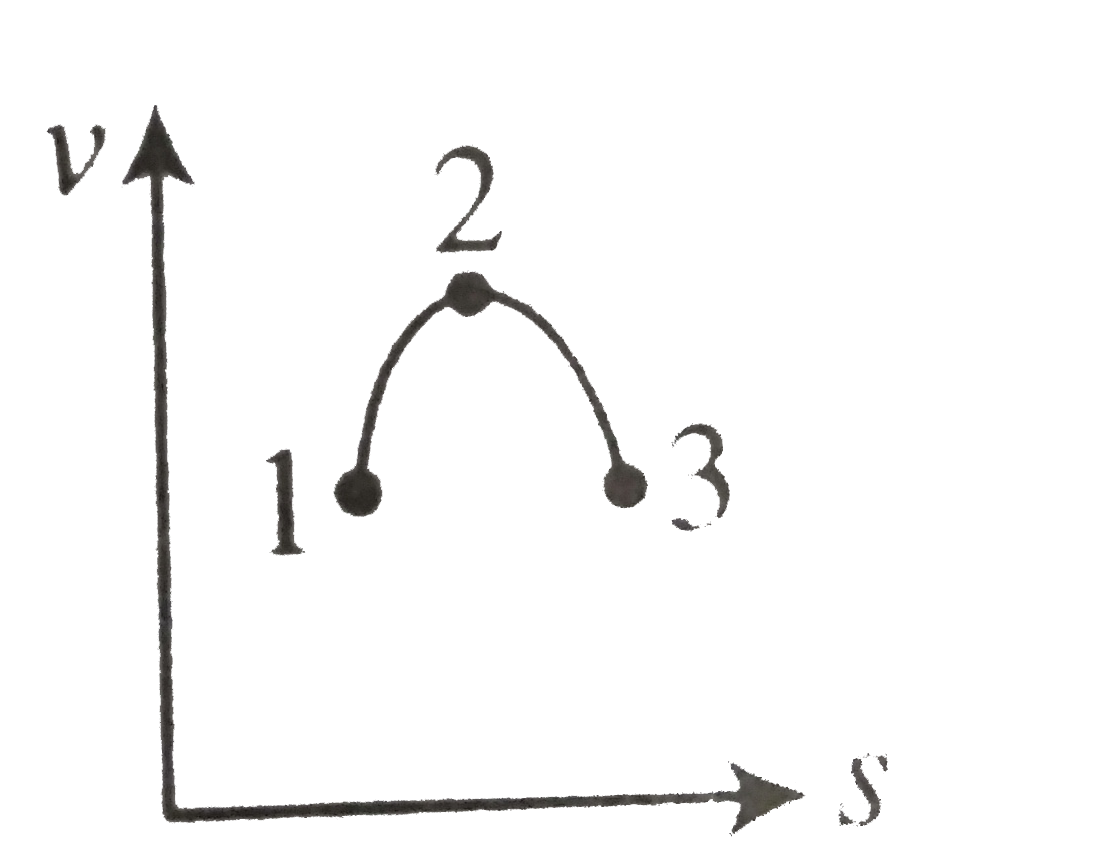
Figure shows the velocity-displacement curve for an object moving along a straight line. At which of the points marked is the object speeding up?

A

1

B

2

C

1 and 3

D

1,2, and 3

Text Solution

Verified by Experts

The correct Answer is:

A

a. From a = v `dv//ds`, we can find the sign of acceleration at various
points. V is positive for all three points 1,2,and 3. `dv//ds` is
positive for point 1, zero for point 2, negative for point 3.
So, only for point 1, velocity and acceleration have same sign,
so the object is speeding up at point 1 only.
Promotional Banner

Topper's Solved these Questions

  • MISCELLANEOUS KINEMATICS

    CENGAGE PHYSICS ENGLISH|Exercise Multiple Correct Answer Type|26 Videos
  • MISCELLANEOUS KINEMATICS

    CENGAGE PHYSICS ENGLISH|Exercise Linked Comprehension Type|35 Videos
  • LINEAR AND ANGULAR SIMPLE HARMONIC MOTION

    CENGAGE PHYSICS ENGLISH|Exercise Single correct anwer type|14 Videos
  • MISCELLANEOUS VOLUME 2

    CENGAGE PHYSICS ENGLISH|Exercise INTEGER_TYPE|10 Videos

Similar Questions

Explore conceptually related problems

Velocity displacement graph of a particle moving in a straight line is as shown in figure.

The figure shows velocity-time graph of a particle moving along a straight line. Identify the correct statement.

The velocity displacement graph of a particle moving along a straight line is shown in figure. Then the acceleration displacement graph is.

The v-x graph for a particle moving along a straight line is shown in the figure. At which of the points marked, the acceleration is negative?

The figure below shows the velocity-time graph of a body moving in a straight line. Find the total displacement of the body.

Figure shows velocity time graph of a particle moving in straight line. Which of the following statement(s) is / are CORRECT :-

The velocity - displacement graph of a particle moving along a straight line is shown The most suitable acceleration - displacement graph will be

The velcocity displacement graph of a particle moving along a straight line is shown in figure. The velocity as function of x(0lexle1) is

If a particle is moving along straight line with increasing speed, then

Figure shows the acceleration-time graph of a particle moving along a straight line. After what time the particle acquires its initial velocity?
