Home
Class 11
PHYSICS
A particle of mass m is moving along the...

A particle of mass `m` is moving along the line `y=b,z=0` with constant speed `v`. State whether the angular momentum of particle about origin is increasing. Decreasing or constant.

Text Solution

Verified by Experts
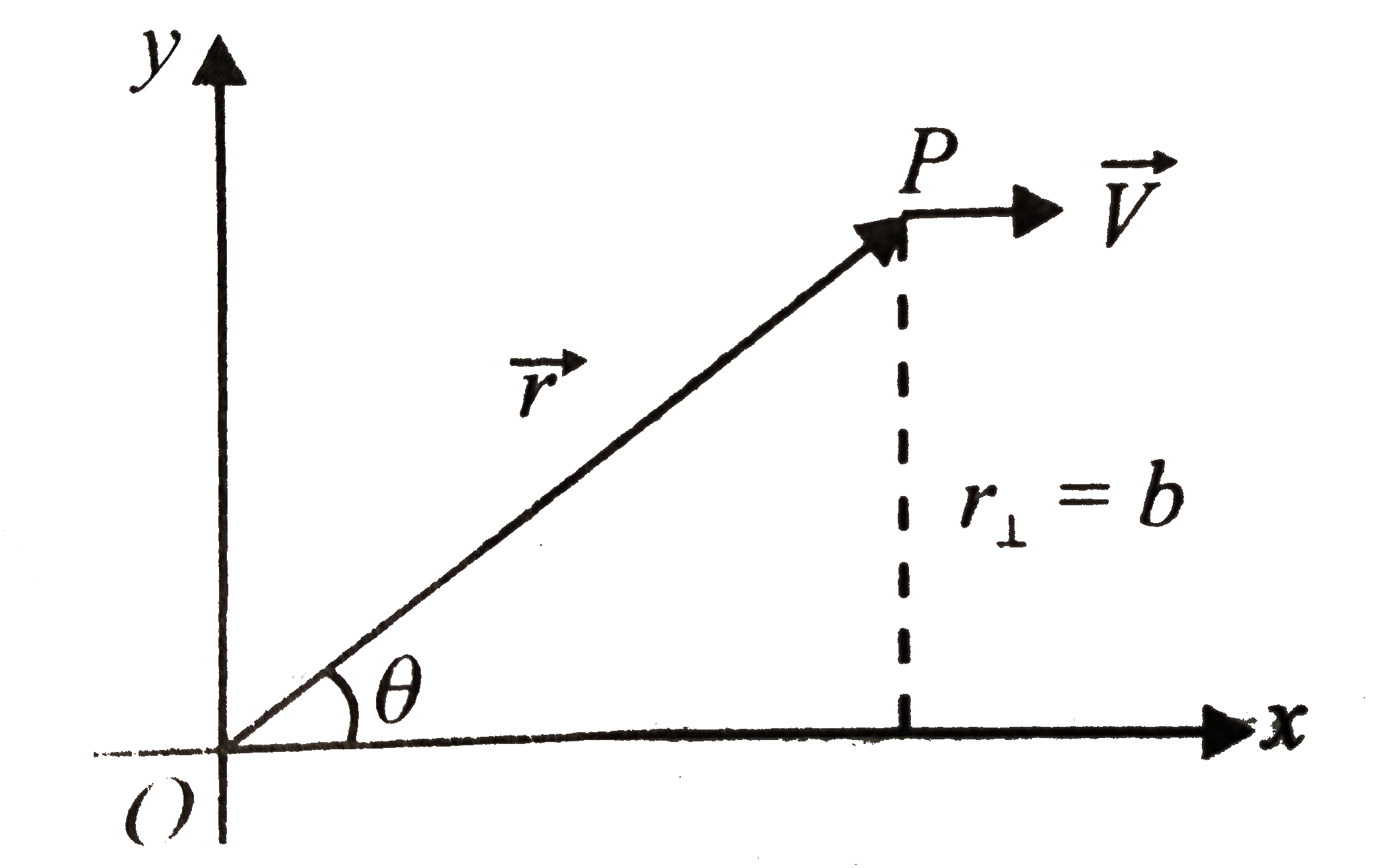
`|vecL|=mvsitheta=mvr_|_mvb`
`:. |vecL|=` constant as `m,v` and `b` all are constants.

Direction of `vecrxxvecv` also remains the same. Therefore, angular momentum of the particle about the origin remains constant with due course of time.
Promotional Banner

Topper's Solved these Questions

  • RIGID BODY DYNAMICS 2

    CENGAGE PHYSICS ENGLISH|Exercise Solved Examples|12 Videos
  • RIGID BODY DYNAMICS 2

    CENGAGE PHYSICS ENGLISH|Exercise Exercise 3.1|11 Videos
  • RIGID BODY DYNAMICS 1

    CENGAGE PHYSICS ENGLISH|Exercise Integer|11 Videos
  • SOUND WAVES AND DOPPLER EFFECT

    CENGAGE PHYSICS ENGLISH|Exercise Integer|16 Videos

Similar Questions

Explore conceptually related problems

A particle of mass 1kg is moving about a circle of radius 1m with a speed of 1m//s . Calculate the angular momentum of the particle.

A particle of mass 1kg is moving about a circle of radius 1m with a speed of 1m//s . Calculate the angular momentum of the particle.

A particle of mass 1 kg is moving along the line y = x + 2 (here x and y are in metres) with speed 2 m//s . The magnitude of angular momentum of paticle about origin is -

A particle of mass m is moving along the line y-b with constant acceleration a. The areal velocity of the position vector of the particle at time t is (u=0)

A particle of mass m moves along line PC with velocity v as shown. What is the angular momentum of the particle about O ?

A particle of mass m is projected with a speed v at an angle theta with the horizontal. Find the angular momentum of the particle about an axis passing through point of projection and perpendicular to the plane of motion of the particle. (a) When the particle is at maximum height and (b) When the particle is just about to collide with the horizontal surface

A particle of mass m is moving on a circular path of radius r with uniform speed v , rate of change of linear momentum is

A particle of mass m is moving with constant velocity v parallel to the x-axis as shown in the figure. Its angular momentum about origin O is

A particle of mass 'm' is moving on a circular path of radius 'r' with uniform speed 'v'. Rate of change of linear momentum is

A cube of mass m and side a is moving along a plane with constant speed v_(o) as shown in figure. The magnitude of angular momentum of the cube about z -axis would be.

