Home
Class 11
PHYSICS
A force of magnitude F is acting on rol...

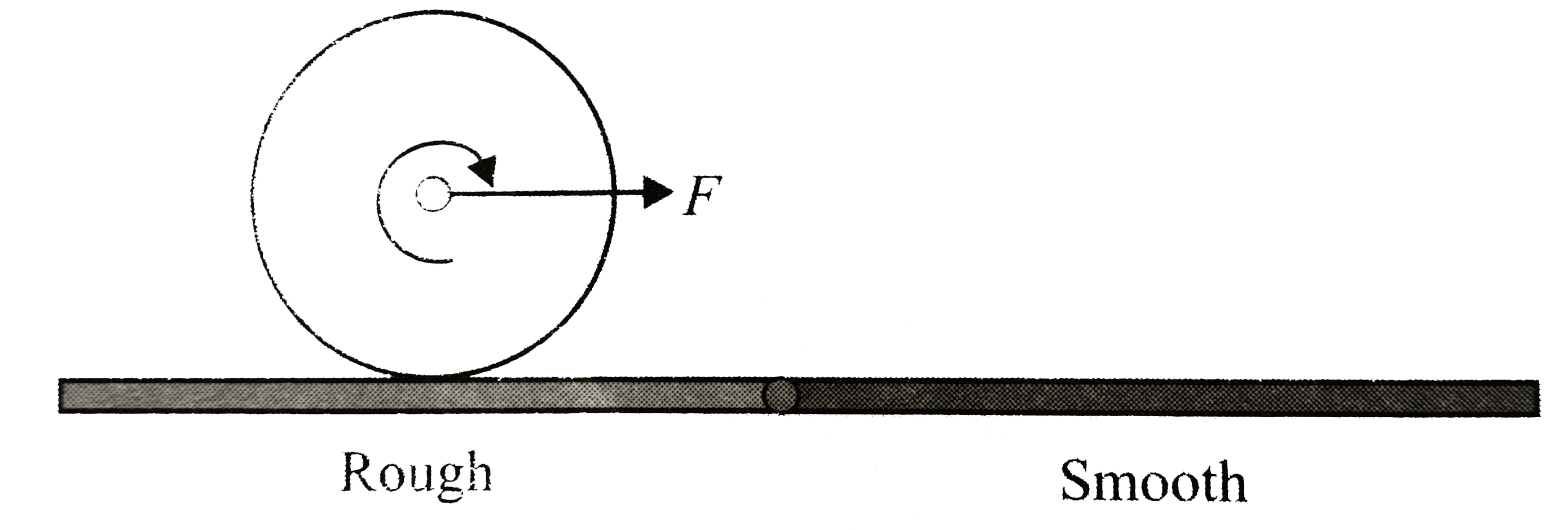
A force of magnitude `F` is acting on rolling body of mass `m` and radius `R` as show in figure. What happens when it enters on a smooth surface?

Text Solution

Verified by Experts

When the body is rolling on the rough surface, the friction force acting on the surface acts in the backward direction. The force `F` increases acceleration of centre of mass while friction force provides torque for providing angular acceleration. The velocity of centre of mass is always such that `v_(c)=omegaR`, i.e, rolling is present. when the body enters on the smooth surface, the pulling force `F` is still acting i.e., `F!=0`
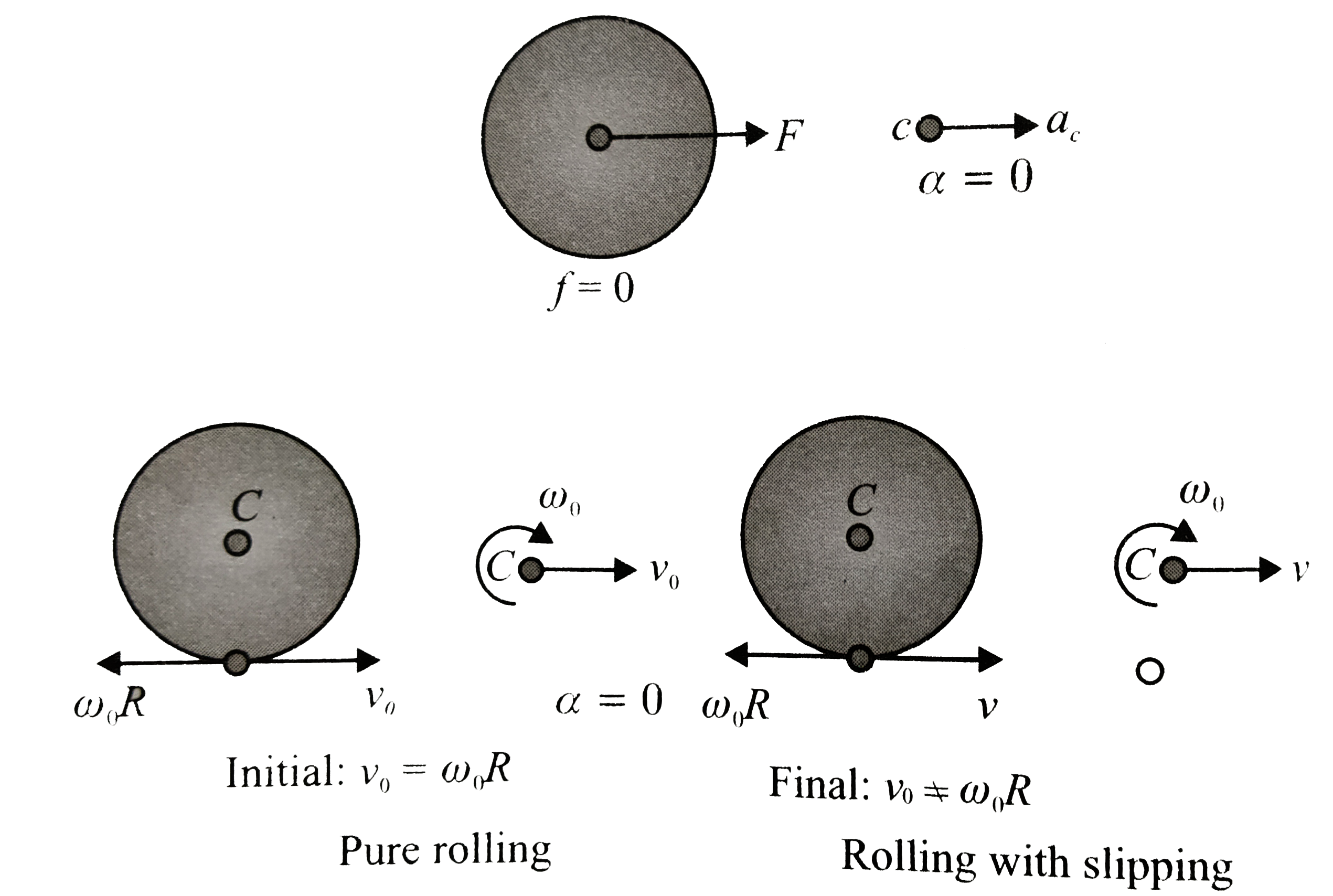
When the rolling body enters on a smooth surface, the force of friction disappears, i.e, `f=0`. As a result angular acceleration of the body about its centre of mass becomes zero.
What ever is the angular speed attained by the body, it continues to rotate with that. On the conntrary, the linear acceleration of the centre of mass suddenly increases to `F/m`
As a result its linear speed starts increasing and the condition `v_(c)=omegaR` does not hold true and the body will not roll on the smooth surface. The point of contact slips forward `(vgtomega_(0)R).`
Promotional Banner

Topper's Solved these Questions

  • RIGID BODY DYNAMICS 2

    CENGAGE PHYSICS ENGLISH|Exercise Solved Examples|12 Videos
  • RIGID BODY DYNAMICS 2

    CENGAGE PHYSICS ENGLISH|Exercise Exercise 3.1|11 Videos
  • RIGID BODY DYNAMICS 1

    CENGAGE PHYSICS ENGLISH|Exercise Integer|11 Videos
  • SOUND WAVES AND DOPPLER EFFECT

    CENGAGE PHYSICS ENGLISH|Exercise Integer|16 Videos

Similar Questions

Explore conceptually related problems

A force of magnitude F is acting on a rolling body of mass m and radius R as shown in figure. What happens if the pulling force F is removed ? Discuss the different posibilities when the pulling acts on the body. a. At centre, b. Above centre, c. Below centre

A rolling body of mass m and radius R is rolling on a rough surface without any pulling force as shown in figure. What happens when it enters on a smooth surface?

Three forces of magnitude F, F and sqrt(2F) are acting on the periphery of a disc of mass m and radius R as shown in the figure. The net torque about the centre of the disc is

At the instant t=0 , a force F=kt (k is a constant) acts on a small body of mass m resting on a smooth horizontal surface. The time, when the body leaves the surface is

When a force F acts on a particle of mass m, the acceleration of particle becomes a. now if two forces of magnitude 3F and 4F acts on the particle simultaneously as shown in figure, then the acceleration of the particle is

When a rolling body enters onto a smooth horizontal surface, it will

A force F is applied at the top of a ring of mass M and radius R placed on a rough horizontal surface as shown in figure. Friction is sufficient to prevent slipping. The friction force acting on the ring is:

When a body is hinged at a point and a force is acting on the body in such a way that the line of action of force is at some distance from the hinged point, the body will start rotating about the hinged point. The angular acceleration of the body can be calculated by finding the torque of that force about the hinged point. A disc of mass m and radius R is hinged at point A at its bottom and is free to rotate in the vertical plane. A force of magnitude F is acting on the ring at top most point. Tangential acceleration of the centre of mass is

When a body is hinged at a point and a force is acting on the body in such a way that the line of action of force is at some distance from the hinged point, the body will start rotating about the hinged point. The angular acceleration of the body can be calculated by finding the torque of that force about the hinged point. A disc of mass m and radius R is hinged at point A at its bottom and is free to rotate in the vertical plane. A force of magnitude F is acting on the ring at top most point. Component of reaction at the hinge in the vertical direction is

When a body is hinged at a point and a force is acting on the body in such a way that the line of action of force is at some distance from the hinged point, the body will start rotating about the hinged point. The angular acceleration of the body can be calculated by finding the torque of that force about the hinged point. A disc of mass m and radius R is hinged at point A at its bottom and is free to rotate in the vertical plane. A force of magnitude F is acting on the ring at top most point. Component of reaction at the hinge in the horizontal direction is

