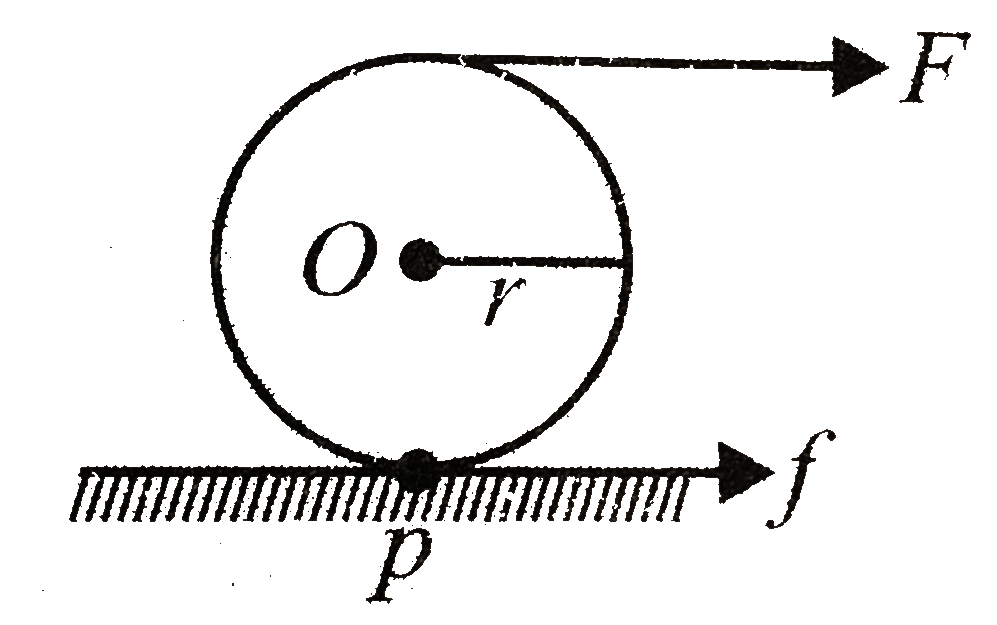
Method 1: As the body rolls, point `F` will be instantasneous centre of rotation (`ICR`). There is clockwise torque about `ICR`. Hecne centre of mass will have acceleratioin in eright direction. As there is net torque about `ICR` in clockwise sense. Hence the reel will rotate in clockwise direction.
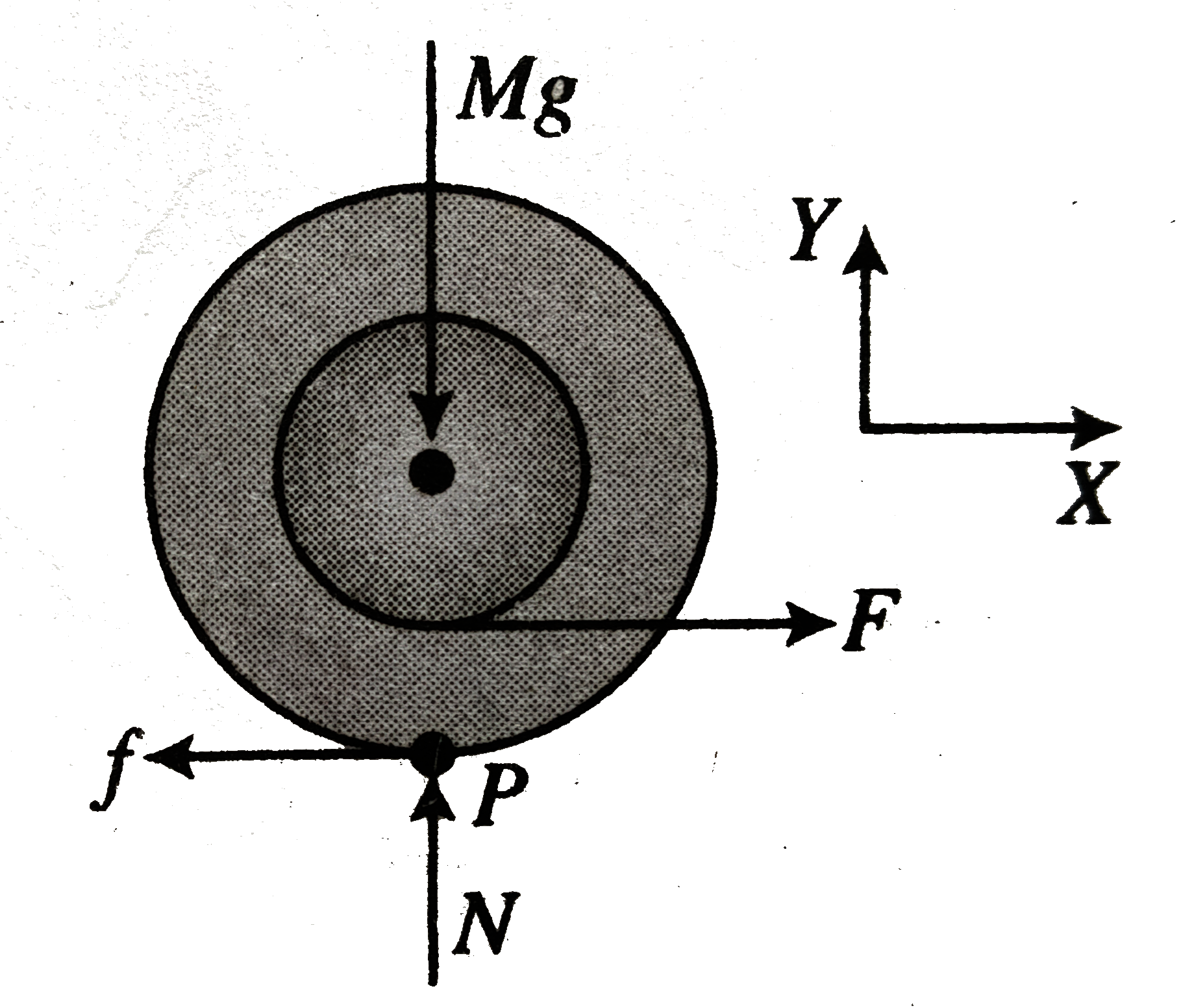
Hence the reel moves to the right. Force `P` exerts anticlockwise torque, therefore friction force must exert a larger clockwise torque to produce clockwise rolling. The equations of the motion are
`SigmaF_(x)=F-f=Ma`.....i
`SigmaF_(y)=N-Mg=0`............ii
`Sigmatau=fxxR-Fxxr=Ialpha`..............iii
As the reel rolls without slipping `a=Ralpha`
From eqn i and iii we get
`(F-f)/M=(R(fxxR-Fxxr))/I`
`f=(F(I+MRr))/(I+MR^(2))`
Force of friction comes out to be positive, therefore our assumption about the direction of friction force was correct. On substituting the expression for in Eqn i we obtain
`a=(FR(R-r))/(I+MR^(2))`
As `Rgtr`, a positive and towards right. Similarly, from eqn iii, we obtain `alpha=(F(R-r))/(I+MR^(2))`
Which is positive i.e., net torque on the reel is clockwise.
Method 2: We can apply torque equation about.
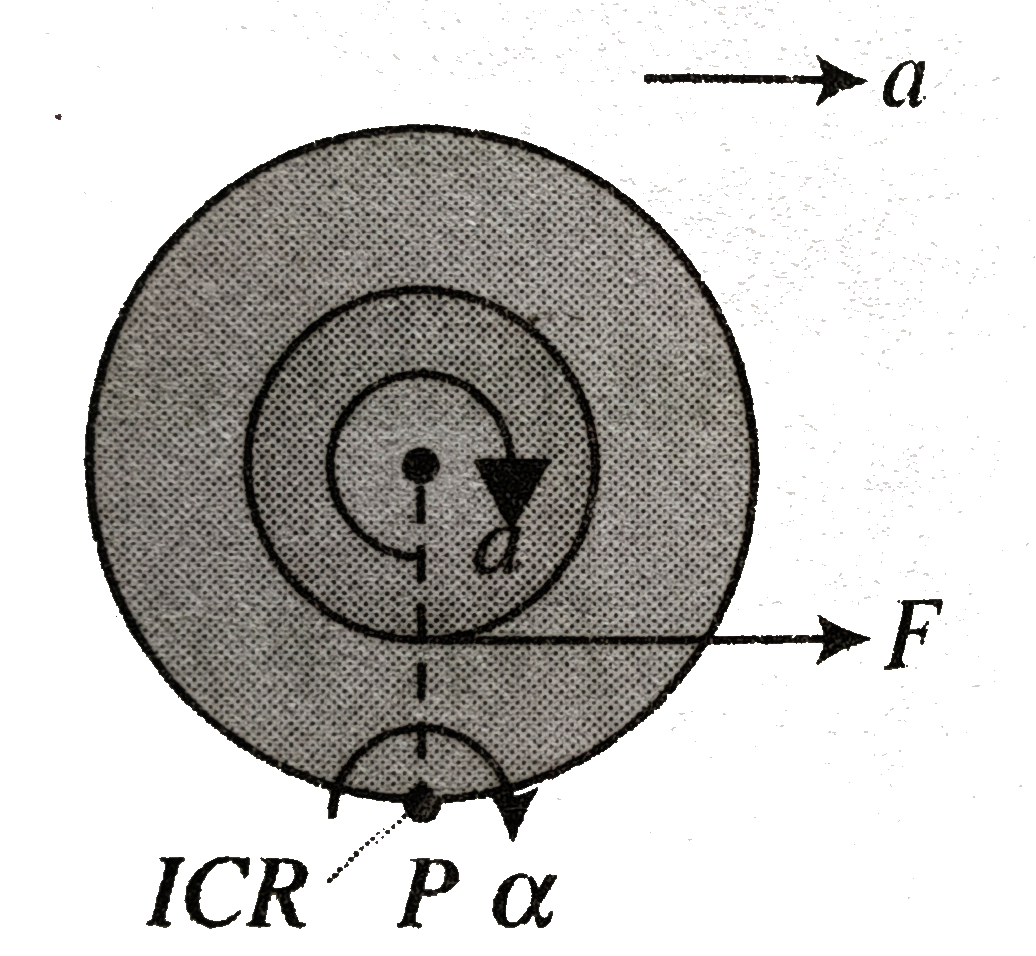
ICR `implies F(R-r)=I_(p)alpha`
`F(R-r)=[I+MR^2]alpha`
`implies alpha=(F(R-r))/([I+MR^(2)])`