Home
Class 11
PHYSICS
A uniform cylnder of radius r and radius...

A uniform cylnder of radius `r` and radius of gyration is kept on a fixed wedge of inclination `theta`. When we push the wedge with a constant acceleration a, the cylinder rolls up the wedge. Find coefficient of friction between the cylinder and wedge.

Text Solution

Verified by Experts

Let us push the wedge with a force `F` such that it moves with an acceleration a, as shown in figure. Now we can impose a pseudo force ma acting on the cylinder to write the force equation relative to the accelerating frame (wedge).
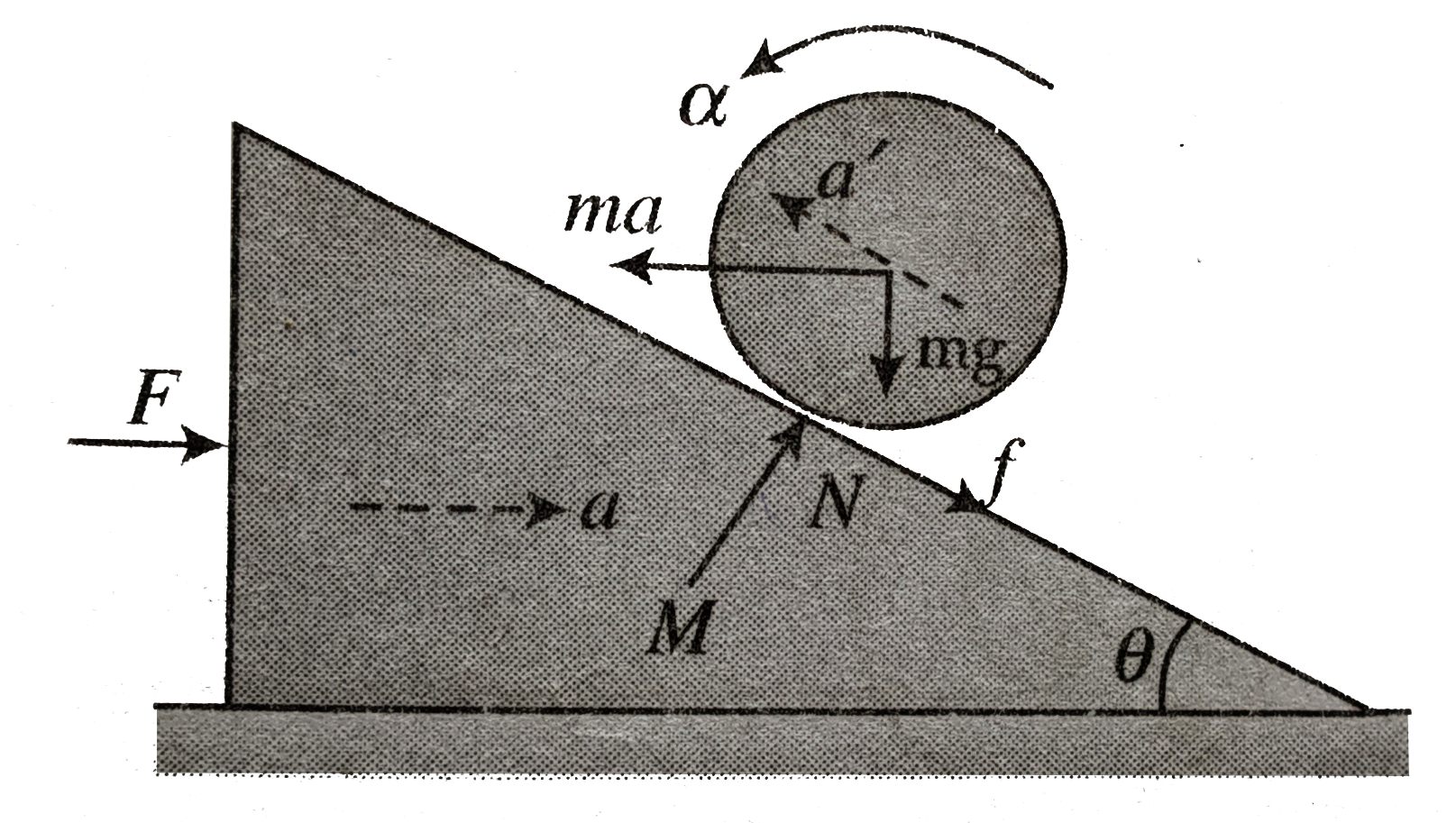
Let us assume that the cylinder rolls up with acceleration `ula'` relative to the wege. Hence, the friction of will point down the incline of the wedge.
Force equation , For `m`
`macostheta-mgsintheta-f=ma'`............i
For `m:mgcostheta+masintheta=N`..........ii
Torque equation
For `m: fr=mk^(2)alpha` .............iii
Equation of rolling of `m: a'=ralpha` ...........iv
Law of static friction : `flemuN` .............v
Eliminating `alpha` eqn iii by substituting `a'=ralpha` from eq iv we have `f=(mk^(2))/(r^(2))a'`
Substituting `a'=("fr"^(2))/(mk^(2))` in eqn i we have
`f=(macostheta-mgsintheta)/((1+(r^(2))/(k^(2))))`
Now substituting `f` from the above equation and `N` from eq ii in eq v we have
`muge(acostheta-gsintheta)/((1+(r^(2))/(k^(2)))(asintheta+gcostheta))`
Promotional Banner

Topper's Solved these Questions

  • RIGID BODY DYNAMICS 2

    CENGAGE PHYSICS ENGLISH|Exercise Solved Examples|12 Videos
  • RIGID BODY DYNAMICS 2

    CENGAGE PHYSICS ENGLISH|Exercise Exercise 3.1|11 Videos
  • RIGID BODY DYNAMICS 1

    CENGAGE PHYSICS ENGLISH|Exercise Integer|11 Videos
  • SOUND WAVES AND DOPPLER EFFECT

    CENGAGE PHYSICS ENGLISH|Exercise Integer|16 Videos

Similar Questions

Explore conceptually related problems

In figure, the pulley shown is smooth. The spring and the string are light. Block B slides down from the top along the fixed rough wedge of inclination theta . Assuming that the block reaches the end of the wedge, find the speed of the block at the end. Take the coefficient of friction between the block and the wedge to be mu and that the spring was relaxed when the block was released from the top of the wedge.

A uniform solid cylinder having mass M and radius R is pulled by a horiozntal force F acting through the center as shown. The cylinder rolls to the right without slipping. What is the magnitude of the force of friction between the cylinder and the ground?

A solid cylinder of mass m is kept in balance on a fixed incline of angle alpha=37^@ with the help of a thread fastened to its jacket. The cylinder does not slip. The values of minimum coefficient of static friction between cylinder and incline in the case when F is minimum.

A block of mass m is lying on a wedge having inclination angle alpha = tan^(-1)((1)/(5)) wedge is moving with a constant acceleration a = 2 ms^(-2) The minimum value of coefficient of friction mu so that m remain stationary w.r.t. wedge is

A block on table shown in figure is just on the wedge of slipping. Find the coefficient of static friction between the block and table top.

A uniform cylinder of mass M and radius R is released from rest on a rough inclined surface of inclination theta with the horizontal as shown in figure. As the cylinder rolls down the inclined surface, the maximum elongation it the spring stiffness k is

A block of mass m is placed at the bottom of a massless smooth wedge which if placed on a horizontal surface. When we push the wedge with a constant force, the block moves up the wedge. Find the work done by the external agent when the block has a speed v and is reaches the top of the wedge.

A block of mass m is placed on a smooth inclined wedge ABC of inclination theta as shown in the figure. The wedge is given an acceleration a towards the right. The relation between a and theta for the block to remain stationary on the wedge is.

A horizontal uniform rod of mass 'm' has its left end hinged to the fixed incline plane, while its right end rrests on the top of a uniform cylinder of mass 'm' which in turn is at rest on the fixed inclined plane as shown. The coefficient of friction between the cylinder and rod, and between the cylinder and inclined plane, is sufficient to keep the cylinder at rest. The ratio of magnitude of frictional force on the cylinder due to the rod and the magnitude of frictional force on the cylinder due to the inclined plane is :

A load of mass m is attached to the end of a string wound on a cylinder of mass M and radius R . The string passes round a pulley. a. Find the acceleration of the cylinder M when it rolls. b. If the coefficient of friction is mu . Find the accelerative of the cylinder when it slips and rolls. c. Find the minimum value of coefficient of friction for which the cylinder rolls always

