Home
Class 11
PHYSICS
A uniform rod of lengh l moving with a d...

A uniform rod of lengh `l` moving with a downward velocity `v_(0)` strikes a peg `P`. If the coefficient of restitutioin of impact is `e`, find the velocity of `CM` of the rod just after impact.

Text Solution

Verified by Experts

Method 1: At the time of impact the force acting on the rod is `N` (upward) and mg (downward). Since normal reaction is an ampulsive force during impact, `Ngt gtmg`. Then we disregard the effect of gravity during the impact.
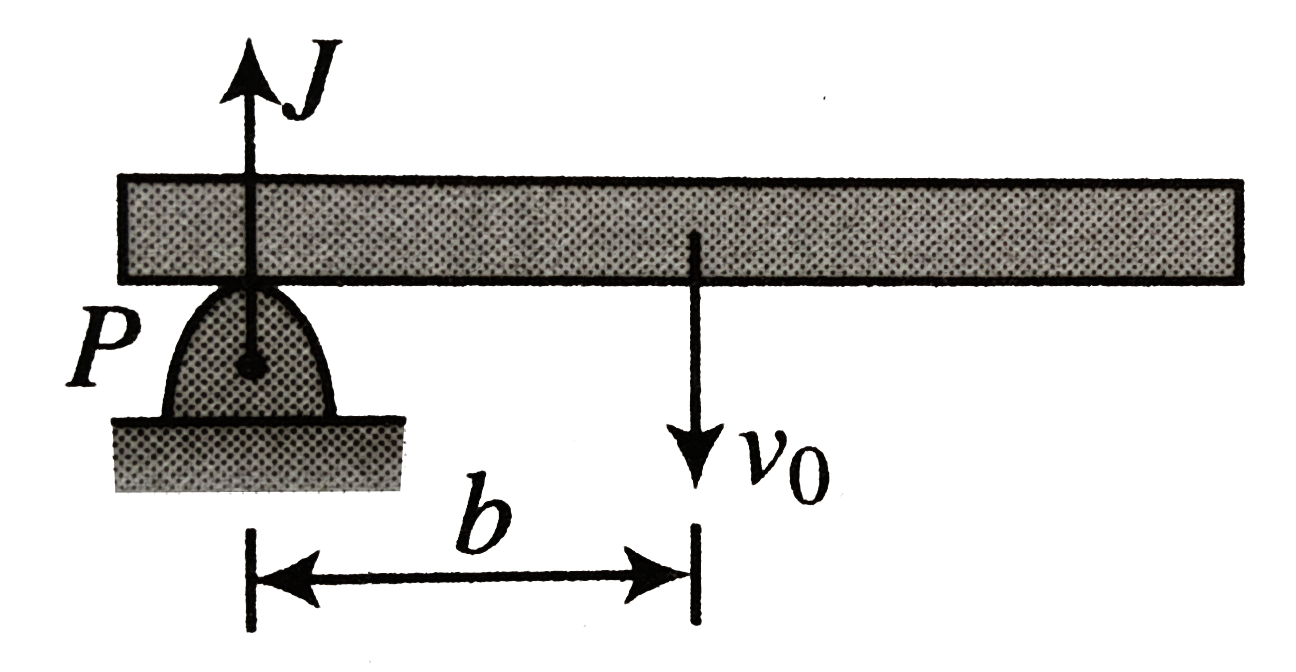
Impulse equation `mv_(0)=J=mv` ..........i
The angular impulse of `N` is `J.b =(ml^(2))/12 omega`
`J=(ml^(2))/(12b)omega`...........ii
Adding eqn i and ii we have
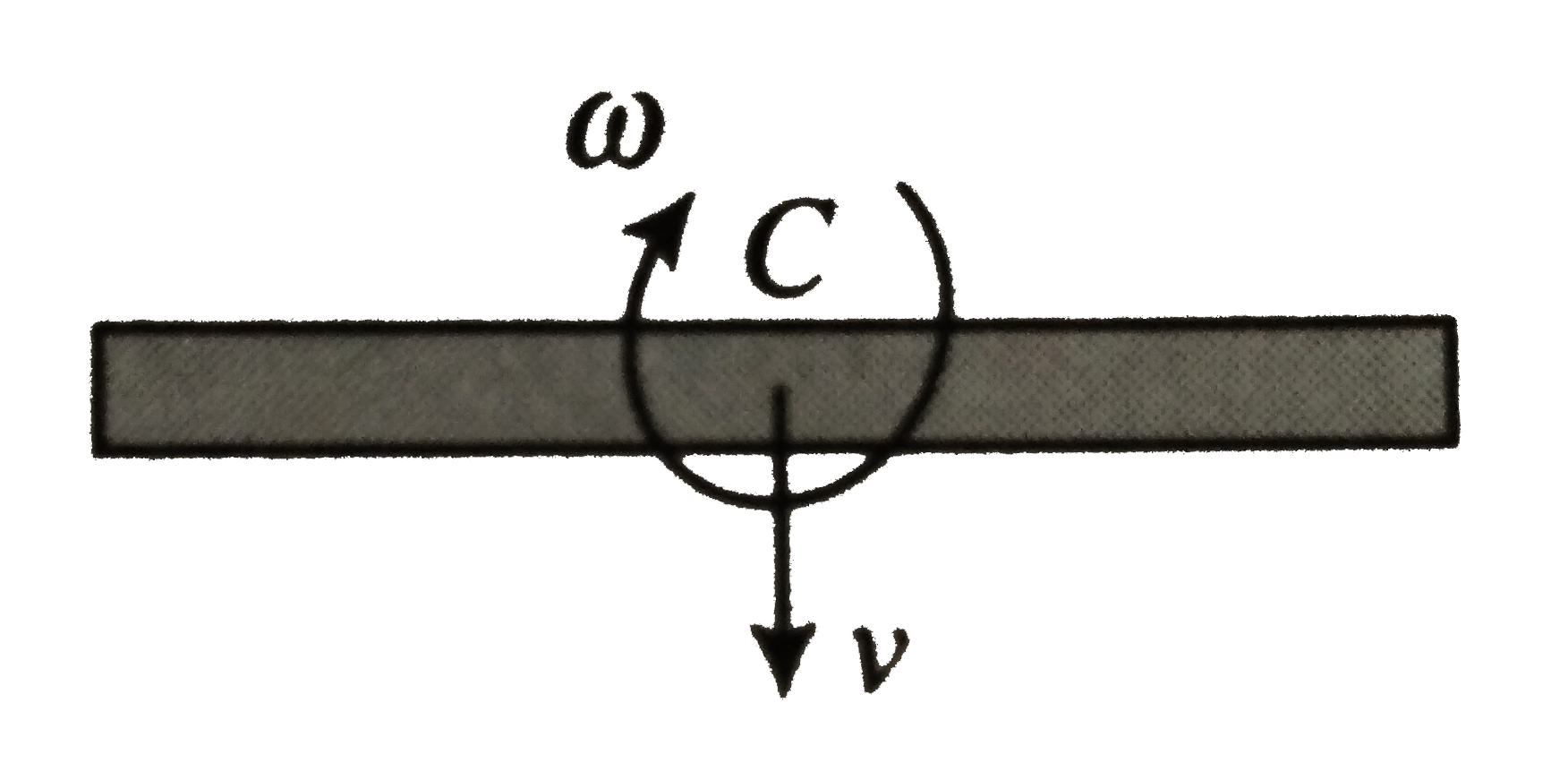
`v_(0)-v=(l^(2)omega)/(12b)`.............iii
Newton's empirical formula gives us
`v_(p)=-v_(0)` ..........iv
The velocity of `P` is `vecv_(P)=vecv_(PC)+vecv_(C)`
`v-bomega=-ev_(0)`..............v
Now we have two equan ii and iv for two unknowns `v` and `omega`,.
Solving these two equations we have `v=(12b^(2)-el^(2))/(12b^(2)+l^(2))v_(0)`
Method 2: If we choose the fixed point at `P`, the angular impulse about `P` is zero because the impusle `J` passes through `P` during impact.
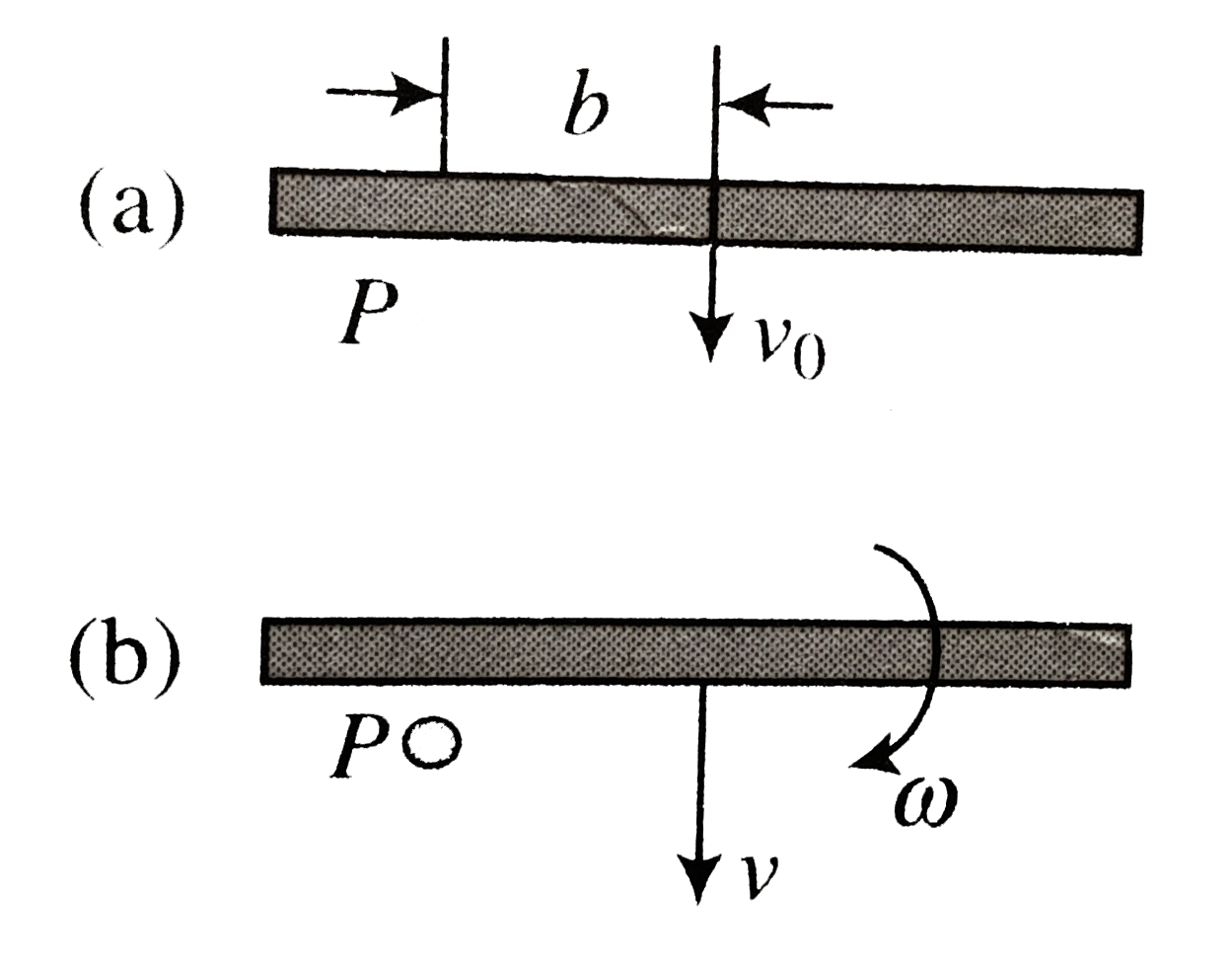
hence the angular momentum of the rod just before and just after the impact about remain constant.
`vecL_(1)=vecL_(2)`, where `vecL_(1)=mv_(0)b(-hatk)`
and `vecL_(2)=(ml^(2))/12 omega(-hatk)+mvb(-hatk)`
Then `mv_(0)b=mvb+(ml^(2))/12 omega`
This gives `v_(0)-v=(l^(2)omega)/(12b)`
The other equations remain as unchanged. Solving the above eqn we will obtain the same value of `v`.
Promotional Banner

Topper's Solved these Questions

  • RIGID BODY DYNAMICS 2

    CENGAGE PHYSICS ENGLISH|Exercise Solved Examples|12 Videos
  • RIGID BODY DYNAMICS 2

    CENGAGE PHYSICS ENGLISH|Exercise Exercise 3.1|11 Videos
  • RIGID BODY DYNAMICS 1

    CENGAGE PHYSICS ENGLISH|Exercise Integer|11 Videos
  • SOUND WAVES AND DOPPLER EFFECT

    CENGAGE PHYSICS ENGLISH|Exercise Integer|16 Videos

Similar Questions

Explore conceptually related problems

An elastic ball of mass 'm' is suspended from a fixed point by an inextensible string. A small particle of same mass m , moving downwards at an angle of 37^(@) with the vertical lits the ball directly with the velocity v_(0) . If the coefficient of restitution is 4//5 , ( i ) find the velocity of the ball just after the impact. ( ii ) determine the impulsive tension(i.e impulse) in the string at the instant of collision.

A particle of mass m=1 kg collides with the end with velocity v_(0)=6 ms^(-1) of a spinning rod of mass 2m and length l=1 m at the end of the rod. If the coefficient of restitution of collision e=(2//3), find the a. velocity of the particle b. angular velocity of the rod just after the impact.

A uniform rod of length l is spinning with an angular velocity omega=2v/l while its centre of mass moves with a velocity v . Find the velocity of the end of the rod.

A ball collides with a frictionless wall with velocity u as shown in the figure. Coefficient of restitution for the impact is e. (a) Find expression for the velocity of the ball immediately after the impact. (b) If impact is perfectly elastic what do you observe?

A uniform rod of mass m and length l is released from rest from its vertical position by giving a gently push. In consequence, the end of the rod collides at P after rotating about the smooth horizontal axis O . If the coefficient of restitution e = (1/2) . Find the: a. angular speed of the rod just after the impact. b. energy loss during collision. c. maximum angle rotated by rod after collision.

A homogenous rod of length l=etax and mass M is lying on a smooth horizontal floor. A bullet of mass m hits the rod at a distance x from the middle of the rod at a velocity v_(0) perpendicular to the rod and comes to rest after collision. If the velocity of the farther end of the rod just after the impact is in the opposite direction of v_(0) , then:

A rod AB of length L and mass M is free to move on a frictionless horizontal surface. It is moving with a velocity v, as shown in figure. End B of rod AB strikes the end of the wall. Assuming elastic impact, the angular velocity of the rod AB, just after impact, is

A rod of length l is moving in a vertical plane ( x-y ) when the lowest point A of the rod is moved with a velocity v . find the a angular velocity of the rod and b velocity of the end B .

A glass rod of length l moves with velocity v in a uniform magnetic field B. What is the e.m.f induced in the rod?

A rod AB of mass M and length 8l lies on a smooth horizontal surface. A particle, of mass m and velocity v_(0) strike's the rod perpendicular to its length, as shown in Fig. As a result of the collision, the centre of mass of the rod attains a speed of v_(0)//8 and the particle rebounds back with a speed of v_(0)//4 . Find the following: a. The ratio M//m . b. The angular velocity of the rod about O . c. The coefficient of restitution 'e' for the collision. d. The velocities of the ends 'A' and 'B' of the rod, namely, v_(A) and v_(B) respectively.

