Home
Class 11
PHYSICS
A particle of mass m=1 kg collides with ...

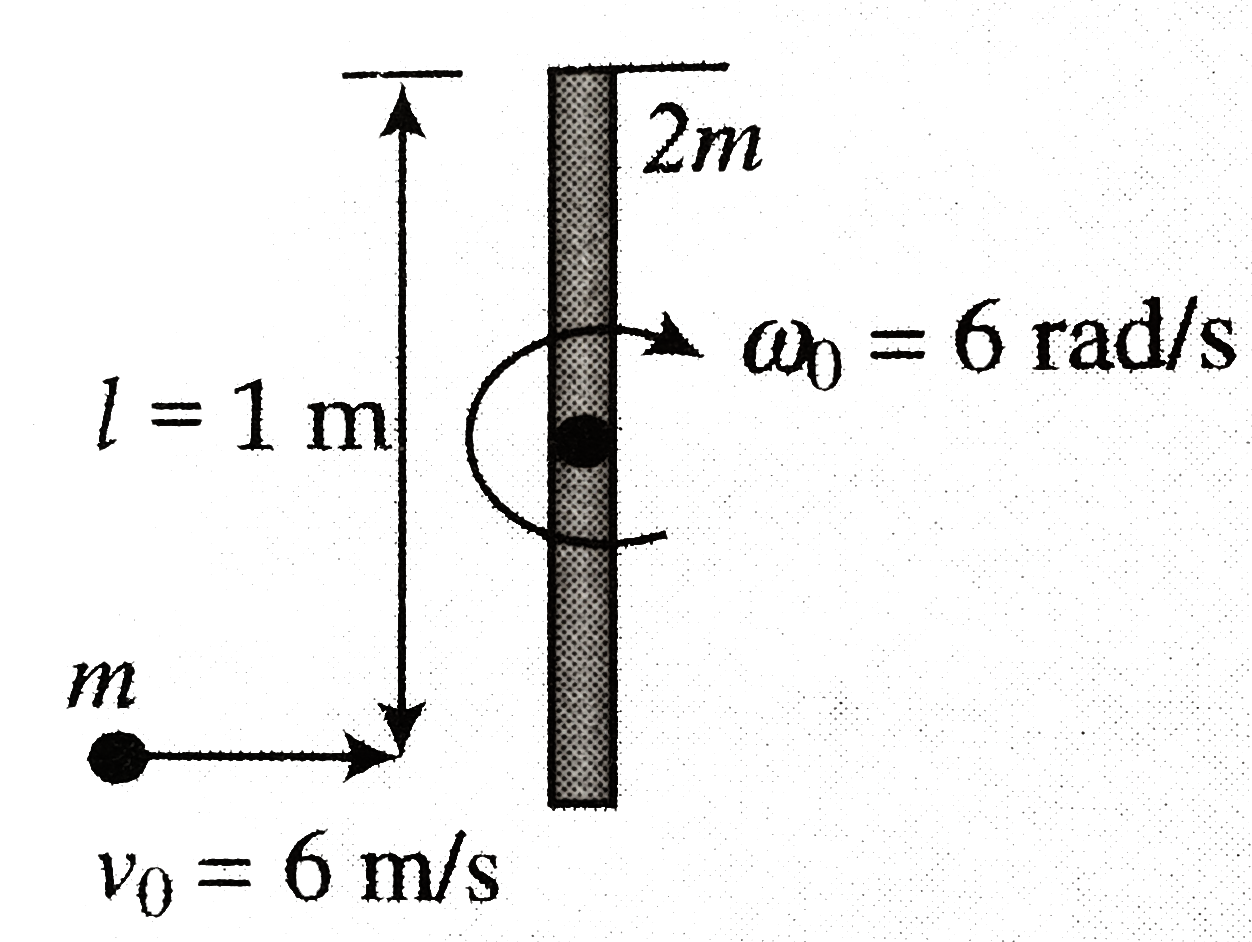
A particle of mass `m=1 kg` collides with the end with velocity `v_(0)=6 ms^(-1)` of a spinning rod of `mass 2m` and length `l=1 m` at the end of the rod. If the coefficient of restitution of collision `e=(2//3), ` find the
a. velocity of the particle
b. angular velocity of the rod just after the impact.

Text Solution

Verified by Experts
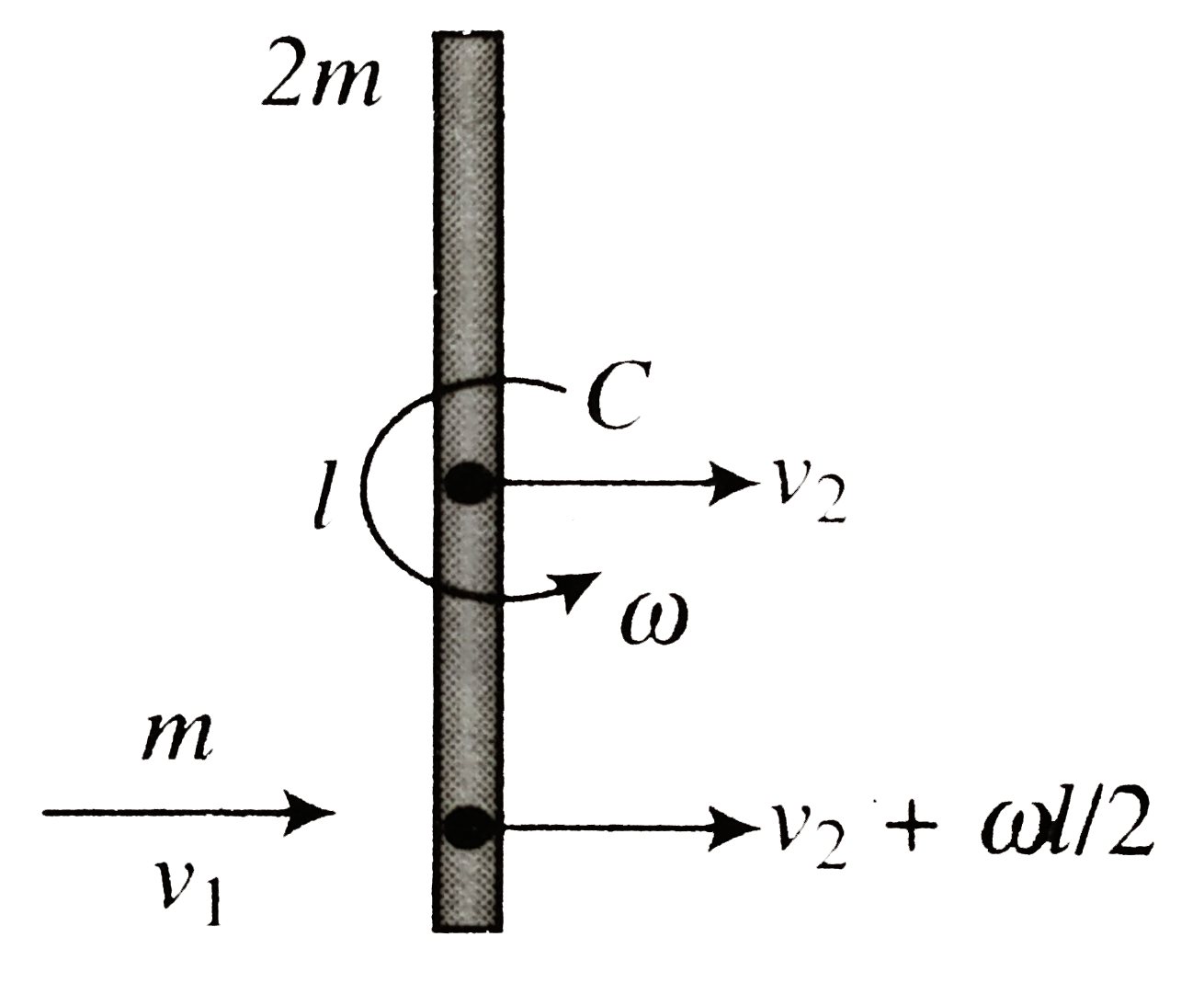
If we take rod and particle as system we find no external impulse acting on the sytem. Hence, we can use conservation of linear moemntum just before collision just after collision. Let the velocities of particle and rod just after collision is `v_(1)` and `v_(2)` respectively.

`mv_(1)+2mg_(2)=mv_(0)`
`v_(1)+2v_(2)=6`..........i
No applying Newton's restitution equation at the point of collision.
`e=2/2=((v_(2)+omegal)=v_(1))/(v_(0)-(-omega_(0)l/2))`
`2.(6+3)=3v_(2)+(3omega)/2-3v_(1)`
`36=6v_(2)3omega-6v_(1)`.........ii
Conservation of angular momentum about point of collision
`(-2ml^(2))/12 .omega_(0)=(2ml^(2))/12.omega-2mv_(2).l/2`
`-omega_(0)l=omegal-6v_(2)impliesomega=6v_(2)-6`..........iii
Put the value of `omega` in ii , `36=6v_(2)+18v_(2)-18-6v_(1)`
`v_(1)-4v_(2)=9`.......iv
From i and iii `v_(1)=1ms^(-1), v_(2)=2.5ms^(-1)` and `omega=9rads^(-1)`
Promotional Banner

Topper's Solved these Questions

  • RIGID BODY DYNAMICS 2

    CENGAGE PHYSICS ENGLISH|Exercise Solved Examples|12 Videos
  • RIGID BODY DYNAMICS 2

    CENGAGE PHYSICS ENGLISH|Exercise Exercise 3.1|11 Videos
  • RIGID BODY DYNAMICS 1

    CENGAGE PHYSICS ENGLISH|Exercise Integer|11 Videos
  • SOUND WAVES AND DOPPLER EFFECT

    CENGAGE PHYSICS ENGLISH|Exercise Integer|16 Videos

Similar Questions

Explore conceptually related problems

A uniform rod of lengh l moving with a downward velocity v_(0) strikes a peg P . If the coefficient of restitutioin of impact is e , find the velocity of CM of the rod just after impact.

A glass ball collides with an identical ball at rest with v_(0)=2 m/sec. If the coefficient of restitution of collision is e = 0.5, find the velocities of the glass balls just after the collision.

A block of mass m moving at a velocity upsilon collides head on with another block of mass 2m at rest. If the coefficient of restitution is 1/2, find the velocities of the blocks after the collision.

In the figure shown, the instantaneous speed of end A of the rod is v to the left. The angular velocity of the rod of length L must be

A particle of mass m, collides with another stationary particle of mass M. If the particle m stops just after collision, then the coefficient of restitution for collision is equal to

A ball of mass m moving with velocity v collides head-on which the second ball of mass m at rest. I the coefficient of restitution is e and velocity of first ball after collision is v_(1) and velocity of second ball after collision is v_(2) then

A ball of mass m moving with velocity u collides head-on which the second ball of mass m at rest. If the coefficient of restitution is e and velocity of first ball after collision is v_(1) and velocity of second ball after collision is v_(2) then

A rod of length l is moving in a vertical plane ( x-y ) when the lowest point A of the rod is moved with a velocity v . find the a angular velocity of the rod and b velocity of the end B .

Two spherical bodies of mass m_(1) and m_(2) fall freely through a distance h . before the body m_(2) collides with the ground. If the coefficient of restitution of all collisions is e , find the velocity of m_(1) just after it collides with m_(2)

A uniform rod of mass m and length l is released from rest from its vertical position by giving a gently push. In consequence, the end of the rod collides at P after rotating about the smooth horizontal axis O . If the coefficient of restitution e = (1/2) . Find the: a. angular speed of the rod just after the impact. b. energy loss during collision. c. maximum angle rotated by rod after collision.

