Home
Class 11
PHYSICS
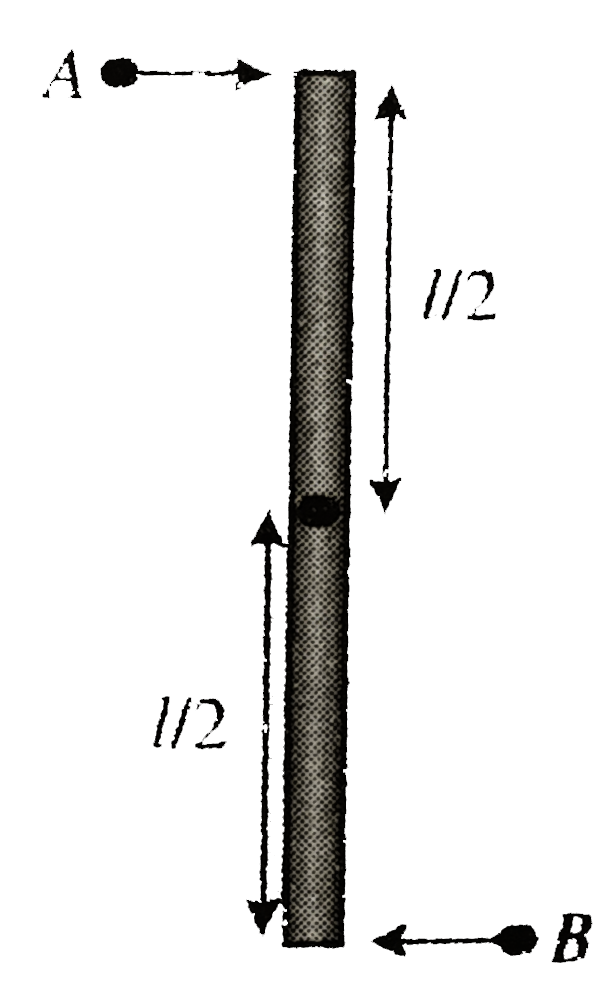
Two particles A and B of mass m each hit...

Two particles `A` and `B` of mass `m` each hit the ends of a rigid bar of mass `M` and length `l` inelastically from opposite sides the speeds `v` and perpendicular to the rod. The bar is kept on a smooth horizontal plane (as shown). Find the linear and angular speed of the system (bar`+`particle).

Text Solution

Verified by Experts

Conservation of linear momentum. There is not external force acting on the system along `x`-axis. There fore the linear momentum of the system before and after the system remains constant.
The momentum of the system before impact.
`P_(i)=mv-mv=0`
The linear momentum of the system after the impact must be zero. therefore, the centre of mass of the system does not translate.
`implies v_(cm)=0`
Conservation of angular momentum
Since the impact forces are internal force, the net torque about a pperpendicular axis passing through `CM` of the system is zero. Thefore the angular momentum of the system before and after the impact will be equal.
`implies L_("initial")=L_("final") where L_("initial")|(ml)/2v+(ml)/2v|=mvl`
Let the system rotate about is `CMO` with an angular speed `omega`
`implies L_("final")=(I_("system"))omega`
where `I_("system")=MI` of the system about `0=(I_("rod"))_(0)+(I_(A))+(I_(B))_(0)`
`implies I_("system")=(Ml^(2))/12+m(l/2)^(2)+m(l/2)^(2)=((M+6m)/12)l^(2)`
Using the above equations we get
`F_(1)=1/2mralpha=1/3masintheta=mvlimpliesomega=(12mv)/((M+6m)l)`
Promotional Banner

Topper's Solved these Questions

  • RIGID BODY DYNAMICS 2

    CENGAGE PHYSICS ENGLISH|Exercise Solved Examples|12 Videos
  • RIGID BODY DYNAMICS 2

    CENGAGE PHYSICS ENGLISH|Exercise Exercise 3.1|11 Videos
  • RIGID BODY DYNAMICS 1

    CENGAGE PHYSICS ENGLISH|Exercise Integer|11 Videos
  • SOUND WAVES AND DOPPLER EFFECT

    CENGAGE PHYSICS ENGLISH|Exercise Integer|16 Videos

Similar Questions

Explore conceptually related problems

Two masses each of mass M are attached to the end of a rigid massless rod of length L . The moment of interia of the system about an axis passing centre of mass and perpendicular to its length is.

A particle of mass m is fixed to one end of a light rigid rod of length l and rotated in a vertical ciorcular path about its other end. The minimum speed of the particle at its highest point must be

Two particles each of mass M are connected by a massless rod. The rod is lying on the smooth horizontal surface. If one of the particle is given an impulse MV as shown in the figure then angular velocity of the system would be:

A particle of mass m is tied to a string of length L and whirled into a horizontal plan. If tension in the string is T then the speed of the particle will be :

Two particles , each of mass m and charge q , are attached to the two ends of a light rigid rod of length 2 R . The rod is rotated at constant angular speed about a perpendicular axis passing through its centre. The ratio of the magnitudes of the magnetic moment of the system and its angular momentum about the centre of the rod is

Two particles , each of mass m and charge q , are attached to the two ends of a light rigid rod of length 2 R . The rod is rotated at constant angular speed about a perpendicular axis passing through its centre. The ratio of the magnitudes of the magnetic moment of the system and its angular momentum about the centre of the rod is

Two balls of masses m and 2m are attached to the ends of a light rod of length L . The rod rotates with an angular speed omega about an axis passing through the center of mass of system and perpendicular to the plane. Find the angular momentum of the system about the axis of rotation.

A particle of mass m moving with a speed v hits elastically another staionary particle of mass 2m on a smooth horizontal circular tube of radius r . Find the time when the next collision will take place?

A particle of mass m moving with a speed v hits elastically another staionary particle of mass 2m on a smooth horizontal circular tube of radius r . Find the time when the next collision will take place?

A particle of mass m moving with a speed v hits elastically another staionary particle of mass 2m on a smooth horizontal circular tube of radius r . Find the time when the next collision will take place?
