A rod AB of mass `M` and length L is lying on a horizontal frictionless surface. A particle of mass `m` travelling along the surface hits the end A of the rod with a velocity `v_(0)` in a direction perpendicular to AB. The collision in elastic. After the collision the particle comes to rest
(a). Find the ratio `m//M`
(b). A point P on the rod is at rest immediately after collision find the distance AP.
(c). Fid the linear speed of the point P a time `piL//3v_(0)` after the collision.
A rod AB of mass `M` and length L is lying on a horizontal frictionless surface. A particle of mass `m` travelling along the surface hits the end A of the rod with a velocity `v_(0)` in a direction perpendicular to AB. The collision in elastic. After the collision the particle comes to rest
(a). Find the ratio `m//M`
(b). A point P on the rod is at rest immediately after collision find the distance AP.
(c). Fid the linear speed of the point P a time `piL//3v_(0)` after the collision.
(a). Find the ratio `m//M`
(b). A point P on the rod is at rest immediately after collision find the distance AP.
(c). Fid the linear speed of the point P a time `piL//3v_(0)` after the collision.
Text Solution
Verified by Experts
a. If we take rod and particle as a system, the impulse between them will be internal. We can conserve the linear momentum of rod `+` particle's system. Let `V` and `omega` be the velocity and angular velocity of the `CM` just after collision.
Using conservation of linear momentum, we have
`mv_(0)=0+Mv_(c)`..........i
Here is this case we can conserve angular momentum about any point on the rod.
And by coservation of angular momentum about the entire of mass of the rod, we get
`mv_(0)L/2=lomega` or `mv_(0)L/2=((ML^(2))/12)omega`...........ii
Form eqn i and ii `v_(c)=(mv_(0))/M` and `omega= (6mv_(0))/(ML)`
We can apply conservation of anngular momentum about point of collision.
`vecL_("initial")=vecL_("final")`
`O=I_(0)omega(-hatk)+Mv_(0)l/2(hatk)`
`(ML^(2))12 omega= (Mv_(c)L)/2` .............iii
which gives `omegaL=6v_(c)`
Solving eqn i and iii we get the same results.
Since collisiion is completely elastic, therefore `KE` before collision is equa to `KE` after collision
or `1/2mv_(0)^(2)+0=1/2mv_(c)^(2)+1/2omega^(2)`
or `1/2mv_(0)^(2)=1/2M((mv_(0))/M)^(2)+1/2((6mv_(0))/(ML))^(2)`
Which gives `m/M=1/4` and `v_(c)=(v_(0))/4`
Alternative method: We can apply coefficient of restitution equation at the positioinof point of collision, we have
`e=((v_(2)-v_(1))/(u_(1)-u_(2)))`
Here `u_(1),u_(2),v_(1)` and `v_(2)` are the velocities of particles and point on the rod at collision point.
`u_(1)=v_(0), u_(2)=0`
`v_(1)=0` and `v_(2)=v_(c)+(omegal)/2`
As collision in elastic `e=1`
Substituting the values in restitution equation we get
`I=((v_(c)+omegaL)/2)-0)/(v_(0)-0)impliesv_(0)=((mv_(0))/M)+((6mv_(0))/(ML))L/2`
Which gives `m/M=1/4`
b. Velocity of point `P` immediately after collisionn is zero, let if be at a distance `y` and from `CM`
`:. v_(c)-omegay=0` or `(mv_(0))/M-((6mv_(0))/(ML))y=0`
which gives `y=L/6`
`:. AP=L/2+L/6=(2L)/3`
c. Angle rotated by the rod at time `(piL)/(3v_(0))`
`theta=omegat=((6mv_(0))/(ML))xx(piL)/(3v_(0))=pi/2`
The rod turns through `pi/2` in this interval of time. the velocity of point `P` in `y`-direction will be
`v_(y)=omega=((6mv_(0))/M)xxL/6=(v_(0))/4`
The resultant velocity of point `P`,
`v=sqrt(v_(c)^(2)+v_(y)^(2))=sqrt(((v_(0))/4)^(2)+((v_(0))/4)^(2))implies(v_(0))/(2sqrt(2))`
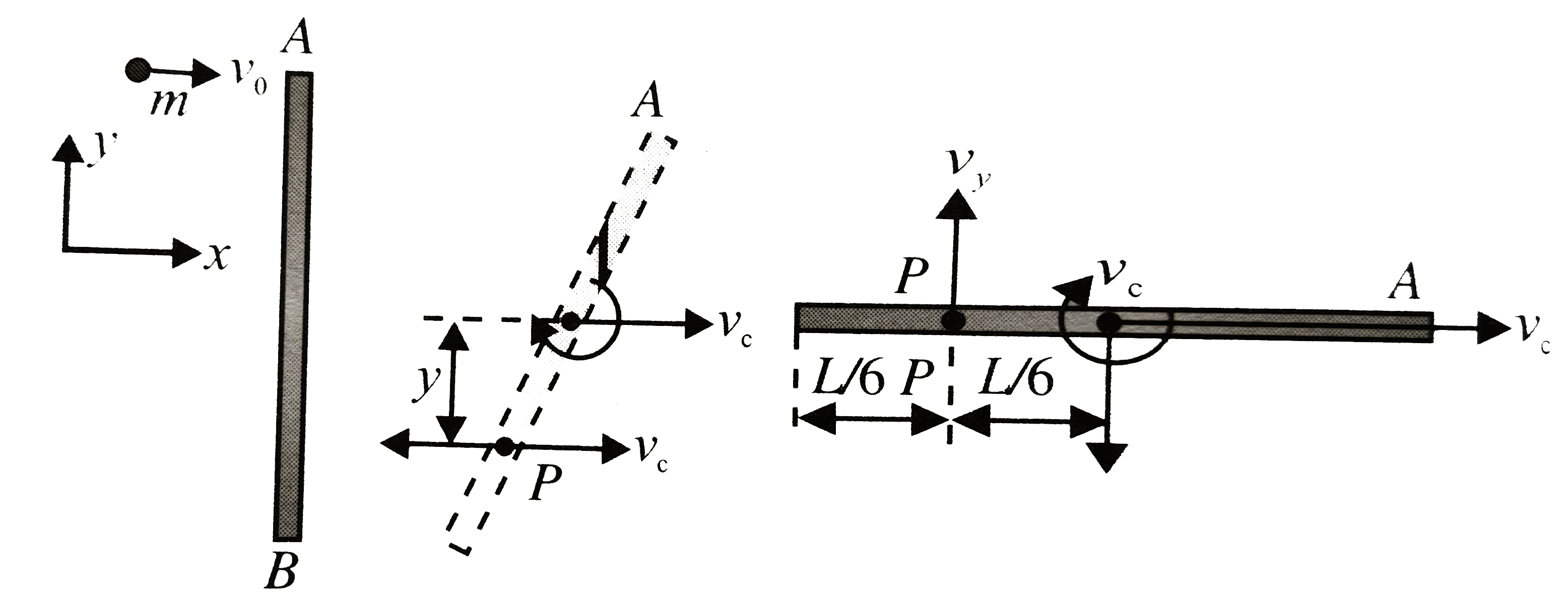
Using conservation of linear momentum, we have
`mv_(0)=0+Mv_(c)`..........i
Here is this case we can conserve angular momentum about any point on the rod.
And by coservation of angular momentum about the entire of mass of the rod, we get
`mv_(0)L/2=lomega` or `mv_(0)L/2=((ML^(2))/12)omega`...........ii
Form eqn i and ii `v_(c)=(mv_(0))/M` and `omega= (6mv_(0))/(ML)`
We can apply conservation of anngular momentum about point of collision.
`vecL_("initial")=vecL_("final")`
`O=I_(0)omega(-hatk)+Mv_(0)l/2(hatk)`
`(ML^(2))12 omega= (Mv_(c)L)/2` .............iii
which gives `omegaL=6v_(c)`
Solving eqn i and iii we get the same results.
Since collisiion is completely elastic, therefore `KE` before collision is equa to `KE` after collision
or `1/2mv_(0)^(2)+0=1/2mv_(c)^(2)+1/2omega^(2)`
or `1/2mv_(0)^(2)=1/2M((mv_(0))/M)^(2)+1/2((6mv_(0))/(ML))^(2)`
Which gives `m/M=1/4` and `v_(c)=(v_(0))/4`
Alternative method: We can apply coefficient of restitution equation at the positioinof point of collision, we have
`e=((v_(2)-v_(1))/(u_(1)-u_(2)))`
Here `u_(1),u_(2),v_(1)` and `v_(2)` are the velocities of particles and point on the rod at collision point.
`u_(1)=v_(0), u_(2)=0`
`v_(1)=0` and `v_(2)=v_(c)+(omegal)/2`
As collision in elastic `e=1`
Substituting the values in restitution equation we get
`I=((v_(c)+omegaL)/2)-0)/(v_(0)-0)impliesv_(0)=((mv_(0))/M)+((6mv_(0))/(ML))L/2`
Which gives `m/M=1/4`
b. Velocity of point `P` immediately after collisionn is zero, let if be at a distance `y` and from `CM`
`:. v_(c)-omegay=0` or `(mv_(0))/M-((6mv_(0))/(ML))y=0`
which gives `y=L/6`
`:. AP=L/2+L/6=(2L)/3`
c. Angle rotated by the rod at time `(piL)/(3v_(0))`
`theta=omegat=((6mv_(0))/(ML))xx(piL)/(3v_(0))=pi/2`
The rod turns through `pi/2` in this interval of time. the velocity of point `P` in `y`-direction will be
`v_(y)=omega=((6mv_(0))/M)xxL/6=(v_(0))/4`
The resultant velocity of point `P`,
`v=sqrt(v_(c)^(2)+v_(y)^(2))=sqrt(((v_(0))/4)^(2)+((v_(0))/4)^(2))implies(v_(0))/(2sqrt(2))`



Topper's Solved these Questions
RIGID BODY DYNAMICS 2
CENGAGE PHYSICS ENGLISH|Exercise Solved Examples|12 VideosRIGID BODY DYNAMICS 2
CENGAGE PHYSICS ENGLISH|Exercise Exercise 3.1|11 VideosRIGID BODY DYNAMICS 1
CENGAGE PHYSICS ENGLISH|Exercise Integer|11 VideosSOUND WAVES AND DOPPLER EFFECT
CENGAGE PHYSICS ENGLISH|Exercise Integer|16 Videos
Similar Questions
Explore conceptually related problems
A rod AB of length 2L and mass m is lying on a horizontal frictionless surface. A particle of same mass m travelling along the surface hits the rod at distance (L)/(2) from COM with a velocity v_(0) in a direction perpendicular to rod and sticks to it. Angular velocity of rod just after collision is
A rod AB of length 2L and mass m is lying on a horizontal frictionless surface. A particle of same mass m travelling along the surface hits the rod at distance (L)/(2) from COM with a velocity v_(0) in a direction perpendicular to rod and sticks to it. Angular velocity of rod just after collision is
A rod AC of length l and mass m is kept on a horizontal smooth plane. It is free to rotate and move. A particle of same mass m moving on the plane with velocity v strikes the rod at point B making angle 37^@ with the rod. The collision is elastic. After collision,
A uniform rod of mass M and length L lies flat on a frictionless horizantal surface. Two forces F and 2F are applied along the length of the rod as shown. The tension in the rod at point P is
A slender rod of mass M and length L rests on a horizontal frictionless surface. The rod is pivoted about one of ends. The impulse of the force exerted on the rod by the pivot when the rod is struck by a blow of impulse J perpendicular to the rod at other end is
A straight rod AB of mass M and length L is placed on a frictionless horizontal surface. A force having constant magnitude F and a fixed direction start acting at the end A. The rod is initially perpendicular to the force. The initial acceleration of end B is
A uniform rod of mass M and length l is placed on a smooth- horizontal surface with its one end pivoted to the surface. A small ball of mass m moving along the surface with a velocity v_(0) , perpendicular to the rod, collides elastically with the free end of the rod. Find: a. the angular velocity of the rod after collision. b. the impulse applied by the pivot on the rod during collision. (Take M//m = 2 )
A uniform rod of mass m and length L is at rest on a smooth horizontal surface. A ball of mass m, moving with velocity v_0 , hits the rod perpendicularly at its one end and sticks to it. The angular velocity of rod after collision is
A rod of mass m and length l in placed on a smooth table. An another particle of same mass m strikes the rod with velocity v_(0) in a direction perpendicular to the rod at distance x( lt l//2) from its centre . Particle sticks to the end. Let omega be the angular speed of system after collision , then As x is increased from 0 to l/2 , the angular speed omega .
A uniform rod of mass M and length a lies on a smooth horizontal plane. A particle of mass m moving at a speed v perpendicular to the length of the rod strikes it at a distance a/4 from the centre and stops after the collision. Find a. the velocity of the cente of the rod and b. the angular velocity of the rod abut its centre just after the collision.