Home
Class 11
PHYSICS
A small mass particle is projected with ...

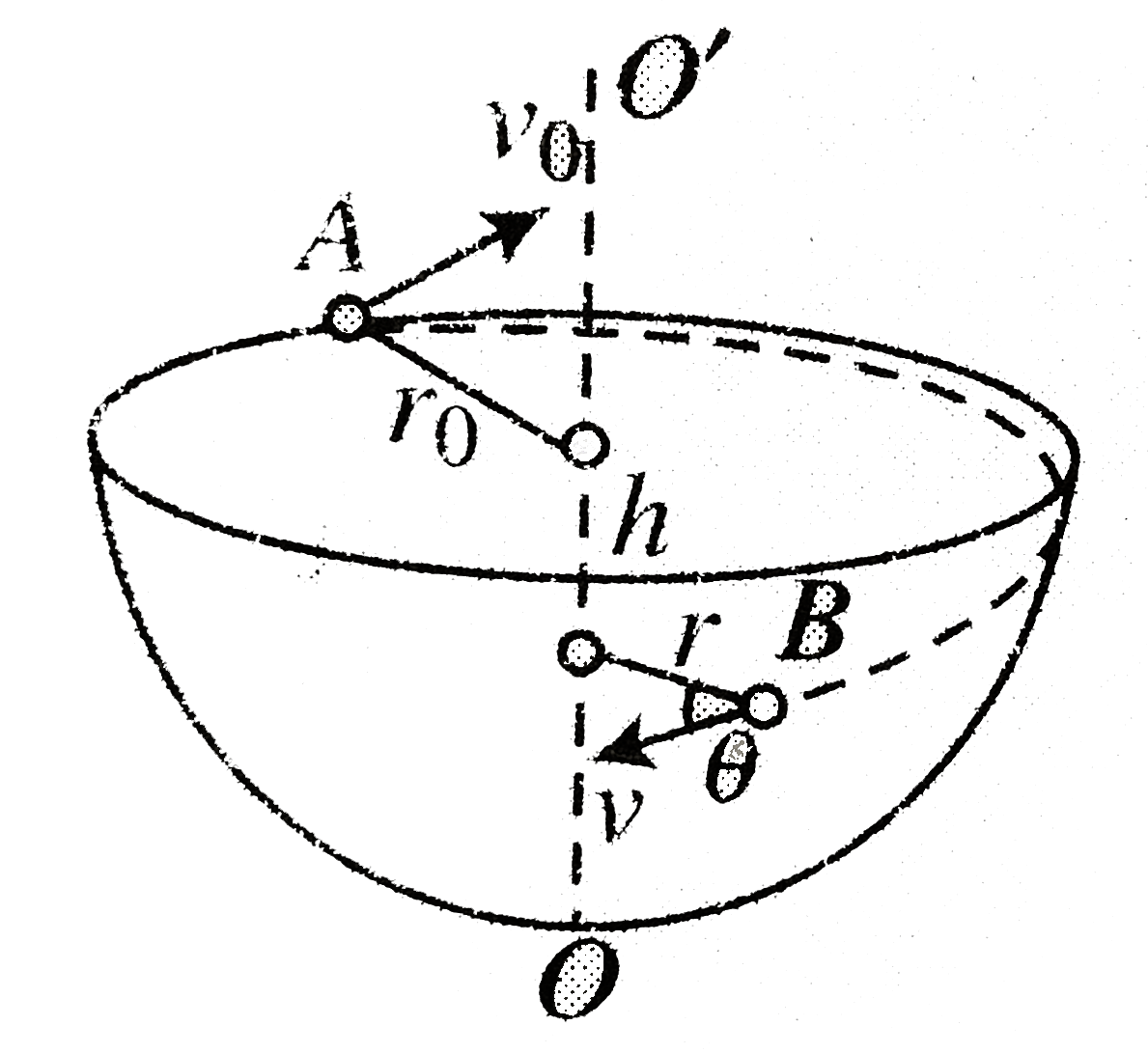
A small mass particle is projected with an initial velocity `v_(0)` tangent to the horizontal rim of smooth hemisphereicla bowl at a radius `r_(0)` from the vertical centre line, as shown at point A. As the particle slide past point `B`, a distance `h` below `A` and distance `r` from the verticle centre line, its velocity `v` makes an angle `theta` with the horizontal tangent to the bowl through `B`. Determine `theta`.

Text Solution

Verified by Experts

The forces on the particle are its weight and the normal reaction exerted by the surface of the bowl. Neither force exers a moment about the axis `O-O'`, so that angular momentum is conserved about that axis thus,
`mv_(0)r_(0)=mvr costheta`
Also energy is coserved so that `E_(1)=E_(2).` thus
`1/2mv_(0)^(2)+mgh=1/2mv^(2)+0`
`v=sqrt(v_(0)^(2)+2gh)`
Eliminating `v` and substituting `r^(2)-r_(0)^(2)-h^(2)` give
`v_(0)r_(0)=sqrt(v_(0)^(2)+2gh) sqrt(v_(0)^(2)-h^(2))costheta`
`theta=cos^(-1) 1/(sqrt(1+(2gh)/v_(0)^(2)sqrt(1-h^(2)/r_(0)^2)))`
Promotional Banner

Topper's Solved these Questions

  • RIGID BODY DYNAMICS 2

    CENGAGE PHYSICS ENGLISH|Exercise Subjective|19 Videos
  • RIGID BODY DYNAMICS 2

    CENGAGE PHYSICS ENGLISH|Exercise Single Correct|142 Videos
  • RIGID BODY DYNAMICS 2

    CENGAGE PHYSICS ENGLISH|Exercise Exercise 3.3|21 Videos
  • RIGID BODY DYNAMICS 1

    CENGAGE PHYSICS ENGLISH|Exercise Integer|11 Videos
  • SOUND WAVES AND DOPPLER EFFECT

    CENGAGE PHYSICS ENGLISH|Exercise Integer|16 Videos

Similar Questions

Explore conceptually related problems

A small particle is given an initial velocity v_(0)=10 m//s along the tangent to the brim of a fixed smooth hemisphere bowl of radius r_(0)=15sqrt(2)m as shown in the figure. The particle slides on the inner surface and reaches point B , a vertical distance h=15m below A and a distance r from the vertical centerline, where its velocity v makes an angle theta with the horizontal tangent to the bowl through B . If theta=15 K^(@) . Find the value of K . (take g=10 m//s^(2) )

A particle is projected from the ground with velocity u making an angle theta with the horizontal. At half of its maximum heights,

A particle is projected with velocity u at angle theta with horizontal. Find the time when velocity vector is perpendicular to initial velocity vector.

A particle is projected with velocity u at angle theta with horizontal. Find the time when velocity vector is perpendicular to initial velocity vector.

A particle is projected with velocity v at an angle theta aith horizontal. The average angle velocity of the particle from the point of projection to impact equals

A particle of mass m is projected with a velocity v at an angle of theta with horizontal. The angular momentum of the particle at the highest point of its trajectory is equal to :

A particle is projected at t = 0 with velocity u at angle theta with the horizontal. Then the ratio of the tangential acceleration and the radius of curvature at the point of projection is :

A particle is projected from a point P with a velocity v at an angle theta with horizontal. At a certain point Q it moves at right angles to its initial direction. Then

A particle is projected from a point P with a velocity v at an angle theta with horizontal. At a certain point Q it moves at right angles to its initial direction. Then

A particle is projected with a velocity u making an angle theta with the horizontal. At any instant its velocity becomes v which is perpendicular to the initial velocity u. Then v is
