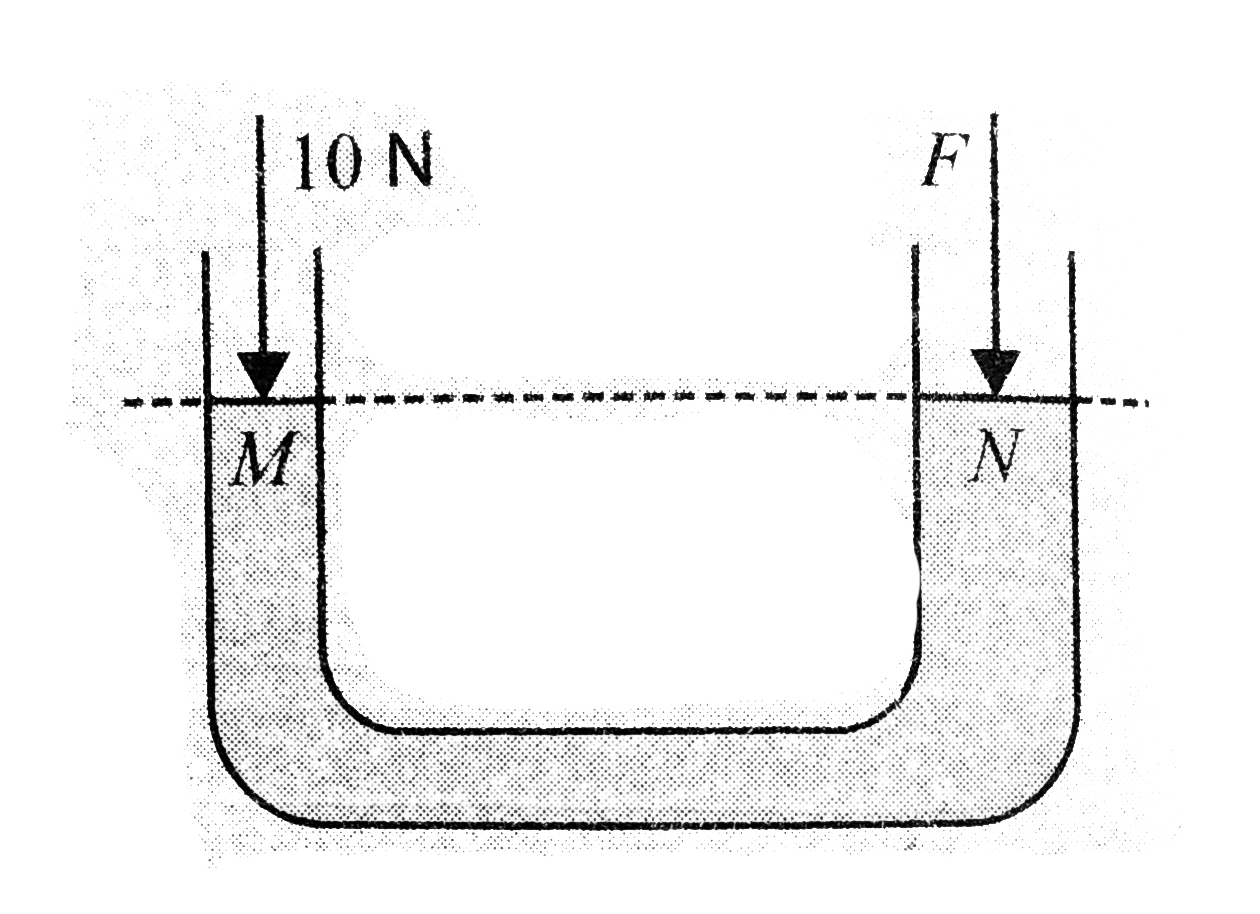
The area of cross sectioin of the two arms of a hydraulic press is `1cm^(2)` and `20 cm^(2)` respectively. A force of `10 N` is applied on the water in the thinner arm. What force should be applid on the water in the thicker arms so that water may remain in equilibrium?
Text Solution
Verified by Experts
In equilibrium, the pressures at the two surfaces should be equal as they lie in the same horizontal level. If the atmospheric pressure is `P_(0)` and a force `F` is applied to maintain the equilibrium the pressur just below the pistons are `P_(M)=P_(0)+(10N)/(1cm^(2))` and `P_(N)=P_(0)+F/(10cm^(2))` These pressures should be the same i.e. `P_(M)=P_(n)`which gives `F=200N`.
The area of cross section of the two arms of a hydraulilc press are 1 cm^2 and 10 cm^2 respectively figure. A force of 5N is applied on the water in the thinner arm. What force should be applied on the water in the thicker arm so that the water may remain in equilibrium? ,
The area of cross section of the two arms of a hydraulilc press are 1 cm^2 and 10 cm^2 respectively figure. A force of 5N is applied on the water in the thinner arm. What force should be applied on the water in the thicker arm so that the water may remain in equilibrium? ,
The area of cross-section of the two vertical arms of a hydraulic press are 1 cm ^(2) and 10 cm^(2) respectively. A force of 10N applied. As shown in the figure, to a tight fitting light piston in the thinner arm balances a force F applied to the corresponding piston in the thicker arm. Assuming that the levels of water in both the arms are the same, we can conclude:-
The radius of one arm of a hydraulic lift is three times the radius of the other arm. What force should be applied on the narrow arm so as to lift 50 kg at the wider arm?
In a hydraulic machine, a force of 2 N is applied on the piston of area of cross section 10 "cm"^2 . What force is obtained on its piston of area of cross section 100 "cm"^2 ?
The area of cross section of a steel wire (Y=2.0 xx 10^(11) N//m^(2)) is 0.1 cm^(2) . The force required to double is length will be
A area of cross section of a large tank is 0.5m^2 . It has an opening near the bottom having area of cross section 1cm^2 . A load of 20 kg is applied on the water at the top. Find the velocity of the water coming out of the opening at the time when the height of water level is 50 cm above the bottom. Take g=10ms^-2
A area of cross section of a large tank is 0.5m^2 . It has an opening near the bottom having area of cross section 1cm^2 . A load of 20 kg is applied on the water at the top. Find the velocity of the water coming out of the opening at the time when the height of water level is 50 cm above the bottom. Take g=10ms^-2
The areas of pistons in a hydraulic machine are 5cm^(2) and 625 cm^(2) . What force on the smaller piston will support a load of 1250 N on the larger piston ? State any assumption which you make in your calculation.
Two syringes of different cross-section (without needle filled with water are connected with a tightly fitted rubber tube filled with water. Diameters of the smaller piston an larger piston are 1 cm and 3 cm respectively. If a force of 10N is applied to the smaller piston then the force exerted on the larger piston is