Home
Class 11
PHYSICS
A solid sphere of mass m=2 kg and densit...

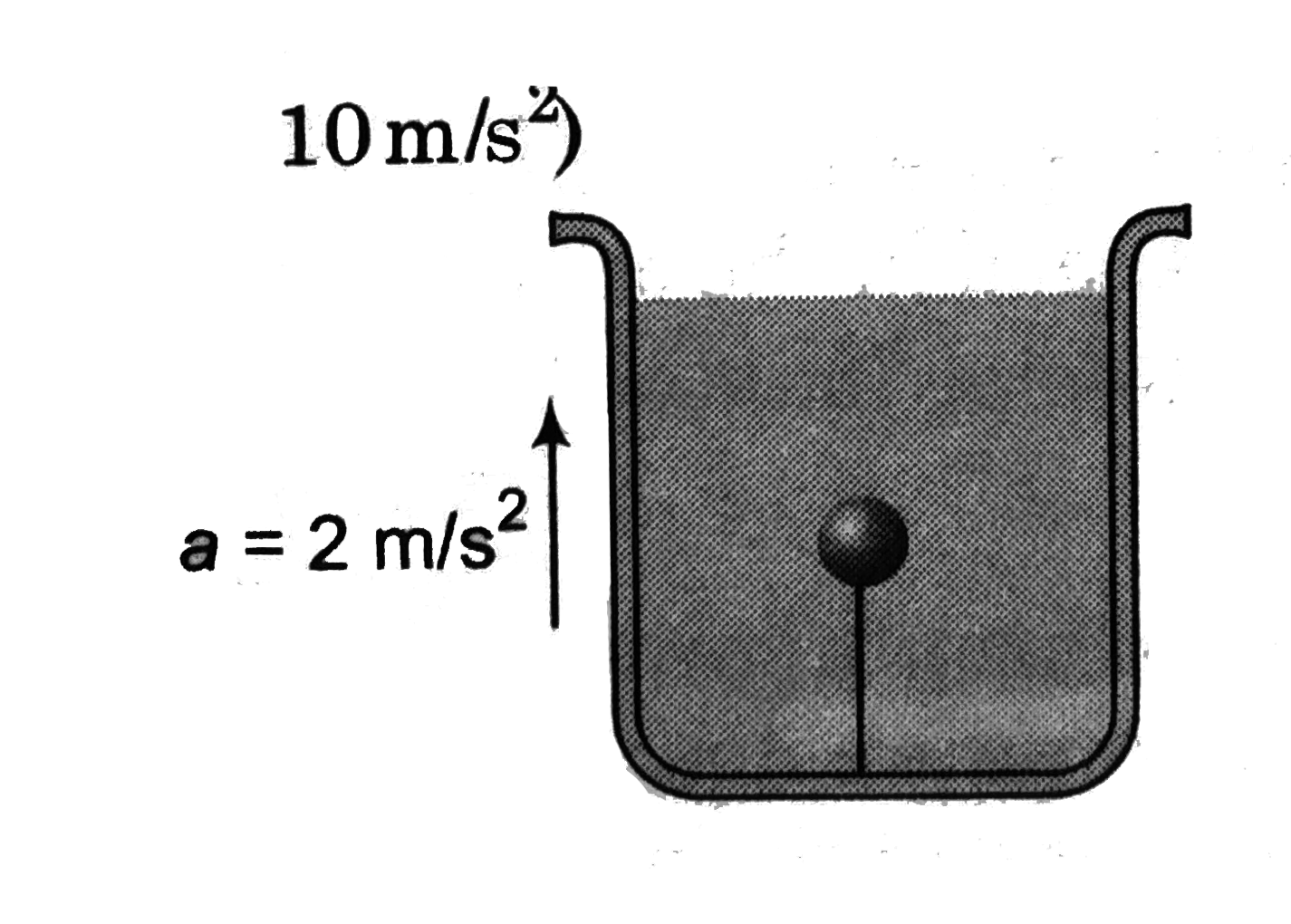
A solid sphere of mass `m=2 kg` and density `rho=500kg//m^(3)` is held stationary relative to a tank filled with water. The tank is acceerating upward with acceleration `2m//s^(2)`. Calculate
(a) Tension in the thread connected between the sphere and the bottom of the tank.
(b) If the thread snaps, calculate the acceleration of sphere with respect to the tank. (Density of water`=1000kg//m^(3),g=10m//s^(2))`

Text Solution

Verified by Experts

Density of the spherical material `=` specific gravity `xx` density of water `="sr"`
its volme is `V=m/(srho)`
Hence mass of water displaced by the shere is
`V_(rho)=m/(srho) rho=m//s=2/0.5=4kg`
since, the tank is accelerating upwards with acceleration a therefore, apparent value of gravitational acceleration is
`g'=g+a=12ms^(-2)`
Hence, upthrust exerted by water on the sphere is
`F=V_(rho)(g+a)=48N` brgt
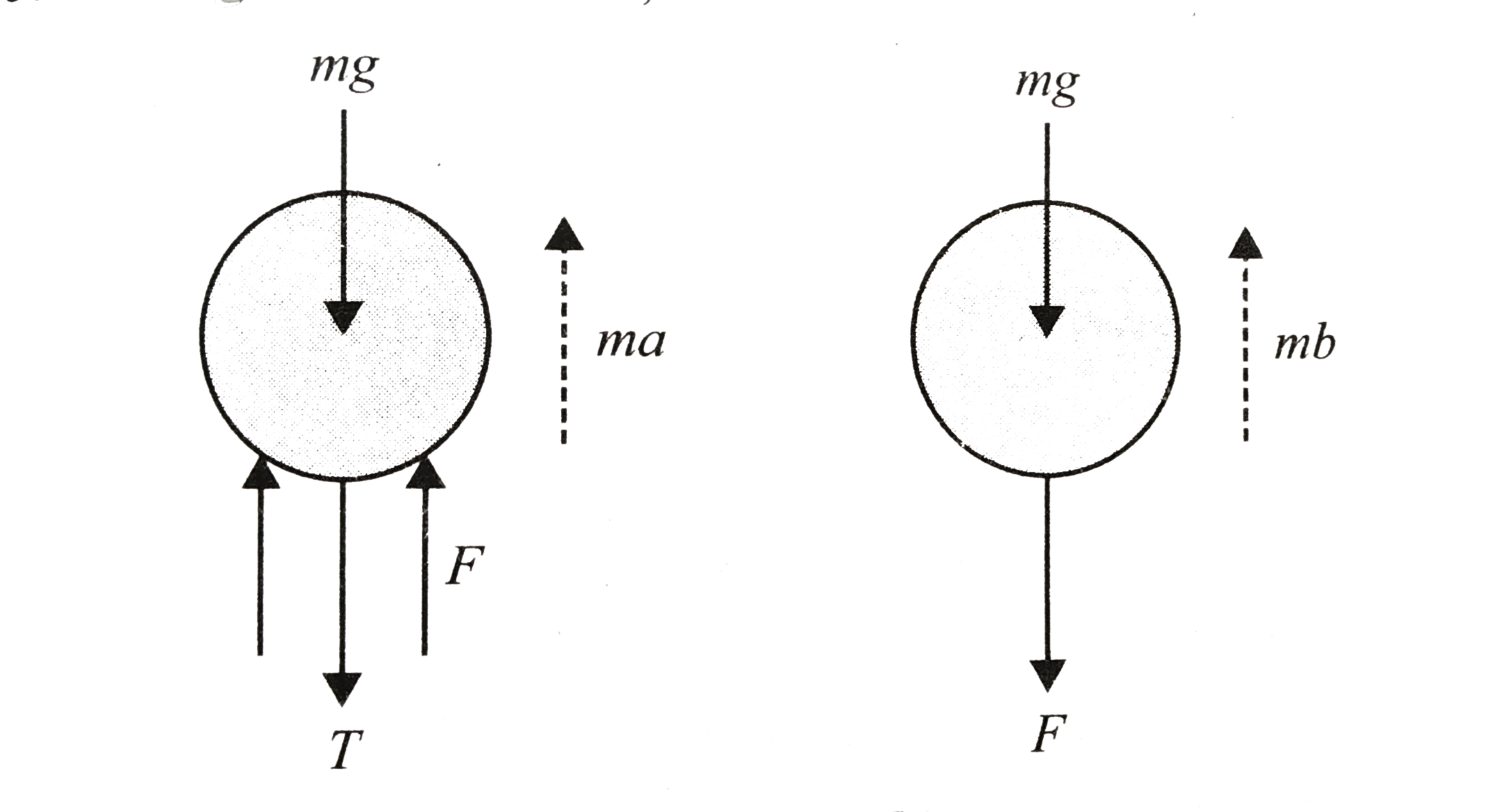
`F=mg-T=ma=.T=F-mg-ma=24N`
When thread snaps, tension `T` disappears. Let the sphere now starts accelerating upwards with acceleration b. Considering the free body diagram.
`F-mg=mb`
`:. b=14ms^(-2)`
Thus is the absolute acceleration of the sphere. But the tank itself is accelerating upwards with acceleration a. Therefore, upward acceleration of the sphere relative to the tank is `b-a=12ms^(-2)`
Promotional Banner

Topper's Solved these Questions

  • FLUID MECHANICS

    CENGAGE PHYSICS ENGLISH|Exercise Solved Examples|7 Videos
  • FLUID MECHANICS

    CENGAGE PHYSICS ENGLISH|Exercise Exercise 4.1|11 Videos
  • DIMENSIONS & MEASUREMENT

    CENGAGE PHYSICS ENGLISH|Exercise Integer|2 Videos
  • GRAVITATION

    CENGAGE PHYSICS ENGLISH|Exercise INTEGER_TYPE|1 Videos

Similar Questions

Explore conceptually related problems

A block of mass 1 kg and density 0.8g//cm^(3) is held stationary with the help of a string as shown in figure. The tank is accelerating vertically upwards with an acceleration a =1.0m//s^(2) . Find (a) the tension in the string, (b) if the string is now cut find the acceleration of block. (Take g=10m//s^(2) and density of water =10^(3)kg//m^(3)) .

The mass of a lift if 600kg and it is moving upwards with a uniform acceleration of 2m//s^(2) . Then the tension in the cable of the lift is :

A lift of mass 200 kg is moving upward with an acceleration of 3m//s^(2) . If g=10 m//s^(2) then the tension of string of the lift will be :

A lift of mass 100 kg is moving upwards with an acceleration of 1 m//s^(2) . The tension developed in the string, which is connected to lift is ( g=9.8m//s^(2) )

The pressure at a point in water is 10 N//m^(2) . The depth below this point where the pressure becomes double is (Given density of water = 10^(3) kg m^(-3) , g = 10 m s^(-2) )

A wooden block of mass 1kg and density 800 Kg m^(-3) is held stationery, with the help of a string, in a container filled with water of density 1000 kg m^(-3) as shown in the figure. If the container is moved upwards with an acceleration of 2 m s^(-2) , then the tension in the string will be ( take g=10ms^(-2) )

Calculate the molarity of water if its density is 1000 kg m^(-3)

A lift of mass 1000kg is moving with an acceleration of 1m//s^(2) in upward direction. Tension developed in the string, which is connected to the lift, is.

A lift of mass 1000kg is moving with an acceleration of 1m//s^(2) in upward direction. Tension developed in the string, which is connected to the lift, is.

Calculate the pressure due to a water column of height 100 m. (Take g=10 ms^(-2) and density of water =10^(3)kg m^(-3)) .

