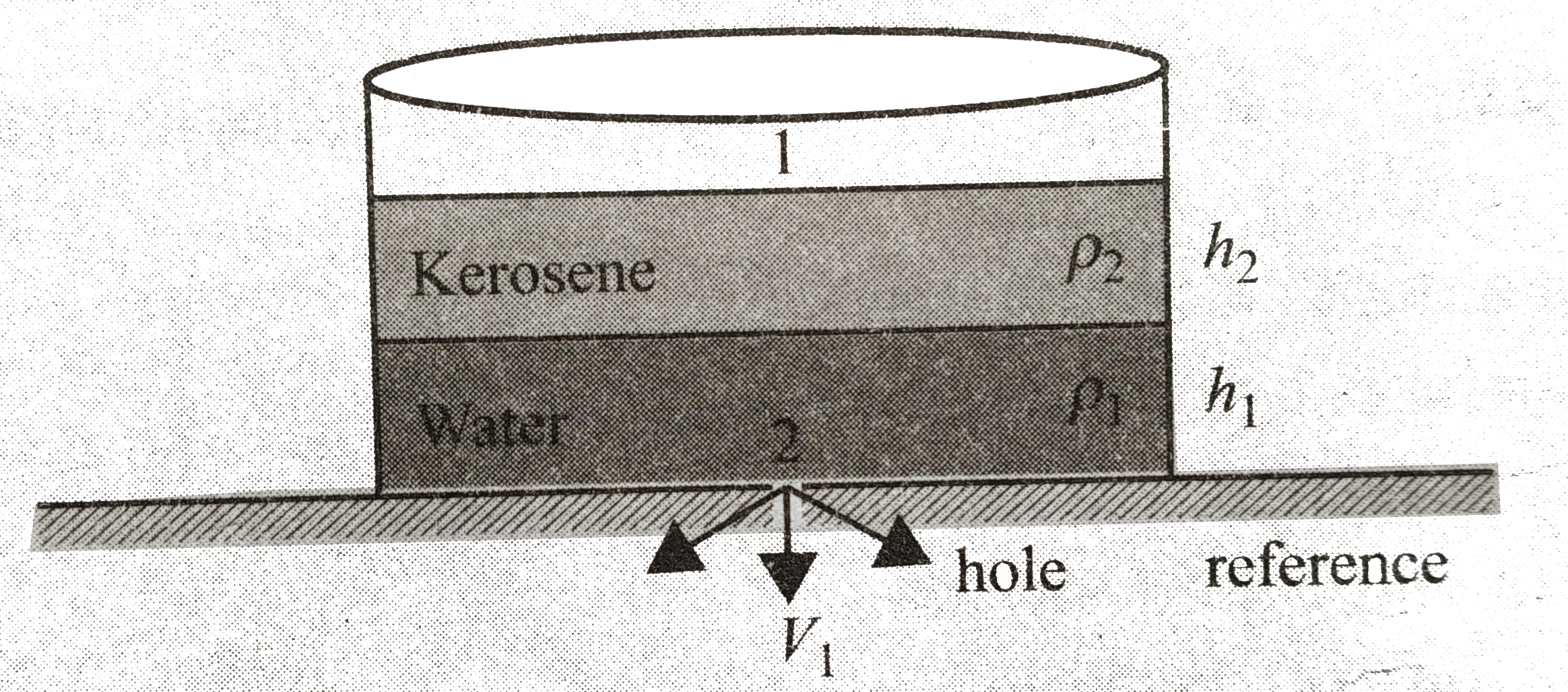
A wide vessel with a small hole in the bottom is filled with water and kerosene. Find the velocity of water flow if the thickness of water layer is `h_(1)=30 cm` and that of kerosene is `h_(2)=20cm` brgt
Text Solution
Verified by Experts
Method 1: Let the densities of water and kerosene be `rho_(1)` and `rho_(2)` respectively. Let the area of the vessel be `A` and area of the hole be `a`. Applying bernoulli's theorem at cross sections `1` and `2` we have `1/2rho_(1)V_(1)^(2)+P_(atm)+0=1/2rho_(1)V_(1)^(2)+(P_(atm)+h_(2)rho_(2)g)+h_(1)rho_(1)g` `av_(1)=Av_(2)` `implies 1/2rho_(1)V_(1)^(2)[1-(a^(2))/(A^(2))]=[h_(1)-(h_(2)P_(2))/(rho_(1))]rho_(1)gimpliesv_(1)=sqrt(2g(h_(1)+(h_(2)rho_(2))/(rho_(1))))` Method 2: We can replace kerosene with water column which produces the same pressure as kerosene column at interface of kerosene column at interface of kerosene and water. Pressure produced by kerosene `P_("interface")=rho_(2)gh_(2)` Let the equivalent height of water column be `h_(1)^(')` Hence `P_("interface")=rho_(1)gh_(1)^(')=rho_(2)gh_(2)` `impliesh_(1)^(')=(rho_(2)h_(2))/(rho_(1))`..........i Total height of water above orifice, which produces the same pressure as before is `H=h_(1)+h_(1)^(')=h_(1)+(rho_(2))/(rho_(1))h_(2)` Using Torricelli's formular for velocity of efflux, `v=sqrt(2gH), sqrt(2g(h-1+(rho_(2))/(rho_(1))h_2))`