A container of large uniform cross sectonal area `A`, resting on horizontal surface, holds two immiscible non viscous and incompresible liquids of density `d` and `2d`, each of height `H/2` as shown in the figure. The lower density liquid is open to the atmosphere having pressure `P_(0)`. A tiny hole of area `s(s`<``<`A)` is punched on the vertical side of the container at a height `h(h`<`H/2)`. Determine
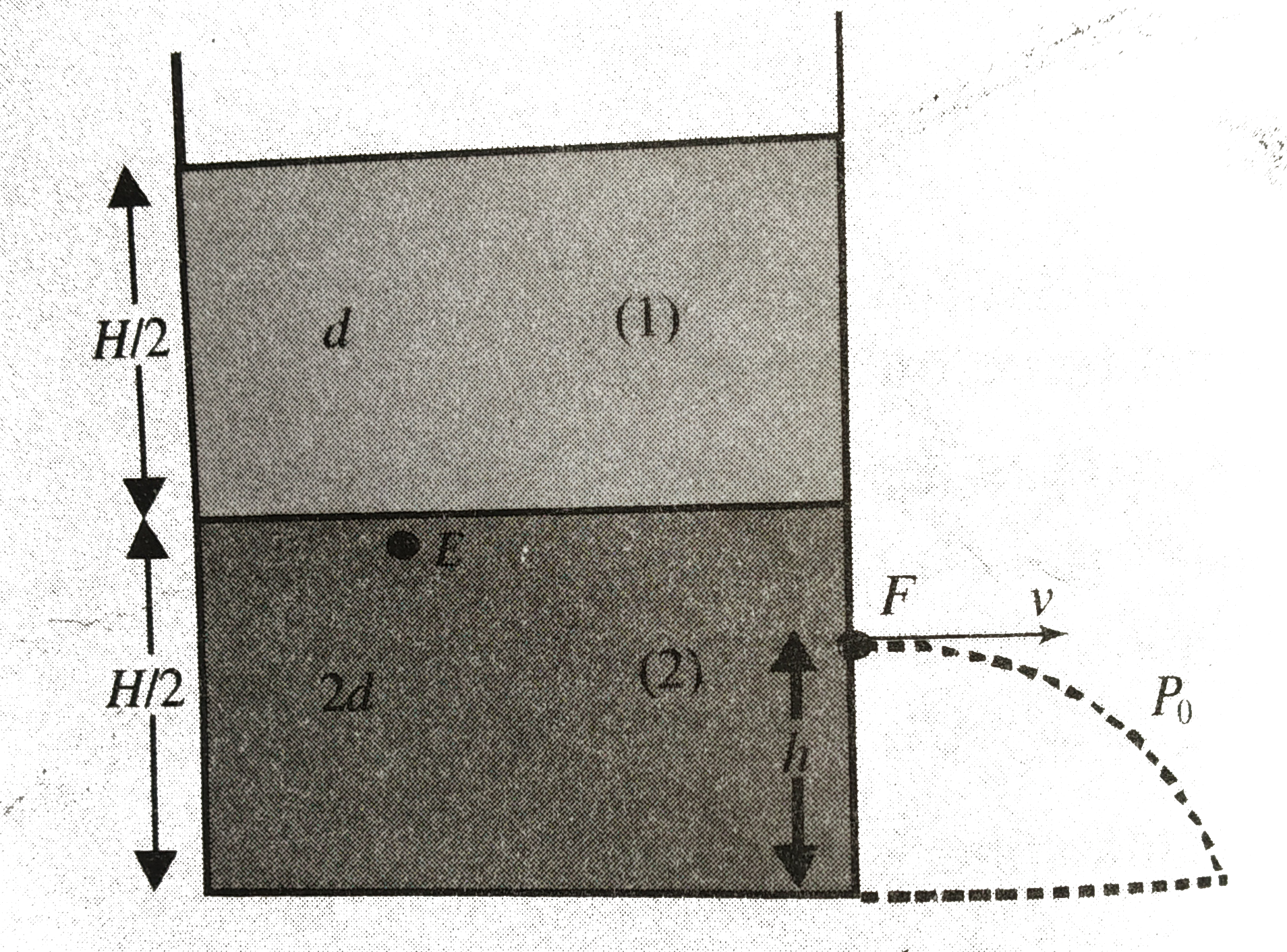
a.the initial speed of efflux of the liquid at the hole
b. the horizontal disance `x` travelled by the liquid initially
c. the height `h_m` at which at the hole should be punched so that the liquid travels the maximum distance `x_(m)` initially. also calculate `x_(m)` (neglect air resistance inte calculations).
A container of large uniform cross sectonal area `A`, resting on horizontal surface, holds two immiscible non viscous and incompresible liquids of density `d` and `2d`, each of height `H/2` as shown in the figure. The lower density liquid is open to the atmosphere having pressure `P_(0)`. A tiny hole of area `s(s`<``<`A)` is punched on the vertical side of the container at a height `h(h`<`H/2)`. Determine
a.the initial speed of efflux of the liquid at the hole
b. the horizontal disance `x` travelled by the liquid initially
c. the height `h_m` at which at the hole should be punched so that the liquid travels the maximum distance `x_(m)` initially. also calculate `x_(m)` (neglect air resistance inte calculations).
a.the initial speed of efflux of the liquid at the hole
b. the horizontal disance `x` travelled by the liquid initially
c. the height `h_m` at which at the hole should be punched so that the liquid travels the maximum distance `x_(m)` initially. also calculate `x_(m)` (neglect air resistance inte calculations).
Text Solution
Verified by Experts
a. Applying Beroulli's theorem at point `E` ( `a` point on the interface of the liquids and on the top surface of the liquid of density `2d`) and `F`, i.e, pressure energy `=` kinetic energy `+` potential energy `=` constant
`implies P_(0)+H/2dg+1/2(2d)xx0+H/2dg`
`=P_(0)+1/2(2d)v^(2)+2hdg`
`implies3/2Hdg=dv^(2)+2hdg`
`implies v^(2)=3/2Hg-2hg=((3H-4h)g)/2`
`:. v=sqrt({((3H-3h))/2g})`
Method :2 Let the equivalent depth of liquid `1` of denisty in terms of density `2d` which gives the dame pressure as liquid `1` at interface i.e.,
`H/2dg=H'(2d)g` which gives `H'=H/4`
Hence depth depth of the liquid above opening (in terms of depth of liquid of density `2d`).
`H'+(H/2-h)=H/4+(H/2-h)`
`H_("net")=((3H-4h)/4)`
and velocity of efflux is given by
`v=sqrt(2gh_("net"))`
`v=sqrt((3H-4h)/2)g`
time taken by the liquid to fall through a vertical height `h` is given by
`H=1/2"gt"^(2)implies t=sqrt((2h)/g)`
Therefore horizontal distance traversed by liquid is
`x=vt=sqrt(((3H-4h)g)/2)xxsqrt((2h)/g)`
c. For the minimum horizontal distance `x`
`(dx)/(dh)=0impliesd/(dh)(3Hh-4h^(2))^(1/2)=0`
or `1/293Hh-4h^(2)^(-1/2)xx(3H-8h)=0`
this gives `3H-8h-0impliesh=(3H)/8`
This is the length of the liquid for which the range is maximum i.e
`hrarr h_(m)=(3H)/8`
The maximum horizontal distance is given by
`x_(m)=sqrt((3H-3h_(m))h_(m))`
`sqrt({(3H-4(3H)/3)(3H)/8}9=3/4H`
`implies P_(0)+H/2dg+1/2(2d)xx0+H/2dg`
`=P_(0)+1/2(2d)v^(2)+2hdg`
`implies3/2Hdg=dv^(2)+2hdg`
`implies v^(2)=3/2Hg-2hg=((3H-4h)g)/2`
`:. v=sqrt({((3H-3h))/2g})`
Method :2 Let the equivalent depth of liquid `1` of denisty in terms of density `2d` which gives the dame pressure as liquid `1` at interface i.e.,
`H/2dg=H'(2d)g` which gives `H'=H/4`
Hence depth depth of the liquid above opening (in terms of depth of liquid of density `2d`).
`H'+(H/2-h)=H/4+(H/2-h)`
`H_("net")=((3H-4h)/4)`
and velocity of efflux is given by
`v=sqrt(2gh_("net"))`
`v=sqrt((3H-4h)/2)g`
time taken by the liquid to fall through a vertical height `h` is given by
`H=1/2"gt"^(2)implies t=sqrt((2h)/g)`
Therefore horizontal distance traversed by liquid is
`x=vt=sqrt(((3H-4h)g)/2)xxsqrt((2h)/g)`
c. For the minimum horizontal distance `x`
`(dx)/(dh)=0impliesd/(dh)(3Hh-4h^(2))^(1/2)=0`
or `1/293Hh-4h^(2)^(-1/2)xx(3H-8h)=0`
this gives `3H-8h-0impliesh=(3H)/8`
This is the length of the liquid for which the range is maximum i.e
`hrarr h_(m)=(3H)/8`
The maximum horizontal distance is given by
`x_(m)=sqrt((3H-3h_(m))h_(m))`
`sqrt({(3H-4(3H)/3)(3H)/8}9=3/4H`



Topper's Solved these Questions
FLUID MECHANICS
CENGAGE PHYSICS ENGLISH|Exercise Exercise 4.1|11 VideosFLUID MECHANICS
CENGAGE PHYSICS ENGLISH|Exercise Exercise 4.2|11 VideosFLUID MECHANICS
CENGAGE PHYSICS ENGLISH|Exercise INTEGER_TYPE|1 VideosDIMENSIONS & MEASUREMENT
CENGAGE PHYSICS ENGLISH|Exercise Integer|2 VideosGRAVITATION
CENGAGE PHYSICS ENGLISH|Exercise INTEGER_TYPE|1 Videos
Similar Questions
Explore conceptually related problems
A container of large uniform cross sectional area A , resting on horizontal surface, holds two immiscible non viscous and incompressible liquids of density d and 2d , each of height H/2 as shown in the figure. The lower density liquid is open to the atmosphere having pressure P_(0) . A tiny hole of area (s(sltltA) is punched on the vertical side of the container at a height h(hltH/2) . Determine The horizontal distance traveled by the liquid, initially, is :
A container of large uniform cross sectional area A , resting on horizontal surface, holds two immiscible non viscous and incompressible liquids of density d and 2d , each of height H/2 as shown in the figure. The lower density liquid is open to the atmosphere having pressure P_(0) . A tiny hole of area (s(sltltA) is punched on the vertical side of the container at a height h(hltH/2) . Determine the initial speed of efflux of the liquid at the hole
A container of cross-section area A resting on a horizontal surface, holds two immiscible and incompressible liquid of densities rho and 2 rho as shown in figure. The lower density liquid is open to the atmosphere having pressure P_(0) . The pressure at the bottom of the container is
Fluids at rest exert a normal force to the walls of the container or to the sruface of the body immersed in the fluid. The pressure exerted by this force at a point inside the liqid is the sum of atmospheric pressure and a factor which depends on the density of the liquid, the acceleration due to gravity and the height of the liquid, above that point. The upthrust acting on a body immersed in a stationary liquid is the net force acting on the body in the upward direction. A number of phenomenon of liquids in motion can be explain by Bernoulli's theorem which relates the pressure, flow speed and height for flow of an ideal incompressible fluid. A container of large uniform corss sectional area. A resting on a horizontal surface holds two immiscible, non viscous and incompressile liquids of densities d and 2d , each of height H//2 as shown in the figure. The lower density liquid is open to the atmosphere having pressure P_(0) . Situation II: A cyliner is removed and the original arrangement is restoreed.A tiny hole of area s(slt ltA) is punched on the veritical side of the containier at a height h(hltH//2) The height h_(m) at which the hole should be punched so that the liquid travels the maximum distance is
A container of large uniform cross-sectional area A resting on a horizontal surface, holes two immiscible, non-viscous and incompressible liquids of densities d and 2d each of height H//2 as shown in the figure. The lower density liquid is open to the atmosphere having pressure P_(0) . A homogeneous solid cylinder of length L(LltH//2) and cross-sectional area A//5 is immersed such that it floats with its axis vertical at the liquid-liquid interface with length L//4 in the denser liquid, The density D of the material of the floating cylinder is
A container of large uniform cross-sectional area A resting on a horizontal surface, holes two immiscible, non-viscon and incompressible liquids of densities d and 2d each of height H//2 as shown in the figure. The lower density liquid is open to the atmosphere having pressure P_(0) . A homogeneous solid cylinder of length L(LltH//2) and cross-sectional area A//5 is immeresed such that it floats with its axis vertical at the liquid-liquid interface with length L//4 in the denser liquid, The cylinder is then removed and the original arrangement is restroed. a tiny hole of area s(sltltA) is punched on the vertical side of the container at a height h(hltH//2) . As a result of this, liquid starts flowing out of the hole with a range x on the horizontal surface. The initial speed of efflux without cylinder is
A container of large uniform cross-sectional area A resting on a horizontal surface, holes two immiscible, non-viscon and incompressible liquids of densities d and 2d each of height H//2 as shown in the figure. The lower density liquid is open to the atmosphere having pressure P_(0) . A homogeneous solid cylinder of length L(LltH//2) and cross-sectional area A//5 is immeresed such that it floats with its axis vertical at the liquid-liquid interface with length L//4 in the denser liquid, The cylinder is then removed and the original arrangement is restroed. a tiny hole of area s(sltltA) is punched on the vertical side of the container at a height h(hltH//2) . As a result of this, liquid starts flowing out of the hole with a range x on the horizontal surface. The initial value of x is
A container of a large uniform cross-sectional area A resting on a horizontal surface holds two immiscible, non viscous and incompressible liquids of densities d and 2d , each of height H//2 as shown in figure. The lower density liquid is open to atmosphere. A homogeneous solid cylinder of length L(L lt (H)/(2)) , cross-sectional area A//5 is immersed such that it floats with its axis vertical of the liquid-liquid interface with length L//4 denser liquid. Determine (a) density D of the solid and (b) the total pressure at the bottom of the container. (Atmospheric pressure = P_0 ). .
Fluids at rest exert a normal force to the walls of the container or to the sruface of the body immersed in the fluid. The pressure exerted by this force at a point inside the liqid is the sum of atmospheric pressure and a factor which depends on the density of the liquid, the acceleration due to gravity and the height of the liquid, above that point. The upthrust acting on a body immersed in a stationary liquid is the net force acting on the body in the upward direction. A number of phenomenon of liquids in motion can be explain by Bernoulli's theorem which relates the pressure, flow speed and height for flow of an ideal incompressible fluid. A container of large uniform corss sectional area. A resting on a horizontal surface holds two immiscible, non viscous and incompressile liquids of densities d and 2d , each of height H//2 as shown in the figure. The lower density liquid is open to the atmosphere having pressure P_(0) . Situation I: A homogeneous solid cylinder of length L(LltH//2) . cross sectional area A//5 is immersed such that it floats with its axis vertical at liquid -liquid interface with lenght L//4 in the denser liquid. The total pressure at the bottom of the container is
Fluids at rest exert a normal force to the walls of the container or to the sruface of the body immersed in the fluid. The pressure exerted by this force at a point inside the liqid is the sum of atmospheric pressure and a factor which depends on the density of the liquid, the acceleration due to gravity and the height of the liquid, above that point. The upthrust acting on a body immersed in a stationary liquid is the net force acting on the body in the upward direction. A number of phenomenon of liquids in motion can be explain by Bernoulli's theorem which relates the pressure, flow speed and height for flow of an ideal incompressible fluid. A container of large uniform cross sectional area. A resting on a horizontal surface holds two immiscible, non viscous and incompressile liquids of densities d and 2d , each of height H//2 as shown in the figure. The lower density liquid is open to the atmosphere having pressure P_(0) . Situation II: A cyliner is removed and the original arrangement is restored.A tiny hole of area s(slt ltA) is punched on the veritical sideof the containier at a height h(hltH//2) The initial speed of efflux of the liquid at the hole is
CENGAGE PHYSICS ENGLISH-FLUID MECHANICS-Solved Examples
- A homogeneous solid cylinder of length L(LltH/2), cross-sectional area...
Text Solution
|
- A container of large uniform cross sectonal area A, resting on horizon...
Text Solution
|
- A large open top container of negligible mass and uniform cross sectio...
Text Solution
|
- A wooden stick of length L, radius R and density rho has a small metal...
Text Solution
|
- A uniform solid cylinder of density 0.8g//cm^3 floats in equilibrium i...
Text Solution
|
- Consider a horizontally oriented syringe containing water locate at a ...
Text Solution
|
- A non-viscous liquid of constant density 1000 kg//m^(3) flows in a str...
Text Solution
|