Home
Class 11
PHYSICS
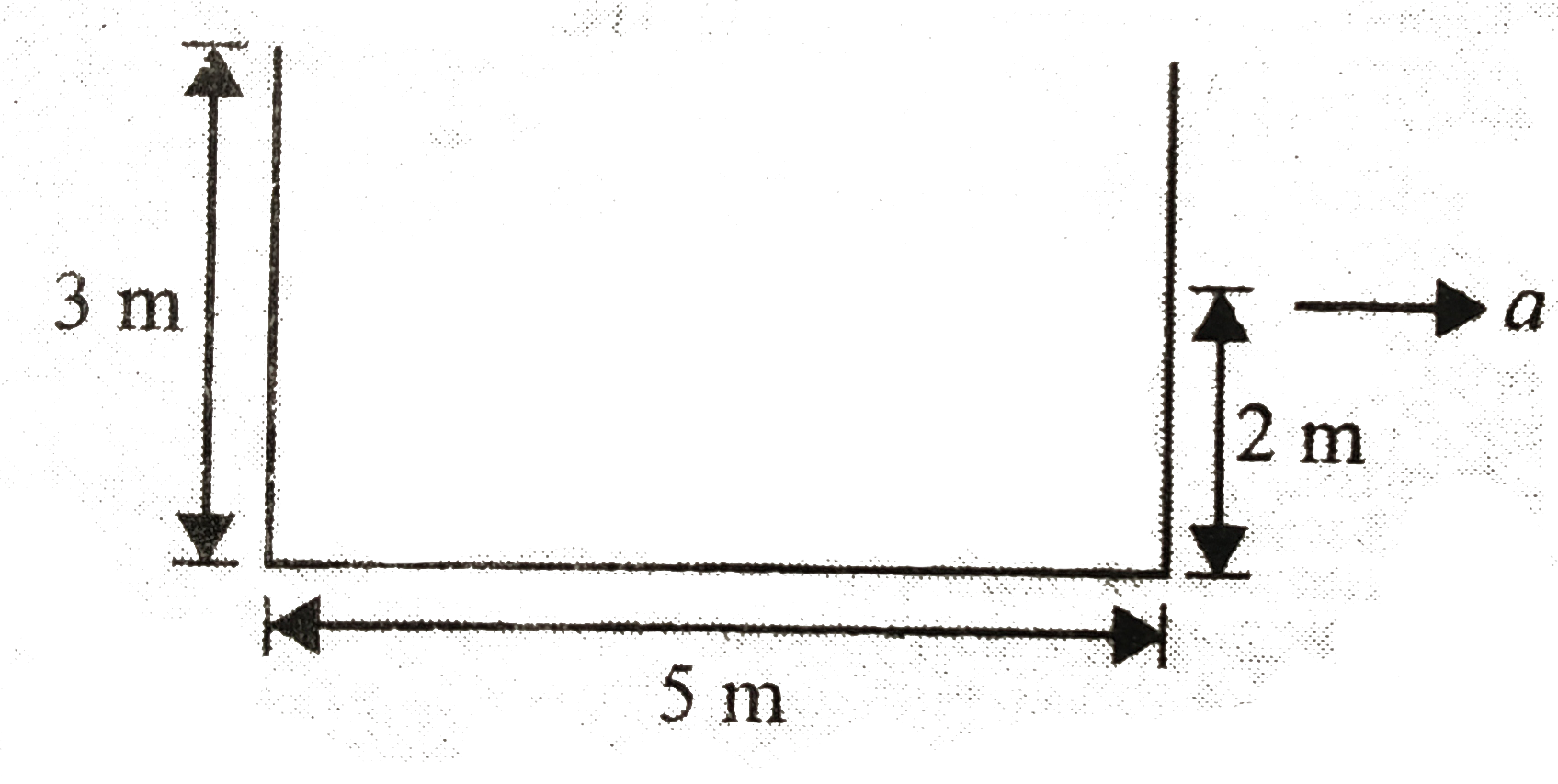
A container shown in Fig. is accelerated...

A container shown in Fig. is accelerated horizontally with acceleration `a`.
a. Find the minimum value of `a` at which liquid just starts spilling out.

Text Solution

Verified by Experts
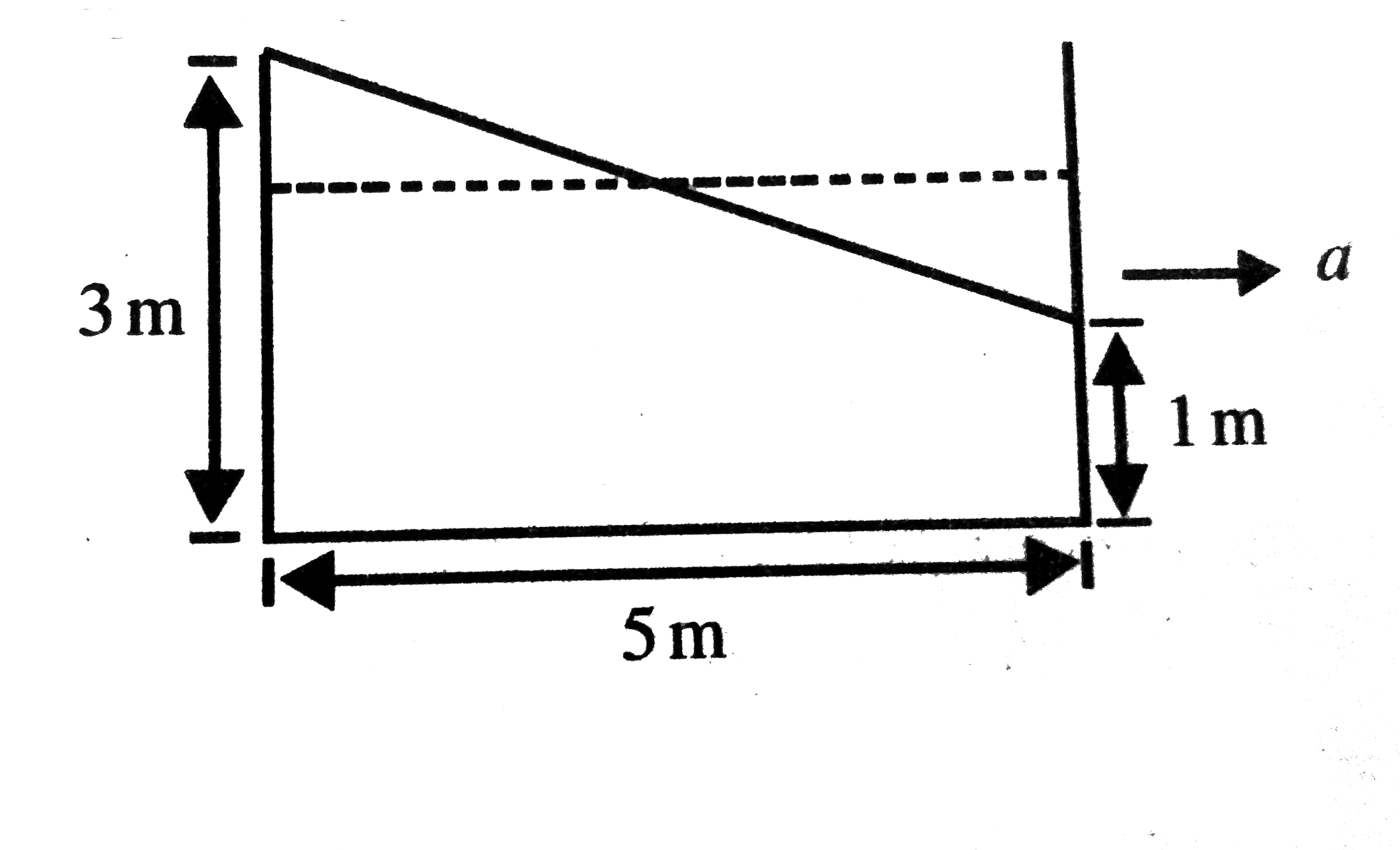
The level of liquid rises by by `1 m` on the left side and falls by `1 m` on the right side

`a/g=(3/1)/5=2/5`
or `a=0.4g=4m//s^(2)`
Promotional Banner

Topper's Solved these Questions

  • FLUID MECHANICS

    CENGAGE PHYSICS ENGLISH|Exercise Exercise 4.3|10 Videos
  • FLUID MECHANICS

    CENGAGE PHYSICS ENGLISH|Exercise Exercise 4.4|10 Videos
  • FLUID MECHANICS

    CENGAGE PHYSICS ENGLISH|Exercise Exercise 4.1|11 Videos
  • DIMENSIONS & MEASUREMENT

    CENGAGE PHYSICS ENGLISH|Exercise Integer|2 Videos
  • GRAVITATION

    CENGAGE PHYSICS ENGLISH|Exercise INTEGER_TYPE|1 Videos

Similar Questions

Explore conceptually related problems

A rectangular box is completely filled with a liquid of density rho , as shown in Fig. The box is accelerated horizontally with a constant acceleration a. Determine the gauge pressures at the four points A, B, C and D .

A U-tube containing a liquid is accelerated horizontally with a constant acceleration a_0 . If the separation between the vertical limbs is l find the difference in the heights of the liquid in the two arms.

A uniform solid cylinder having height l and diameter d is placed on a rough horizontally plank which is being pulled horizontal with an acceleration. Find the maximum value of the acceleration for which the cylinder remain in equilibrium

An open rectangular tank 5m xx 4m xx 3m high containing water upto a height of 2m is accelerated horizontally along the longer side . (a) Determine the maximum acceleration that can be given without spilling the water .

An open retangular tank 5mxx4mxx3m high containing water upto a height of 2m is accelerated horizontally along the longer side. (i). Determine the maximum acceleration that can be given without spilling the water. (ii). Calculate the percentage of water split over if this acceleration of increased by 20% (iii). If initially the tank is closed at the top and its accelerated horizontally by 9m//s^(2) find the gauge pressure at the bottom of the front and rear walls of the tank.

A closed rectangular tank is completely filled with water and is accelerated horizontally with an acceleration towards the right. Pressure is i. maximum and ii. minimum at

As shown in fig, if acceleration of M with respect to ground is 2ms^(-2) , then

Figure shows a closed container completely filled with an ideal liquid of density rho . In the liquid there is a spherical body of volume V and density sigma attached to a string whose other end is attached to the roof of the container. The container is accelerating with an acceleration 'a' towards right. The force exerted by the liquid on the spherical body when it is in equillibrium with respect to the liquid, will be :

A man is 45 m behind the bus when the bus starts acceleration from rest with acceleration 2.5(m)/(s^2) . With what minimum velocity should man start running to catch the bus?

In the arrangement shown in fig., if the acceleration of B is vec(a) . Then find the acceleration of A.

