Home
Class 11
PHYSICS
A U tube is rotated about one of it's li...

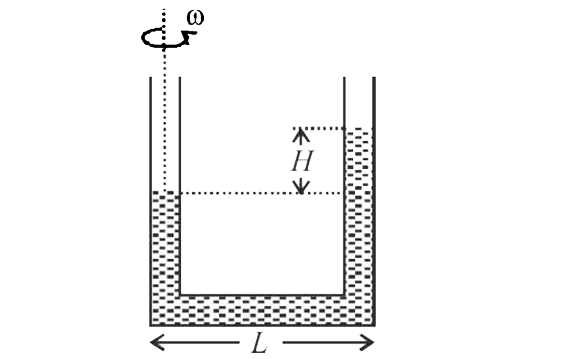
A U tube is rotated about one of it's limbs with an angular velocity `omega`. Find the difference in height H of the liquid (density `rho`) level, where diameter of the tube `dlt lt L`.

Text Solution

Verified by Experts
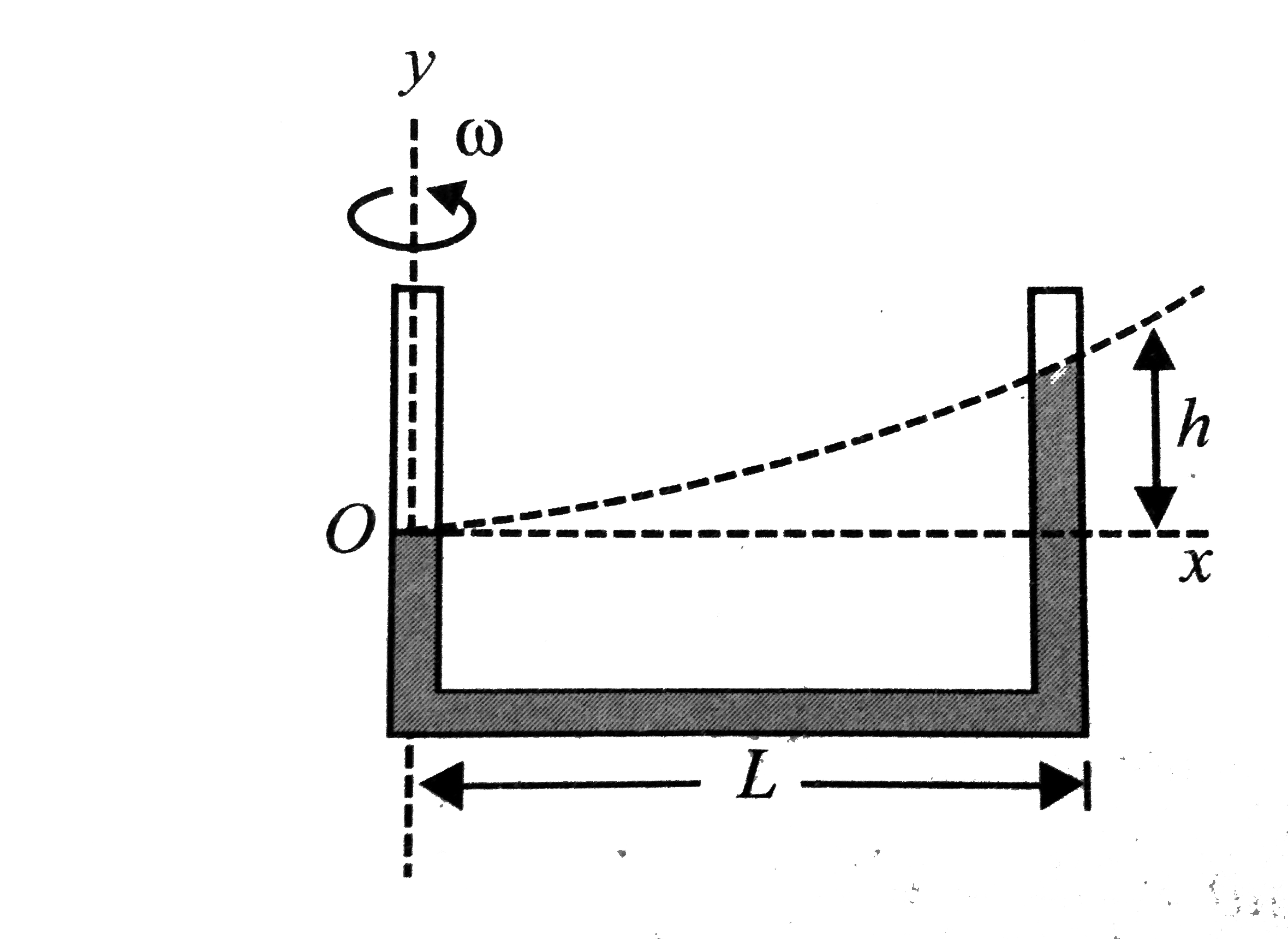
Equation of parabola `y=(omega^(2)x^(2))/(2g)`……i

At `A` coordinate will be `(L,h)`
Substituting in eqn i `h=(omega^(2)L^(2))/(2g)`
Promotional Banner

Topper's Solved these Questions

  • FLUID MECHANICS

    CENGAGE PHYSICS ENGLISH|Exercise Exercise 4.3|10 Videos
  • FLUID MECHANICS

    CENGAGE PHYSICS ENGLISH|Exercise Exercise 4.4|10 Videos
  • FLUID MECHANICS

    CENGAGE PHYSICS ENGLISH|Exercise Exercise 4.1|11 Videos
  • DIMENSIONS & MEASUREMENT

    CENGAGE PHYSICS ENGLISH|Exercise Integer|2 Videos
  • GRAVITATION

    CENGAGE PHYSICS ENGLISH|Exercise INTEGER_TYPE|1 Videos

Similar Questions

Explore conceptually related problems

A tube of length L is filled completely with an incompressible liquid of mass M and closed at both the ends. The tube is then rotated in a horizontal plane about one of its ends with a uniform angular velocity omega . Determine the force exerted by the liquid at the other end.

Length of the horizontal arm of a uniform cross - section U - tube is l = 5 cm and both ends of the vertical arms are open to the surrounding pressure of "7700 N m"^(-2) . A liquid of density rho=10^(3)" kg m"^(-3) is poured into the tube such that the liquid just fills the horizontal part of the tube. Now, one of the open ends is sealed and the tube. Now, one of the open ends is sealed and the tube is then rotaed about a vertical axis passing through the other veritcal arm with angular velocity omega due to which the liquid rises up to half the length of the vertical arm. If length of each vertical arm is a = 6 cm. What is the value of omega("in rad s"^(-1)) ?

A tube of length L is filled completely with an incompressible liquid of mass M and closed at both the ends. The tube is then rotated in a horizontal plane about one of its ends with a uniform angular velocity omega. The force exerted by the liquid at the other end is

A conducting rod OA of length l is rotated about its end O with an angular velocity omega in a uniform magnetic field directed perpendicualr to the rotation. Find the emf induced in the rod, between it's ends.

A cylindrical vessel of radius r containing a liqiud is rotating about a vertical axis through the centre of circular base, If the vessel is rotating with angular velocity omega then what is the difference of the heights of liquid at centre of vessel and edge?

The ratio of the radius of the tube of a venturimeter is eta (eta gt 1) . The ratio of the densities of the liquid in the manometer and the moving fluid is eta _(1) . If the difference in heights of the liquid column in the manometer is h , find the minimum speed of flow of the fluid .

A U -tube rotates with angular velocity omega about the vertical axis AB . What is the difference in fluid level h in terms of omega the radii r_(1) and r_(2) and the fluid density rho?

A cylinder of radius R and height H is foam unknown height h . When is rotated at an unknown constant angular velocity omega , the base of the cylinder gets exposed when the liquid just starts spilling out, as shown in Fig. a. Find the height h of the liquid. b. Find the angular speed w of the cylinder.

When a vertical capillary of length l with a sealed upper end was brought in contact with the surface of a liquid, the level of this liquid rose to the height h . The liquid density is rho , the inside diameter the capillary is d , the contact angle is theta , the atmospheric pressure is rho_(0) . Find the surface tension of the liquid. (Temperature in this process remains constant.)

When a vertical capillary of length with the sealed upper end was brought in contact with the surface of a liquid, the level of this liquid rose to the height h . The liquid density is rho , the inside diameter the capillary is d , the contact angle is theta , the atmospheric pressure is rho_(0) . Find the surface tension of the liquid. (Temperature this process remains constant.)

