Home
Class 11
PHYSICS
A vertical glass capillary tube, open at...

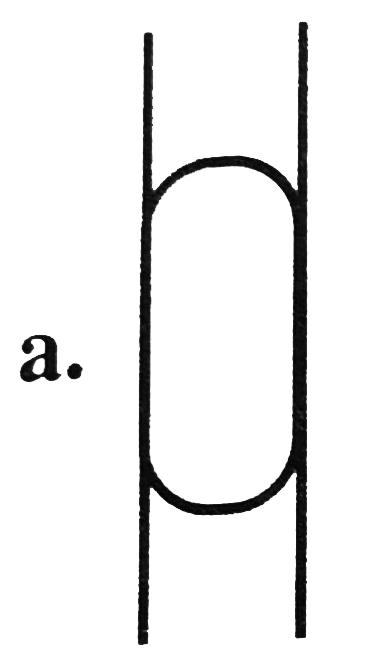
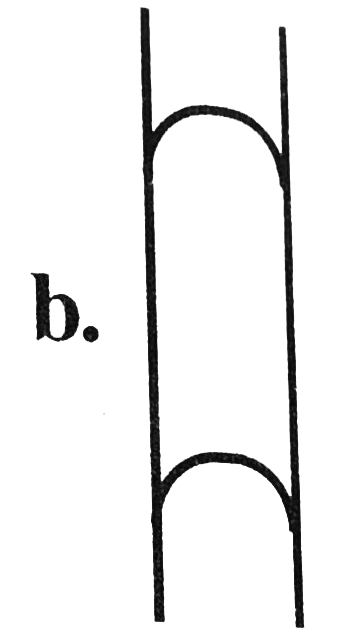
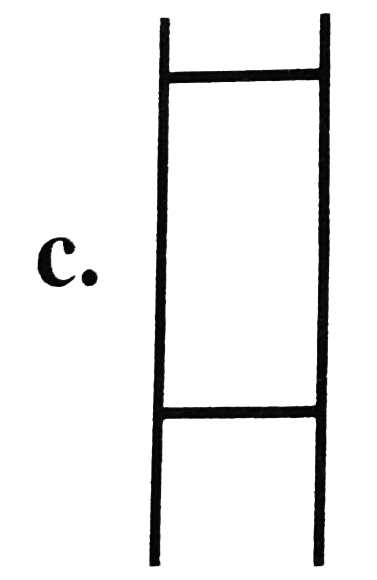
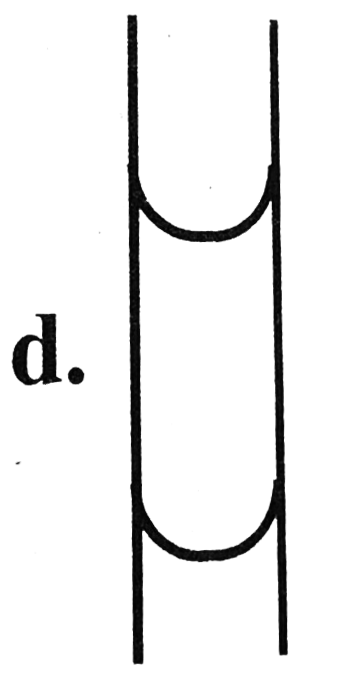
A vertical glass capillary tube, open at both ends, contains some water. Which of the following shapes may not be taken by the water -in the tube?

A

B

C

D

Text Solution

AI Generated Solution

The correct Answer is:

To determine which shape may not be taken by the water in a vertical glass capillary tube that is open at both ends, we need to consider the forces acting on the water and the nature of surface tension. ### Step-by-step Solution: 1. **Understanding the Setup**: - We have a vertical glass capillary tube that is open at both ends and contains water. - The forces acting on the water are gravitational force (weight of the water, \( mg \)) acting downwards and surface tension acting upwards at the water's surface. 2. **Analyzing the Forces**: - The gravitational force pulls the water downwards, while surface tension tends to pull the water upwards. - For the water to remain in the tube, these forces must be balanced. 3. **Identifying Possible Shapes**: - The water can take various shapes depending on the balance of these forces. - Common shapes include a flat surface, a concave meniscus (curving upwards), or a convex meniscus (curving downwards). 4. **Considering the Shapes**: - **Flat Surface**: This is possible as the forces can balance out. - **Concave Meniscus**: This shape is typical in capillary action due to surface tension being stronger than the weight of the water. - **Convex Meniscus**: This shape is generally not possible in a vertical tube open at both ends because the weight of the water would dominate over surface tension, causing the water to fall rather than form a convex shape. 5. **Conclusion**: - Therefore, the shape that may not be taken by the water in the tube is the **convex meniscus**. ### Final Answer: The shape that may not be taken by the water in the vertical glass capillary tube is a **convex meniscus**. ---

To determine which shape may not be taken by the water in a vertical glass capillary tube that is open at both ends, we need to consider the forces acting on the water and the nature of surface tension. ### Step-by-step Solution: 1. **Understanding the Setup**: - We have a vertical glass capillary tube that is open at both ends and contains water. - The forces acting on the water are gravitational force (weight of the water, \( mg \)) acting downwards and surface tension acting upwards at the water's surface. ...
Promotional Banner

Topper's Solved these Questions

  • PROPERTIES OF SOLIDS AND FLUIDS

    CENGAGE PHYSICS ENGLISH|Exercise Assertion- Reasoning|13 Videos
  • PROPERTIES OF SOLIDS AND FLUIDS

    CENGAGE PHYSICS ENGLISH|Exercise Linked Comprehension|30 Videos
  • PROPERTIES OF SOLIDS AND FLUIDS

    CENGAGE PHYSICS ENGLISH|Exercise Single Correct|112 Videos
  • NEWTON'S LAWS OF MOTION 2

    CENGAGE PHYSICS ENGLISH|Exercise Integer type|1 Videos
  • RIGID BODY DYNAMICS 1

    CENGAGE PHYSICS ENGLISH|Exercise Integer|11 Videos

Similar Questions

Explore conceptually related problems

A long horizontal glass capillary tube open at both ends contains a mercury thread 1 m long at 0^@C . Find the length of the mercury thread, as read on this scale, at 100^@C .

A U-shaped tube open to the air at both ends contains some mercury. A quantity of water is carefully poured into the left arm of the U-shaped tube until the vertical height of the water column is 15.0 cm . (a) What is the gauge pressure at the water mercury interface ? (b) Calculate the vertical distance h from the top of the mercury in the right hand arm of the tube to the top of the water in the left-hand arm. .

A glass capillary tube of inner diameter 0.28 mm is lowered vertically into water in a vessel. The pressure to be applied on the water in the capillary tube so that water level in the tube is same as the vessel in (N)/(m^(2)) is (surface tension of water =0.07(N)/(m) atmospheric pressure =10^(5)(N)/(m^(2))

A capillary tube (A) is dipped in water. Another identical tube (B) is dipped in a soap-water solution. Which of the following shows the relative nature of the liquid columns in the two tubes?

A capillary tube (A) is dipped in water. Another identical tube (B) is dipped in a soap-water solution. Which of the following shows the relative nature of the liquid columns in the two tubes?

A uniform capillary tube of inner radius r is dipped vertically into a beaker filled with water. The water rises to a height h in the capillary tube above the water surface in the beaker. The surface tension of water is sigma . The angle of contact between water and the wall of the capillary tube is theta . Ignore the mass of water in the meniscus. Which of the following statements is (are) true?

Two narrow bores of diameters 3.0mm and 6.0 mm are joined together to form a U-shaped tube open at both ends. If th U-tube contains water, what is the difference in its levels in the two limbs of the tube? Surface tension of water at the temperature of the experiment is 7.3xx10^(-2)Nm^(-1) . Take the angle of contact to be zero. and density of water to be 1.0xx10^(3)kg//m^(3) . (g=9.8 ms^(-2))

Two narrow bores of diameters 3.0mm and 6.0 mm are joined together to form a U-shaped tube open at both ends. If th U-tube contains water, what is the difference in its levels in the two limbs of the tube? Surface tension of water at the temperature of the experiment is 7.3xx10^(-2)Nm^(-1) . Take the angle of contact to be zero. and density of water to be 1.0xx10^(3)kg//m^(3) . (g=9.8 ms^(-2))

Water rises in a capillary tube to a height 4 cm. If the tube is inclined at an angle of 45^(@) with the vertical , find the position of the water in the tube.

A capillary tube is dipped in water to a depth and the water rises to a height h( lt l) in the capillary tube. The lower end of the tube is closed in water by putting a lower over it. The tube is now taken out and the thumb is removed from the lower end and it kept open. The length of liquid column in the tube will be
