Home
Class 11
PHYSICS
A heavy block of mass 150 kg hangs with ...

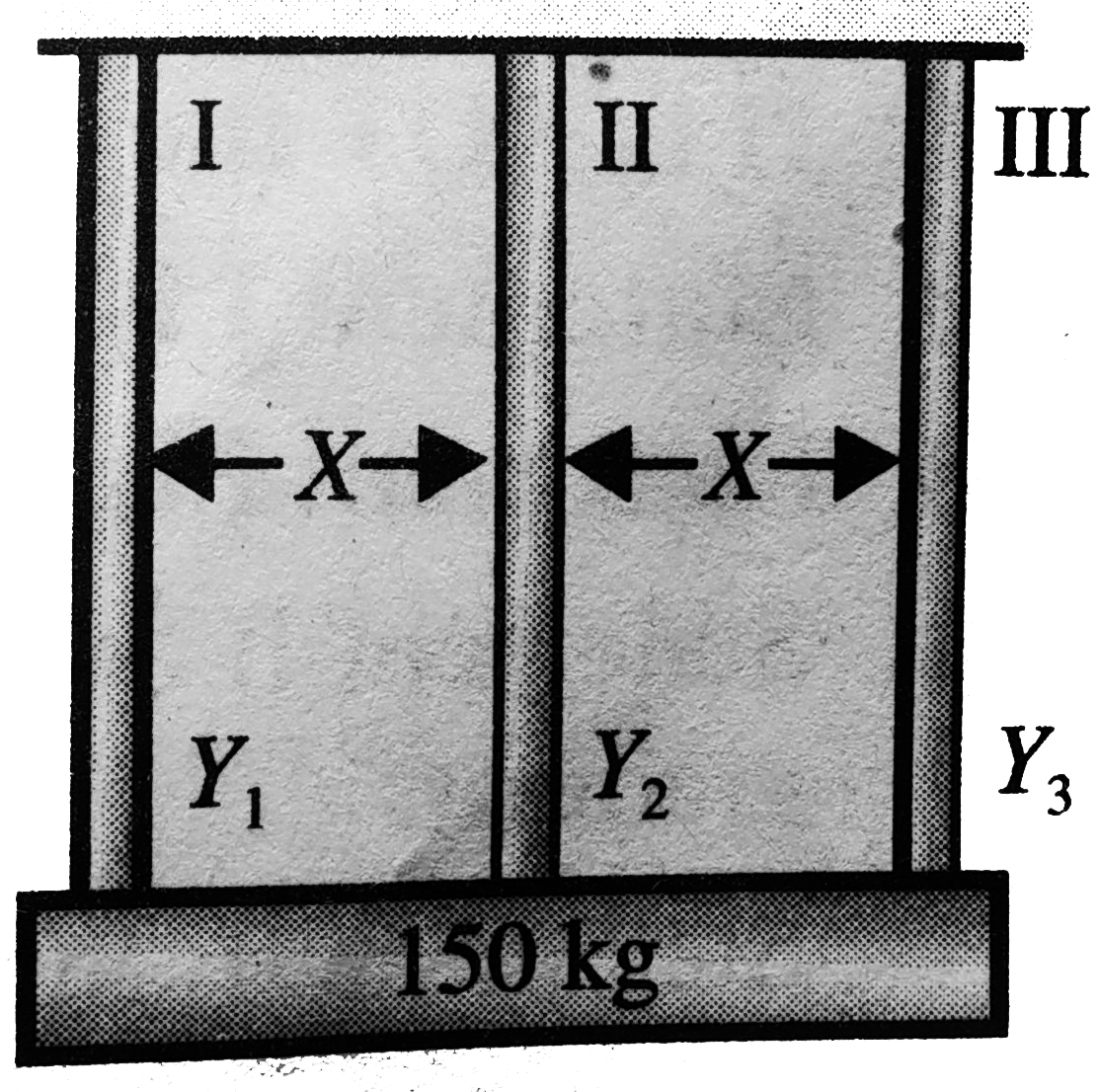
A heavy block of mass `150 kg` hangs with the help of three vertical wires of equal length and equal cross-sectional area as shown in Fig.
Wire is attached to the mid-point (centre of mass) of block. Take `Y_(2) = 2Y_(1)`. For this arrangement mark out the correct statement(s).

A

The wire I and III should have same Young's modulus.

B

Tension in I and III would be always equal.

C

Tension in I and III would be different.

D

Tension in II is `75g`

Text Solution

Verified by Experts

The correct Answer is:

A, B, D

Here for all three wires length `l`, elongaton `/_\l` and cross sectioinal area `A` are the same. From
`Y="Stress"/"Strain"=(T//A)/(/_\l//l)`
`rarr TpropY`
Let `T_(1), T_(2)` and `T_(3)` be tension in thre wires I, II and III, respectively.
For vertical eqilibrium
`T_(1)xxT_(2)+T_(3)=150g`
For rotation equilibrium
`T_(1)xx x-T_(3)x=0`
`impliesT_(1)=T_(3)` so `Y_(1)=Y_(3)`
`implies(T_(2))/(T_(1))=(T_(2))/(Y_(1))=2`
`implies T_(2)=2T_(1)`
so `2T_(1)+T_(2)=150g`
`impliesT_(2)=75g`
Promotional Banner

Topper's Solved these Questions

  • PROPERTIES OF SOLIDS AND FLUIDS

    CENGAGE PHYSICS ENGLISH|Exercise Assertion- Reasoning|13 Videos
  • PROPERTIES OF SOLIDS AND FLUIDS

    CENGAGE PHYSICS ENGLISH|Exercise Linked Comprehension|30 Videos
  • PROPERTIES OF SOLIDS AND FLUIDS

    CENGAGE PHYSICS ENGLISH|Exercise Single Correct|112 Videos
  • NEWTON'S LAWS OF MOTION 2

    CENGAGE PHYSICS ENGLISH|Exercise Integer type|1 Videos
  • RIGID BODY DYNAMICS 1

    CENGAGE PHYSICS ENGLISH|Exercise Integer|11 Videos

Similar Questions

Explore conceptually related problems

Two wires of equal length and cross-section area suspended as shown in figure. Their Young's modulus are Y_(1) and Y_(2) respectively. The equavalent Young's modulus will be

Three rods of uniform area of cross section A =10^(-7)m^(2) are arranged as shown in Fig. Find out the shift in point B, C and D .

A heavy plank of mass 100 kg hangs on three vertical wires of equal length arranged symmetrically (see figure). All the wires have the same cross - section. The middle wire is of steel and the other two are of copper . The modulus of elasticity of steel is assumed to be double that copper. Determine the tensions in the wire. (use g=9.8ms^-2 )

A block of mass M is suspended from a wire of length L, area of cross-section A and Young's modulus Y. The elastic potential energy stored in the wire is

A homogeneous block with a mass m hangs on three vertical wires of equal length arranged symmetrically . Find the tensions of the wires if the middle wire is of steel and the other two are of copper . All the wires have the same cross - section . Consider the modulus of elasticity of steel to be double than that of copper .

Two blocks of masses 1 kg and 2 kg are suspended with the help of two wires having same area of cross section. If the ratio of Young's moduli i.e., Y_(1):Y_(2)=1:2 , then the ratio of extensions produced in wires is

A cylindrical vessel of a very large cross sectional area is containing two immiscible liquids of density rho_(1)=600kg//m^(3) and rho_(2)=1200kg//m^(3) as shown in the figure. A small hole having cross sectional area 5cm^(2) is made in right side vertical wall as shown. Take atmospheric pressure as p_(0)=10^(5)N//m^(2), g=10m//s^(2) . For this situation mark out the correct statement (s). Take cross sectional area of the cylindrical vessel as 1000cm^(2) . Neglect the mass of the vessel.

A metal wire of length L_1 and area of cross section A is attached to a rigid support. Another metal wire of length L_2 and of the same cross sectional area is attached to the free end of the first wire. A body of mass M is then suspended from the free end of the second wire, if Y_1 and Y_2 are the Young's moduli of the wires respectively the effective force constant of the system of two wires is

A metal wire of length L_1 and area of cross section A is ttached to a rigid support. Another metal wire of length L_2 and of the same cross sectional area is attached to the free end of the first wire. A body of mass M is then suspended from the free end of the second wire, if Y_1 and Y_2 are the Young's moduli of the wires respectively the effective force constant of the system of two wires is

One end of a Nichrome wire of length 2L and cross-sectional area A is attached to an end of another Nichrome wire of length L and cross-sectional area 2A . If the free end of the longer wire is at an electric potential of 8.0 volts, and the free end of the shorter wire is at an electric potential 1.0 volts, the potential at the junction of the two wires is equal to
