Home
Class 11
PHYSICS
On gradual loading , stress - strain rel...

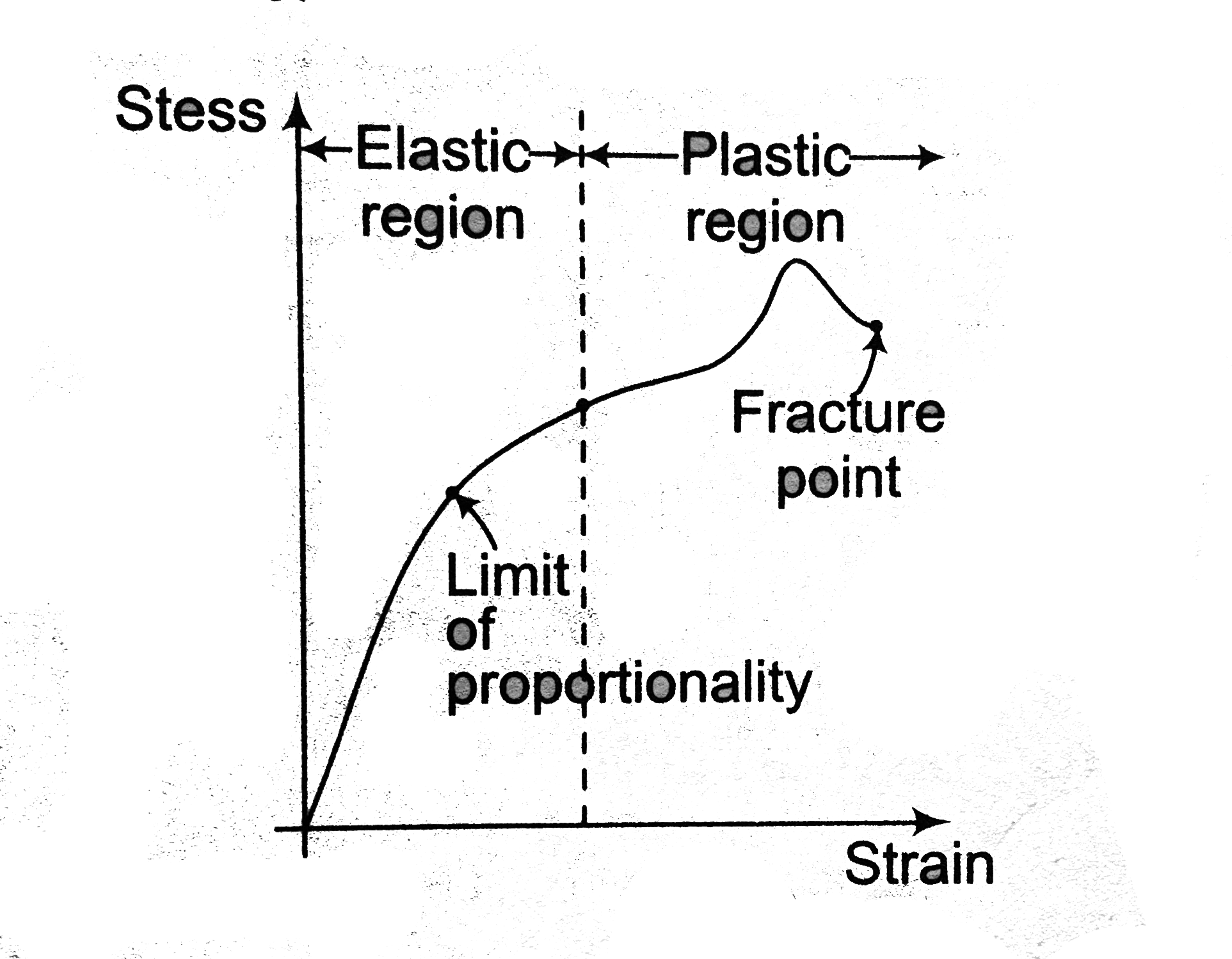
On gradual loading , stress - strain relationship for a metal wire is as follows . Within proportionality limit , stress proportional to strain or, `"Stress"/"strain"` = a constant for the material of wire.
Just on crossing the yield region, the material will have

A

reduced stress

B

increased stress

C

breaking stress

D

constant stress

Text Solution

Verified by Experts

The correct Answer is:

A, C

On crossing the yield region, the material will experience the breaking stress and further elongation causes reduction in stress and break of the wire. So,options a and c are correct.
Promotional Banner

Topper's Solved these Questions

  • PROPERTIES OF SOLIDS AND FLUIDS

    CENGAGE PHYSICS ENGLISH|Exercise Integer|6 Videos
  • PROPERTIES OF SOLIDS AND FLUIDS

    CENGAGE PHYSICS ENGLISH|Exercise Fill In The Blanks|1 Videos
  • PROPERTIES OF SOLIDS AND FLUIDS

    CENGAGE PHYSICS ENGLISH|Exercise Assertion- Reasoning|13 Videos
  • NEWTON'S LAWS OF MOTION 2

    CENGAGE PHYSICS ENGLISH|Exercise Integer type|1 Videos
  • RIGID BODY DYNAMICS 1

    CENGAGE PHYSICS ENGLISH|Exercise Integer|11 Videos

Similar Questions

Explore conceptually related problems

On gradual loading , stress - strain relationship for a metal wire is as follows . Within proportionality limit , stress prop strain or, "Stress"/"strain" = a constant for the material of wire. Just on crossing the yield region, the material will have

On gradual loading , stress - strain relationship for a metal wire is as follows . Within proportionality limit , stress prop strain or, "Stress"/"strain" = a constant for the material of wire. If "Stress"/"Strain" is x in elastic region and y in the region of yield , then

On gradual loading , stress - strain relationship for a metal wire is as follows . Within proportionality limit , stress prop strain or, "Stress"/"strain" = a constant for the material of wire. Two wires of same material have length and radius (L,r) and (2L , r/2) . The ratio of their young's modulii is

Within the elastic limit, stress is directly proportional to strain produced in a body is the statement of

Figure shows the relationship between tensile stress and strain for a typical material. Below proportional point A, stress is directly proportional to strain which means Young's moudulus (Y) is a constant. In this region the material obeys Hooke's law. Provided the strain is below the yield point 'B' the material returns to its original shape and size when the force is removed. Beyond the yield point, the material retains a permancnt deformation after the stress is removed. For stresses beyond the yeld point, the material exhibit plastic flow, which means that it continues to elongate for little increases in the stress. Beyond C a local constriction occurs. The material fractures at D (i.e. breaking point). The graph below shows the stress-strain curve for 4 different materials. Material which is good for making wires by stretching is

Figure shows the relationship between tensile stress and strain for a typical material. Below proportional point A, stress is directly proportional to strain which means Young's moudulus (Y) is a constant. In this region the material obeys Hooke's law. Provided the strain is below the yield point 'B' the material returns to its original shape and size when the force is removed. Beyond the yield point, the material retains a permancnt deformation after the stress is removed. For stresses beyond the yeld point, the material exhibit plastic flow, which means that it continues to elongate for little increases in the stress. Beyond C a local constriction occurs. The material fractures at D (i.e. breaking point). The graph below shows the stress-strain curve for 4 different materials. If you bough a new shoe which bites in the beginning and later on fits perfectly, then the material used to making the shoe is

Figure shows the relationship between tensile stress and strain for a typical material. Below proportional point A, stress is directly proportional to strain which means Young's moudulus (Y) is a constant. In this region the material obeys Hooke's law. Provided the strain is below the yield point 'B' the material returns to its original shape and size when the force is removed. Beyond the yield point, the material retains a permancnt deformation after the stress is removed. For stresses beyond the yeld point, the material exhibit plastic flow, which means that it continues to elongate for little increases in the stress. Beyond C a local constriction occurs. The material fractures at D (i.e. breaking point). The graph below shows the stress-strain curve for 4 different materials. If you bough a new shoe which bites in the beginning and later on fits perfectly, then the material used to making the shoe is

Figure shows the relationship between tensile stress and strain for a typical material. Below proportional point A, stress is directly proportional to strain which means Young's moudulus (Y) is a constant. In this region the material obeys Hooke's law. Provided the strain is below the yield point 'B' the material returns to its original shape and size when the force is removed. Beyond the yield point, the material retains a permancnt deformation after the stress is removed. For stresses beyond the yeld point, the material exhibit plastic flow, which means that it continues to elongate for little increases in the stress. Beyond C a local constriction occurs. The material fractures at D (i.e. breaking point). The graph below shows the stress-strain curve for 4 different materials. If you bough a new shoe which bites in the beginning and later on fits perfectly, then the material used to making the shoe is

The stress- strain graphs for materials A and B are as shown. Choose the correct alternative

Fig., shows the stress-strain curve for a given materal. What are (a) Young's modulus and (b) approximate yield strength for this material?

CENGAGE PHYSICS ENGLISH-PROPERTIES OF SOLIDS AND FLUIDS-Linked Comprehension
  1. A steel wire of length 4.5 m and cross-sectional area 3 xx 10^(-5) m^(...

    Text Solution

    |

  2. A steel bolt of cross-sectional area A(b) = 5 xx 10^(-5) m^(2) is pass...

    Text Solution

    |

  3. On gradual loading , stress - strain relationship for a metal wire is ...

    Text Solution

    |

  4. On gradual loading , stress - strain relationship for a metal wire is ...

    Text Solution

    |

  5. According to Hooke's law, within the elastic limit stress/strain = con...

    Text Solution

    |

  6. Molecular forces exist between the molecules of a liquid in a containe...

    Text Solution

    |

  7. Molecular forces exist between the molecules of a liquid in a containe...

    Text Solution

    |

  8. Molecular forces exist between the molecules of a liquid in a containe...

    Text Solution

    |

  9. Materials get deformed when force is applied. Some of them regain thei...

    Text Solution

    |

  10. Materials get deformed when force is applied. Some of them regain thei...

    Text Solution

    |

  11. Materials get deformed when force is applied. Some of them regain thei...

    Text Solution

    |

  12. Figure shows a capillary tube of radius r dipped into water. If the a...

    Text Solution

    |

  13. Figure shows a capillary tube of radius r dipped into The atmospheric ...

    Text Solution

    |

  14. Figure shows a capillary tube of radius r dipped into water. If the a...

    Text Solution

    |

  15. In the figure shown, A and B are two short steel rods each of cross-se...

    Text Solution

    |

  16. In the figure shown, A and B are two short steel rods each of cross-se...

    Text Solution

    |

  17. In the figure shown, A and B are two short steel rods each of cross-se...

    Text Solution

    |

  18. Two opposite forcesF(1) = 120 N and F(2) = 80 N act on an elastic plan...

    Text Solution

    |

  19. A ring of radius r made of wire of density rho is rotated about a stat...

    Text Solution

    |

  20. The weight of a body at earth's surface is W. At a depth half way to t...

    Text Solution

    |
