Refer to figure, force of attraction on body at `C` due to body at `A` is
`F_(1)=(Gmm)/(r^(2))=(Gm^(2))/(r^(2))` along `CA`
Force of attraction on body at `C` due to body at `B` is
`F_(2)=(Gmm)/(r^(2))=(Gm^(2))/(r^(2))` along `CB`.
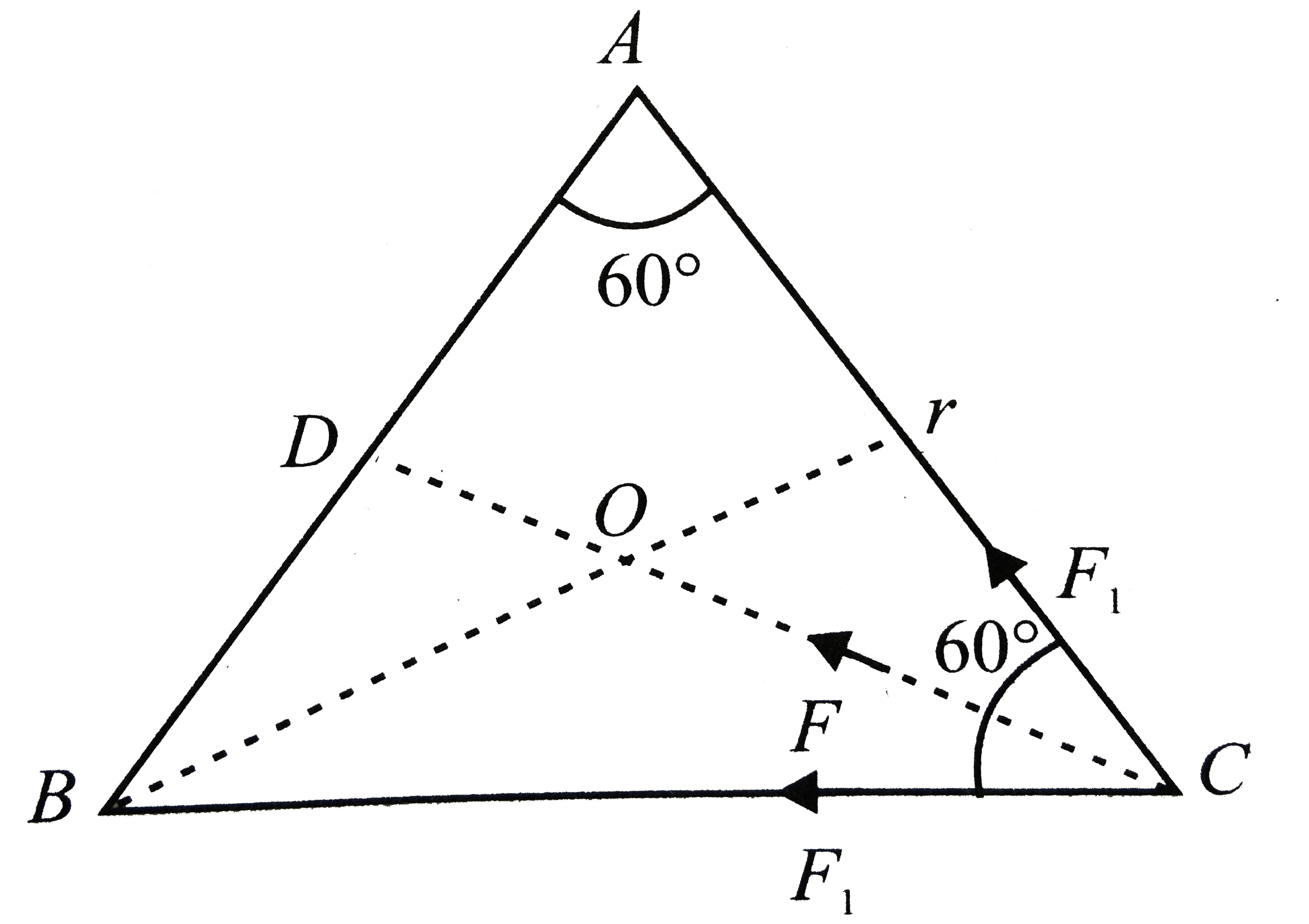
These force `vecF_(1)` and `vecF_(2)` are inclined at an angle `60^@`. the resultant force on the body at `C` is
`F=sqrt(F_(1)^(2)+F_(2)^(2)+2F_(1)F_(2)cos60^@)`
`=sqrt(F_(1)^(2)+F_(2)^(2)+2F_(1)F_(2)(1/2))`
`sqrt(3)F_(1)=sqrt(3)(Gm^(2))/(r^(2))` acting along CD
`:'F_(1)=F_(2)=[(Gm^(2))/(r^(2))]`
Here `OC=2/3 C=2/3ACsin60^@`
`=2/3rxx(sqrt(3))/2=r/(sqrt(3))`
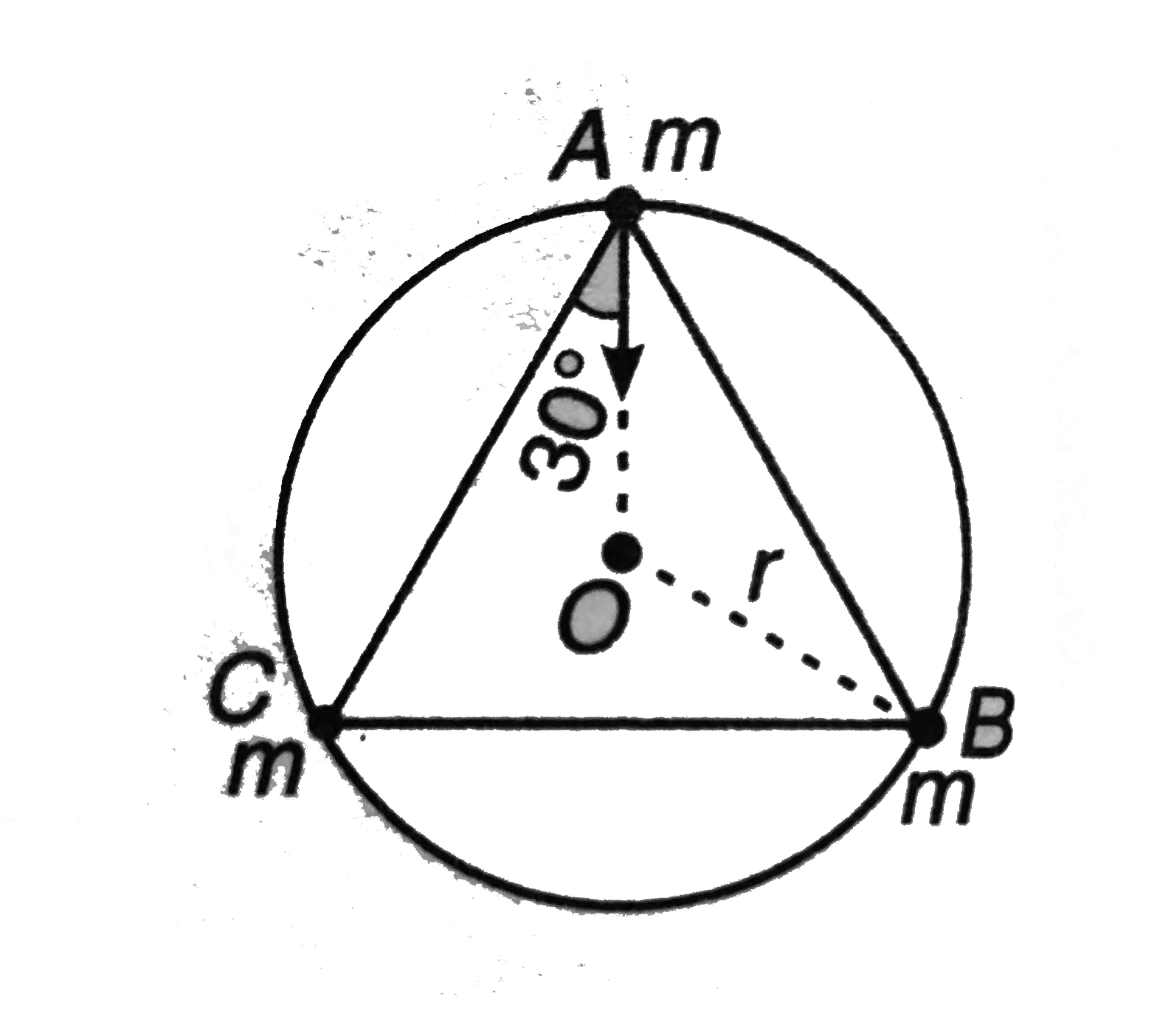
When each body is describing a circular orbit with cenre of orbit at `O`, the force `F` provides the required centripetal force. The radius of the circular orbit is `OC=r//sqrt(3)`. If `v` is the speed of the body in circular orbit, then
`(Mv^(2))/(r//sqrt(3))=(sqrt(3)Gm^(2))/(r^(2))` or `v=sqrt((Gm)/r)`
 .
.

