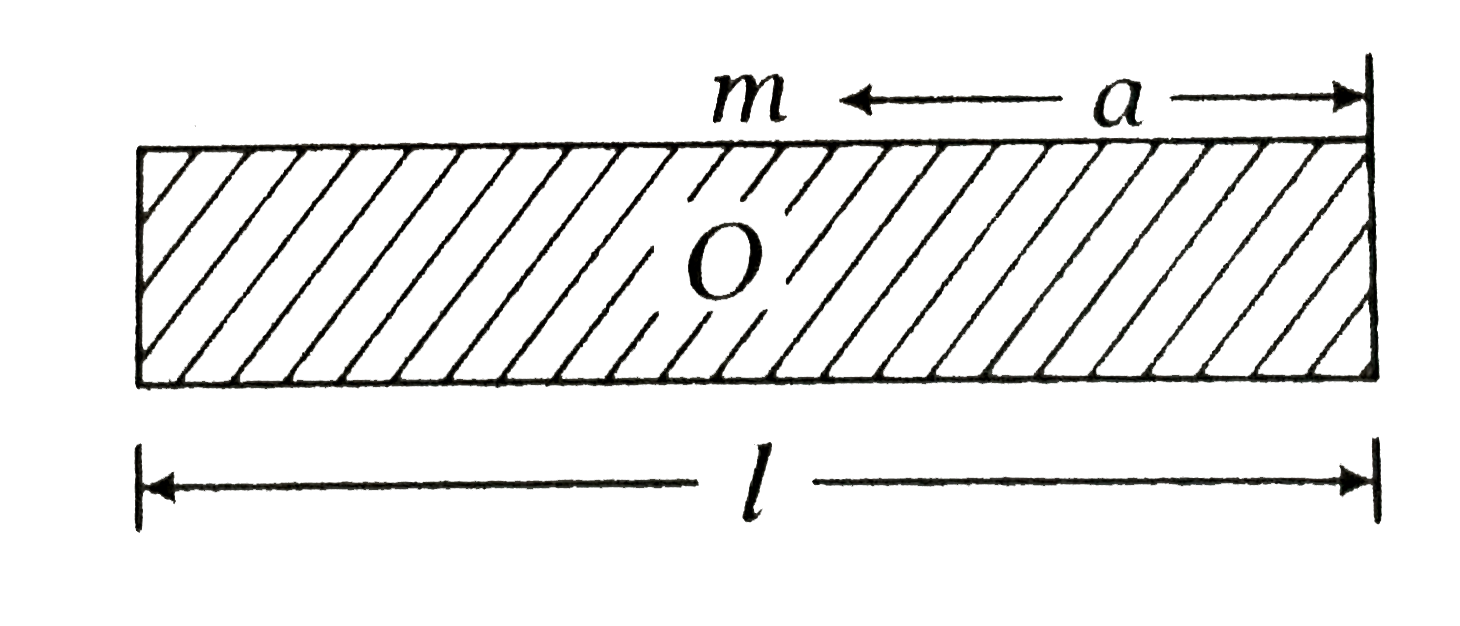
A mass `m` is at a distance a from centre of a uniform rod of length `l` and M. The gravitational force on the mass due to the rod is
Text Solution
Verified by Experts
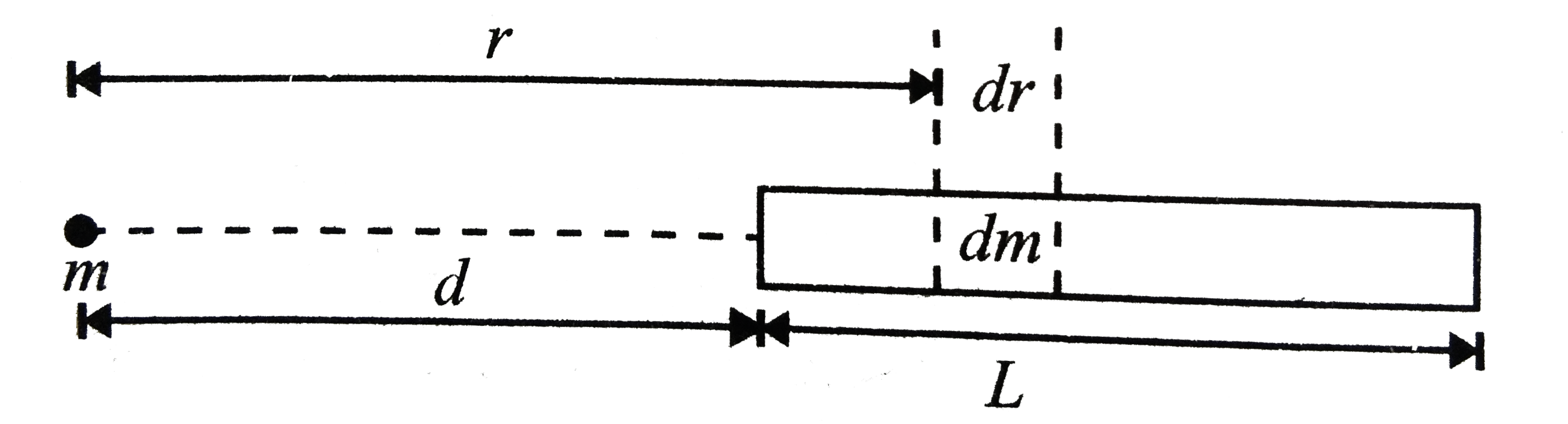
As m is a point mass, consider an element on the rod at distance `r` from `m` `dF=(G(m)(dm))/(r^(2))=(G(m)(M/L)dr)/(r^(2))` or `F=int_(d)^(L+d)(Gmm)/L 1/(r^(2))dr =(GMm)/L int_(d)^(L+d) 1/(r^(2)) dr=(GMm)/(d(L+d))`
A mass m is at a distance a from one end of a uniform rod of length l and mass M. Find the gravitational force on the mass due to the rod.
A mass m is at a distance a from one end of a uniform rod of length l and mass M. Find the gravitational force on the mass due to tke rod.
A uniform ring of mas m and radius a is placed directly above a uniform sphere of mass M and of equal radius. The centre of the ring is at a distance sqrt3 a from the centre of the sphere. Find the gravitational force exerted by the sphere on the ring.
A uniform ring of mas m and radius a is placed directly above a uniform sphere of mass M and of equal radius. The centre of the ring is at a distance sqrt3 a from the centre of the sphere. Find the gravitational force exerted by the sphere on the ring.
(a) A uniform rod of mass M and length L is placed at distance L from a point mass m as shown. Find force on m (b) A semiconductor wire has a length L and mass M . A particle of mass m is placed at the centre of the circle. find the gravitational attraction on the particle due to the wire.
A particle of mass m is situated at a distance d from one end of a rod of mass M and length L as shown in diagram. Find the magnitude of the gravitational force between them
A semicircular wire has a length L and mass M. A particle of mass m is placed at the centre of the circle. Find the gravitational attraction on the particle due to the wire.
A semicircular wire hs a length L and mass M. A paricle of mass m is placed at the centre of the circle. Find the gravitational attraction on the particle due to the wire.
A uniform rod of mass M and length a lies on a smooth horizontal plane. A particle of mass m moving at a speed v perpendicular to the length of the rod strikes it at a distance a/4 from the centre and stops after the collision. Find a. the velocity of the cente of the rod and b. the angular velocity of the rod abut its centre just after the collision.
The radius of gyration of a uniform rod of length L about an axis passing through its centre of mass is