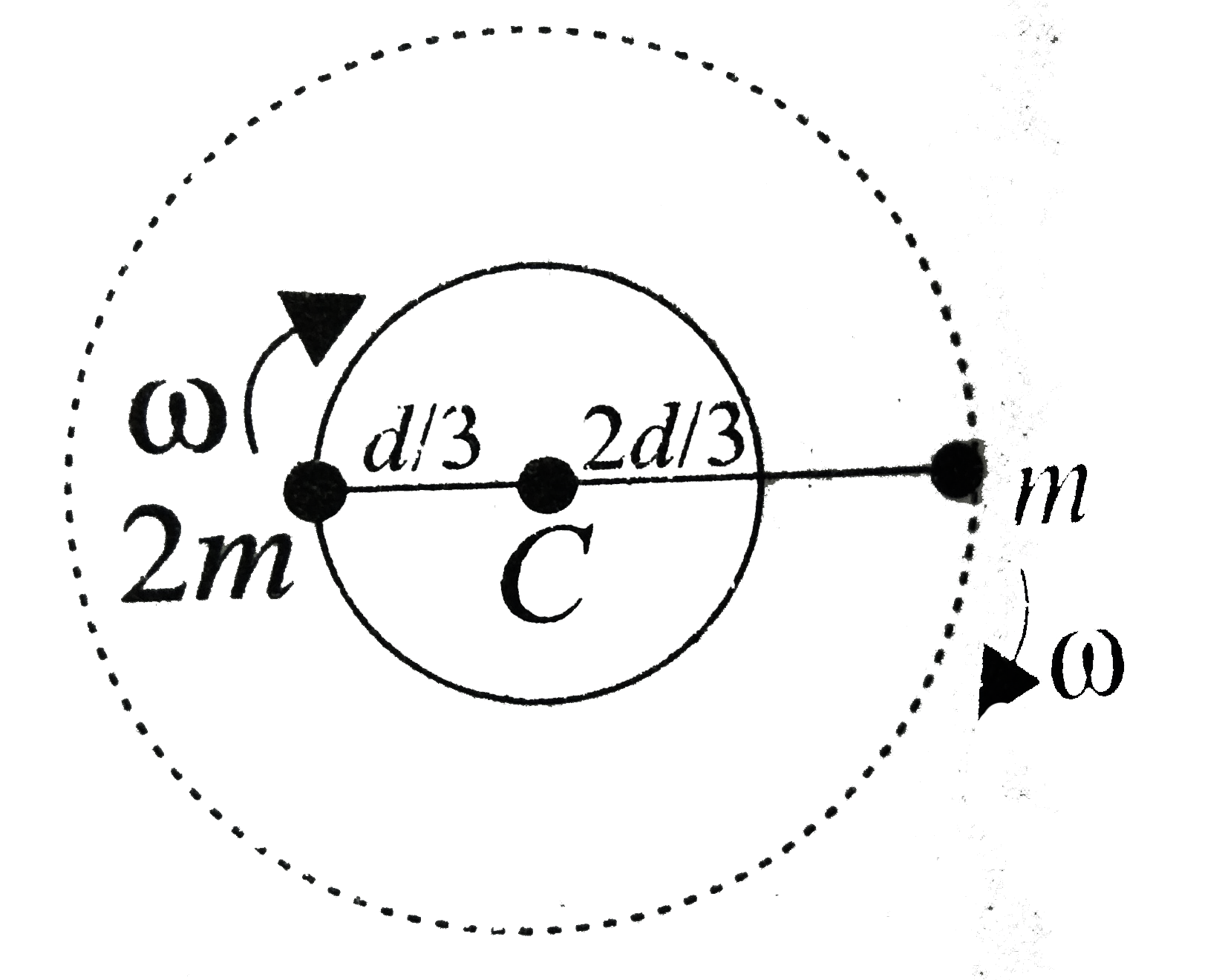
The centre of mass `C` will be at distance `d//3` and `2d//3` from masses `2m` and `m`, respectively. Both the stars rotate round `C` in their respective orbits with the same angular velocity `omega`. The gravitational force acting on each star due to the other supplies the necessary centripetal force.
The gravitational force on either star is `G(2m)m//(d^(2))`. If We consider the rotation of the smaller star, the centripetal force
`(mromega^(2)) is [m(2d//3)omega^(2)]` and `[(2mdomega^(2)//3)]` for the bigger star, i.e., the same.
`:. (G(2m)m)/(d^(2))=m((2d)/3) omega^(2)` or `omega= sqrt(((3Gm)/(d^(3))))`
Therefore, the period of revolution is given by
`T=(2pi)/omega=2pisqrt(((d^(3))/(3GMm)))`
The ratio of angular momenta is
`((Iomega)_("big)"))/((Iomega)_("small"))=I_("big")/I_("small")=((2m)(d/3)^(2))/(m((2d)/3)^(2))=1/2`
Since `omega` is the same for both.
The ratio of their kinetic energies is
`((1/2Iomega^(2))_("big"))/((1/Iomega^(2))_("small"))=I_("big")/I_("small")=1/2`
which is the same as the ratio of their angular momenta.