Home
Class 11
PHYSICS
Four particles, each of mass M, move alo...

Four particles, each of mass M, move along a circle of radius R under the action of their mutual gravitational attraction. The speed of each particle is

A

`(GM)/R`

B

`sqrt(2sqrt(2)(GM)/R)`

C

`sqrt((GM)/R(2sqrt(2)+1))`

D

`sqrt((GM)/R((2sqrt(2)+1)/4))`

Text Solution

Verified by Experts

The correct Answer is:
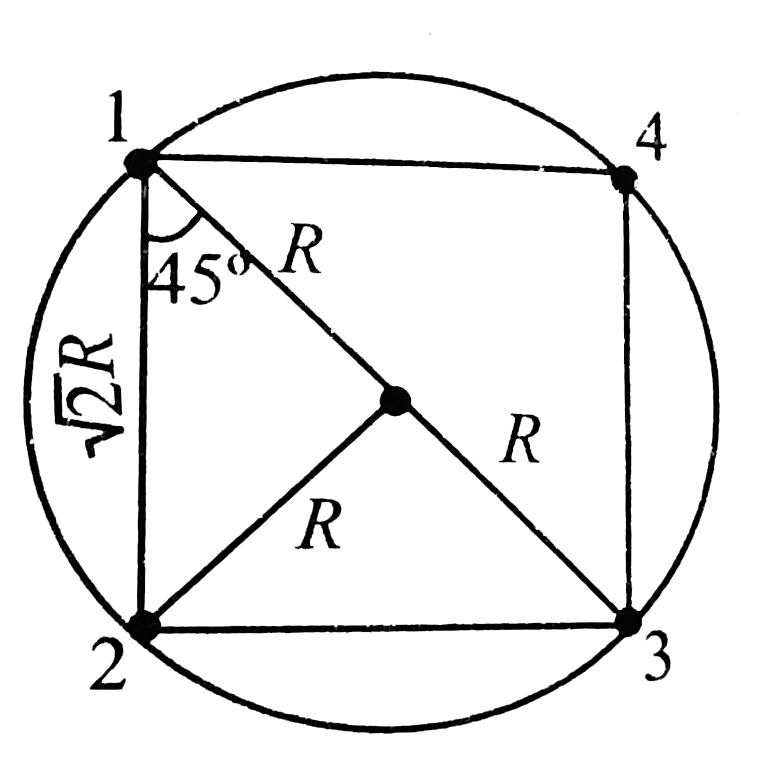
D

`F_(12)=(GM^(2))/(2R^(2))`
`F_(14)=(GM^(2))/(2R^(2))`

The resultant of these two forces is `(sqrt(2)GM^(2))//2R^(2))`. Now `F_(12)(GM^(2))//(4R^(2))`.
The combined resultant of all the forces is
`(sqrt(2)GM^(2))/(2R^(2))+(GM^(2))/(4R^(2))` or `(GM^(2))/(4R^(2)) [(sqrt(2))/2+1/4]`
Equating this with centripetal force, we get
`(Mv^(2))/R=(GM^(2))/R[(2sqrt(2)+1)/4]`
or `v^(2)=(GM)/R[(2sqrt(2)+1)/4]` or `v=sqrt((GM)/R((2sqrt(2)+1)/4))`
Promotional Banner

Topper's Solved these Questions

  • GRAVITATION

    CENGAGE PHYSICS ENGLISH|Exercise Multiple Correct|24 Videos
  • GRAVITATION

    CENGAGE PHYSICS ENGLISH|Exercise Assertion- Reasoning|13 Videos
  • GRAVITATION

    CENGAGE PHYSICS ENGLISH|Exercise Subjective|15 Videos
  • FLUID MECHANICS

    CENGAGE PHYSICS ENGLISH|Exercise INTEGER_TYPE|1 Videos
  • KINEMATICS-1

    CENGAGE PHYSICS ENGLISH|Exercise Integer|9 Videos

Similar Questions

Explore conceptually related problems

Four particles of equal masses M move along a circle of radius R under the action of their mutual gravitational attraction. Find the speed of each particle.

Two particles of equal mass go around a circle of radius R under the action of their mutual gravitational attraction. The speed v of each particle is

Two particles of equal masses m go round a circle of radius R under the action of their mutual gravitational attraction. The speed of each particle is v=sqrt((Gm)/(nR)) . Find the value of n.

Two particles of equal mass go round a circle of radius R under the action of their mutual gravitational attraction. Find the speed of each particle.

Four particles, each of mass M and equidistant from each other, move along a circle of radius R under the action of their mutual gravitational attraction. The speed of each particle is:

Four particles, each of mass M and equidistant from each other, move along a circle of radius R under the action of their mutual gravitational attraction. The speed of each particle is:

Four particles, each of mass M and equidistant from each other, move along a circle of radius R under the action of their mutual gravitational attraction. The speed of each particle is:

Two particles of equal mass (m) each move in a circle of radius (r) under the action of their mutual gravitational attraction find the speed of each particle.

Three particles of equal mass M each are moving on a circular path with radius r under their mutual gravitational attraction. The speed of each particle is

Four particles of equal mass are moving round a circle of radius r due to their mutual gravitational attraction . Find the angular velocity of each particle .

CENGAGE PHYSICS ENGLISH-GRAVITATION-Single Correct
  1. Consider two solid uniform spherical objects of the same density rho. ...

    Text Solution

    |

  2. A body starts from rest from a point distant r(0) from the centre of t...

    Text Solution

    |

  3. Four particles, each of mass M, move along a circle of radius R under ...

    Text Solution

    |

  4. The mass of the earth is 81 times the mass of the Moon and the distanc...

    Text Solution

    |

  5. Three equal masses m are placed at the three corners of an equilateral...

    Text Solution

    |

  6. Suppose the gravitational force varies inversely as the n^(th) power o...

    Text Solution

    |

  7. Two astronauts have deserted their spaceship in a region of space far ...

    Text Solution

    |

  8. A satellite of mass m revolves around the earth of radius R at a heigh...

    Text Solution

    |

  9. A projectile is fired from the surface of earth of radius R with a vel...

    Text Solution

    |

  10. An artificial satellite is moving in a circular orbit around the earth...

    Text Solution

    |

  11. Two concentric shells of masses M(1) and M(2) are having radii r(1) an...

    Text Solution

    |

  12. A satellite of mass m is circulating around the earth with constant an...

    Text Solution

    |

  13. Two concentric shells have masses M and m and their radii are R and r,...

    Text Solution

    |

  14. A solid sphere of uniform density and radius 4 units is located with i...

    Text Solution

    |

  15. Three equal masses m are placed at the three corners of an equilateral...

    Text Solution

    |

  16. Figure shows a planet in an elliptical orbit around the Sun S. Where i...

    Text Solution

    |

  17. The escape velocity corresponding to a planet of mass M and radius R i...

    Text Solution

    |

  18. A planet is revolving around the Sun in an elliptical orbit. Its close...

    Text Solution

    |

  19. The radii of two planets are respectively R1 and R2 and their densitie...

    Text Solution

    |

  20. Figure shows the motion of a planet around the Sun S in an elliptical ...

    Text Solution

    |

