Home
Class 11
PHYSICS
The orbit of Pluto is much more eccentri...

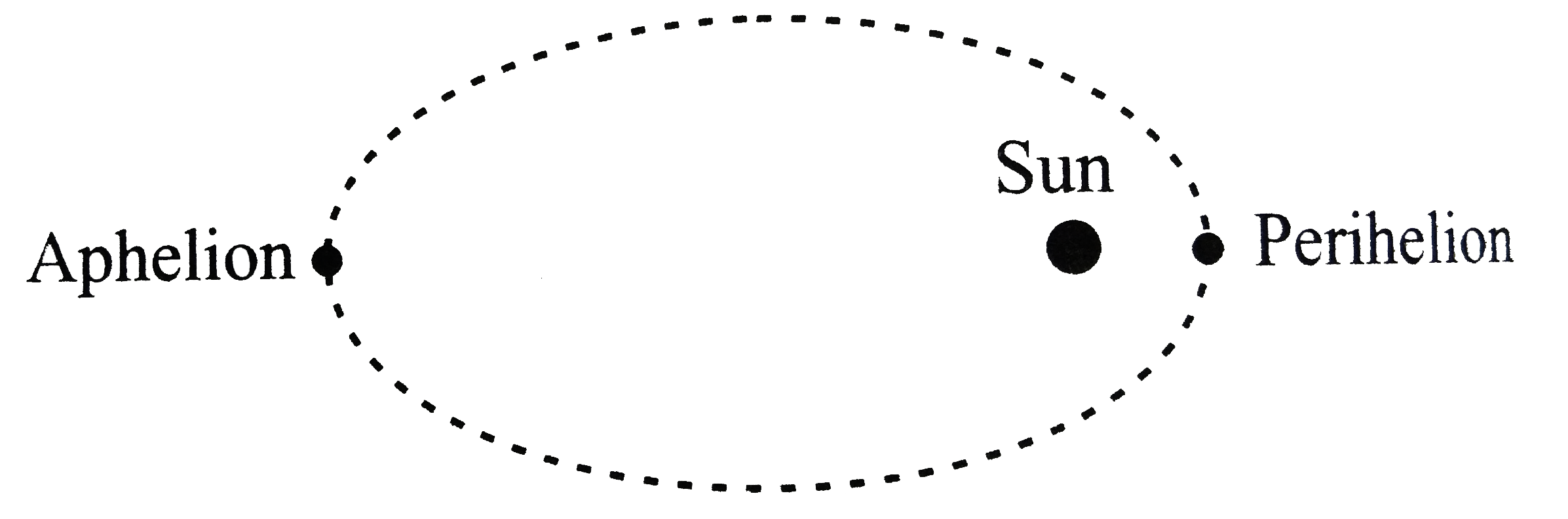
The orbit of Pluto is much more eccentric than the orbits of the other planets. That is, instead of being nearly circular, the orbit is noticeably elliptical. The point in the orbit nearest to the Sun is called the perihelion and the point farthest from the Sun is called the aphelion.

At perihelion, the mechanical energy of Pluto's orbit has

A

its maximum value

B

its minimum value

C

the same value at every other point in the orbit

D

the value which depends on the sense of rotation

Text Solution

Verified by Experts

The correct Answer is:

C

Total energy `=` constant.
Promotional Banner

Topper's Solved these Questions

  • GRAVITATION

    CENGAGE PHYSICS ENGLISH|Exercise Integer|5 Videos
  • GRAVITATION

    CENGAGE PHYSICS ENGLISH|Exercise Fill In The Blanks|5 Videos
  • GRAVITATION

    CENGAGE PHYSICS ENGLISH|Exercise Assertion- Reasoning|13 Videos
  • FLUID MECHANICS

    CENGAGE PHYSICS ENGLISH|Exercise INTEGER_TYPE|1 Videos
  • KINEMATICS-1

    CENGAGE PHYSICS ENGLISH|Exercise Integer|9 Videos

Similar Questions

Explore conceptually related problems

The orbit of Pluto is much more eccentric than the orbits of the other planets. That is, instead of being nearly circular, the orbit is noticeably elliptical. The point in the orbit nearest to the Sun is called the perihelion and the point farthest from the Sun is called the aphelion. At perihelion, the gravitational potential energy of Pluto in its orbit has

The orbit of Pluto is much more eccentric than the orbits of the other planets. That is, instead of being nearly circular, the orbit is noticeably elliptical. The point in the orbit nearest to the Sun is called the perihelion and the point farthest from the Sun is called the aphelion. As Pluto moves from the perihelion to the aphelion, the work done by gravitational pull of Sun on Pluto is

A planet is revolving in an elliptical orbit around the sun. Its closest distance from the sun is r and the farthest distance is R. If the velocity of the planet nearest to the sun be v and that farthest away from the sun be V. then v/V is

In the figure shown a planet moves in an elliptical orbit around the sun. Compare the speeds, linear and angular momenta at the points A and B .

A planet is moving round the sun in an elliptical orbit as shows. As the planet moves from A to B

A planet is revolving round the sun in an elliptical orbit, If v is the velocity of the planet when its position vector from the sun is r, then areal velocity of the planet is

A planet is revolving around the Sun in an elliptical orbit. Its closest distance from the Sun is r and farthest distance is R . If the orbital velocity of the planet closest to the Sun is v , then what is the velocity at the farthest point?

An artificial satellite is in an elliptical orbit around the earth with aphelion of 6R and perihelion of 2R where R is radius of the earth =6400 km . Calculate the eccentricity of the elliptical orbit.

A comet revolves around the sun in an eliptical orbit. When it is closest to the sun at a distance d, its corresponding kinetic energy is k_(0) . If it is farthest from the sun at distance 3d then the corresponding kinetic energy will be

A planet is revolving around the Sun in an elliptical orbit. Its closest distance from the sun is r_(min) . The farthest distance from the sun is r_(max) if the orbital angular velocity of the planet when it is nearest to the Sun omega then the orbital angular velocity at the point when it is at the farthest distance from the sun is

CENGAGE PHYSICS ENGLISH-GRAVITATION-Linked Comprehension
  1. The minimum and maximum distances of a satellite from the center of th...

    Text Solution

    |

  2. The orbit of Pluto is much more eccentric than the orbits of the other...

    Text Solution

    |

  3. The orbit of Pluto is much more eccentric than the orbits of the other...

    Text Solution

    |

  4. The orbit of Pluto is much more eccentric than the orbits of the other...

    Text Solution

    |

  5. A solid sphere of mass m and radius r is placed inside a hollow thin s...

    Text Solution

    |

  6. a solid sphere of mass m and radius r is placed inside a hollow thin s...

    Text Solution

    |

  7. A solid sphere of mass m and radius r is placed inside a hollow thin s...

    Text Solution

    |

  8. The gravitational field in a region is given by vecE=(5Nkg^-1)veci+(12...

    Text Solution

    |

  9. The gravitational field in a region is given by vecE=(5Nkg^-1)veci+(12...

    Text Solution

    |

  10. The gravitational field in a region is given by vecE=(5Nkg^-1)veci+(12...

    Text Solution

    |

  11. The gravitational field in a region is given by vecE=(5Nkg^-1)veci+(12...

    Text Solution

    |

  12. A uniform metal sphere of radius R and mass m is surrounded by a thin ...

    Text Solution

    |

  13. A uniform metal sphere of radius R and mass m is surrounded by a thin ...

    Text Solution

    |

  14. In the graph shown, the PE of earth-satellite system is shown by a sol...

    Text Solution

    |

  15. In the graph shown, the PE of earth-satellite system is shown by a sol...

    Text Solution

    |

  16. In the graph shown, the PE of earth-satellite system is shown by a sol...

    Text Solution

    |

  17. An unmanned satellite A and a spacecraft B are orbiting around the ear...

    Text Solution

    |

  18. An unmanned satellite A and a spacecraft B are orbiting around the ear...

    Text Solution

    |

  19. An unmanned satellite A and a spacecraft B are orbiting around the ear...

    Text Solution

    |

  20. An unmanned satellite A and a spacecraft B are orbiting around the ear...

    Text Solution

    |
