Home
Class 12
PHYSICS
Point charge are placed at the verticas ...

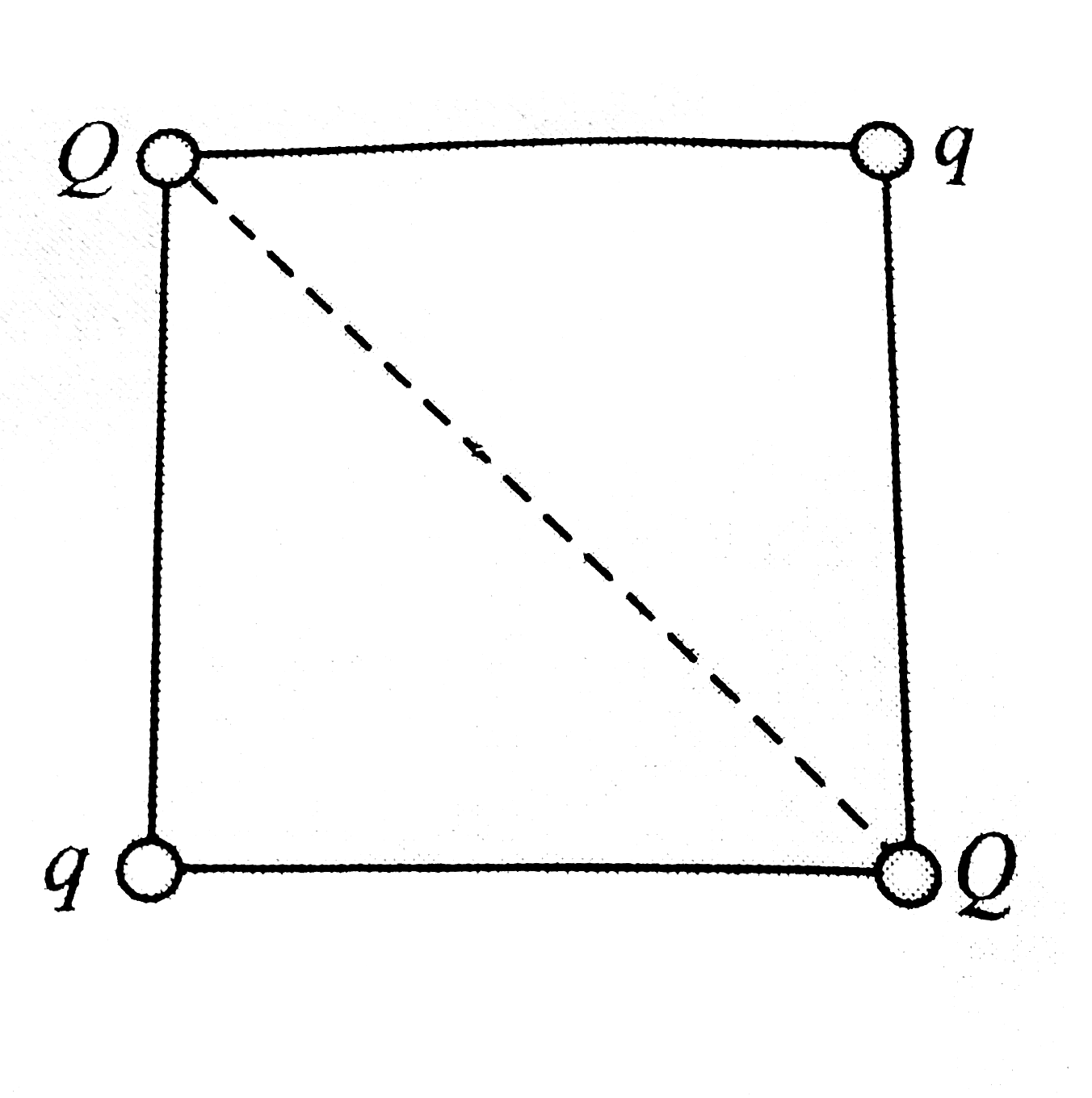
Point charge are placed at the verticas of a squre of side a as shown in fig. What should be the sign of charge q and magnitude of the ratio `|q//Q|` so that
(i) net force on each Q is zero?
(ii) net force on each q is zero?
Is it possible that the entire system could be in electrostatic equilibrium?

Text Solution

Verified by Experts
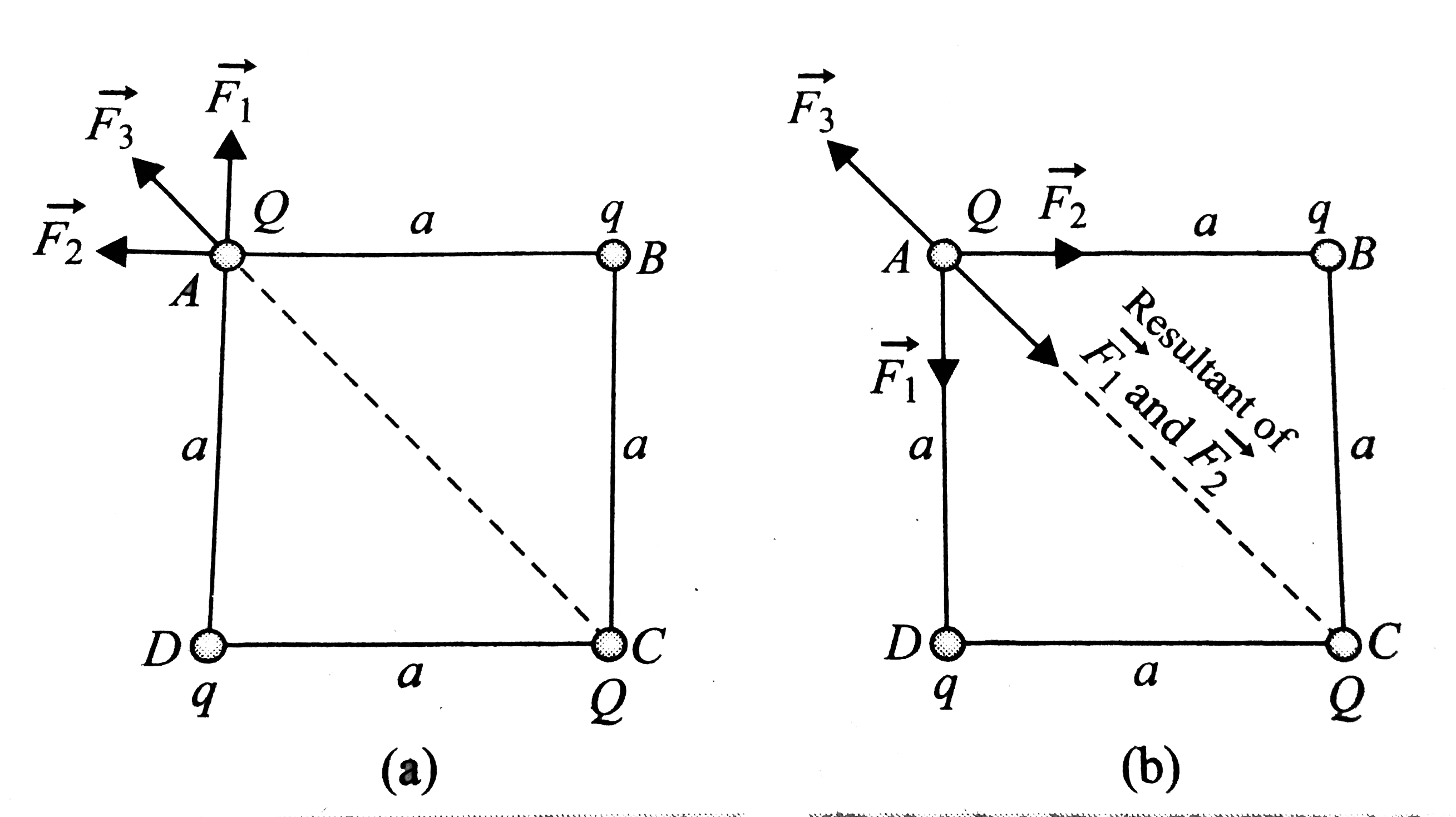
Consider the force action on charge Q placed at (shown in fig. )
Case I. Let the charge q and Q be of same sign.
here,
`(F_1)=1/(4 pi epsilon_(0)) (qQ)/(a^2)` (force of q at D on Q at A)
,
`(F_2)=1/(4 pi epsilon_(0)) (qQ)/(a^2)` (force of q atB on Q at A)
`(F_3)=1/(4 pi epsilon_(0)) (qQ)/(a^2)` (force of q atC on Q at A)
In fig. the resultant of force `vec(F_1)` and `vec(F_2)` will along `vec(F_3)` so that the net force on Q can not be zero. Hence, q and Q have to be of opposite signs.
Case II. Let the charges q and Q be of opposite signs. In this case, as shown in fig. resultant of `vec(F_1)` and `vec(F_2)` will be opposite to `vec(F_3)` so that it bexomes possible to obtain a condition of zero net force. Let us write `vecF_(R ) =vecF_(1) + vecF_(2)`. so
`sqrt(F_(1)^(2)+F_(2)^(2)) = (1)/(4 pi epsilon_(0)) (qQ)/(a^(2))sqrt(2)`
The direction of `vecF_(R )` will be along AC (`vecF_(R )`, being the resultant of force of equal magnitude, bisects the angle between the two). `vecF_(R )` and `vecF_(3)` are omn opposite directions. Theat force on Q can be zero if their magnitudes are also equal. i,e.
`(1)/(4 pi epsilon_(0)) (qQ)/(a^(2))sqrt(2)=(1)/(4 pi epsilon_(0)) (Q Q)/(2a^(2))` or `(Q)/(4 pi epsilon_(0))(q sqrt(2)-(Q)/(2))=0`
or `q=(Q)/(2 sqrt(2))` or `|(q)/(Q)|=(1)/(2 sqrt(2)) {Q!=0}`
Therefore, the sign of q should be the negative of Q.
(ii) Consider now the forces acting on charge q placed at B. In a similar manner, as dicussed in (i) , for the net force on q to be zero. q and Q have to be of opposite signs. This is also shown in the given figure.
`F_(1)=(1)/(4 pi epsilon_(0)) (qQ)/(a^(2))` (force of Q at A on q at B)
`F_(2)=(1)/(4 pi epsilon_(0)) (qQ)/(a^(2))` (force of Q at C on q at B)
`F_(3)=(1)/(4 pi epsilon_(0)) (qQ)/(a^(2))` (force of q at D on qat B)
,
From fig. we can write
`vecF_(R ) =vecF_(1) + vecF_(2)`
`:. F_(R) =sqrt(F_(1)^(2)+F_(2)^(2))=(1)/(4 pi epsilon_(0)) (Qq)/(a^(2)) sqrt(2)`
The resultant of `vecF_(1)` and `vecF_(2)` i.e `vecF_(R)` is opposite to `vecF_(3)` . Net force can become zero if their magnitudes are also equal i.e.
`(1)/(4 pi epsilon_(0)) (Qq)/(a^(2))sqrt(2) =(1)/(4 pi epsilon_(0)) (q^(2))/(2a^(2))` or `(q)/(4 pi epsilon_(0)a^(2)) [sqrt(2)Q-(q)/(2)]=0`
or `Q=(q)/(2 sqrt(2))` or `|(q)/(Q)| = 2 sqrt(2) {q!=0}`
Therefore, the sign of q should be negative of Q. In this case, we need not to repeat the calculation as the present situation id same as the previous one, we can directly write `|q//Q|=2 sqrt(2)`. The entire system cannot be in equilibrium since both conditions i.e. `q=-Q//2 sqrt(2)` and `Q=-q//2sqrt(2)` cannot be satisfied together.
Promotional Banner

Topper's Solved these Questions

  • COULOMB LAW AND ELECTRIC FIELD

    CENGAGE PHYSICS ENGLISH|Exercise Solved examples|10 Videos
  • COULOMB LAW AND ELECTRIC FIELD

    CENGAGE PHYSICS ENGLISH|Exercise Exercises|58 Videos
  • CENGAGE PHYSICS DPP

    CENGAGE PHYSICS ENGLISH|Exercise subjective type|51 Videos
  • ELECTRIC CURRENT & CIRCUITS

    CENGAGE PHYSICS ENGLISH|Exercise Kirchhoff s law and simple circuits|15 Videos

Similar Questions

Explore conceptually related problems

Charges are placed at the corners of a square of side a as shown in the following figure. The charged particle placed at A is in equilibrium. The ratio (q_1)/(q_2) is

Consider the charges q,q and -q placed at the vertices of an equilateral triangle of each side l. What is the force on each charge ?

A charge Q is placed at the centre of the line joining two point charges +q and +q as shown in figure. The ratio of charges Q and q is

Point charge are placed the corners of square of side 'a'. The value and nature of q can be best represented, to make the net force on Q zero as -

Four point charges Q, q, Q and q are placed at the corners of a square of side' a' as shown in the figure. Find the . (a) resultnat electric force on a charge Q and . (b) potential energy of this system.

Six charges are kept at the vertices of a regular hexagon as shown in the figure. If magnitude of force applied by +Q on +q charge is F, then net electric force on the +Q is nF. Find the value of n.

Three charges Q, (+q) and (+q) are placed at the vertices of an equilateral triangle of side l as shown in the figure. It the net electrostatic energy of the system is zero, then Q is equal to

Three charges Q, (+q) and (+q) are placed at the vertices of an equilateral triangle of side l as shown in the figure. It the net electrostatic energy of the system is zero, then Q is equal to

Five point charge ( +q each) are placed at the five vertices of a regular hexagon of side 2a .what is the magnitude of the net electric field at the centre of the hexazon?

Four identical charges each .q. are placed at four corners of a square of side .a.. Find the charge to be placed at the centre of the square so that the system of charges is in equilibrium

CENGAGE PHYSICS ENGLISH-COULOMB LAW AND ELECTRIC FIELD-Single Answer Correct Type
  1. Point charge are placed at the verticas of a squre of side a as shown ...

    Text Solution

    |

  2. The given figure gives electric line of force due to two charges q(1) ...

    Text Solution

    |

  3. Consider the four field patterns shown. Assuming there are no charge i...

    Text Solution

    |

  4. A charge Q is fixed at a distance d in front of an infinite metal plat...

    Text Solution

    |

  5. The lines of force of the electric field due to two charges q and Q ar...

    Text Solution

    |

  6. Two identical point charges are placed separation of l. P is a point o...

    Text Solution

    |

  7. The bob of a pendulum of mass 8 mu g carries an electric charge of 39....

    Text Solution

    |

  8. Two charges each equal to eta q(eta^(-1) lt sqrt(3)) are placed at the...

    Text Solution

    |

  9. Two ppoint chargres (+Q) and the (-2Q) are fixed on the X-axis at posi...

    Text Solution

    |

  10. A hemisphere is uniformly charged positively. The electric field at a ...

    Text Solution

    |

  11. An electron falls through a small distance in a uniform electric field...

    Text Solution

    |

  12. There is a uniform electric field of strength 10^(3)V//m along y-axis....

    Text Solution

    |

  13. In the figure shown there is a large sheet of charge of uniform surfac...

    Text Solution

    |

  14. Three charges of (+2q), (-q) and (-q) are placed at the corners A,B an...

    Text Solution

    |

  15. An electric dipole is placed along the x-axis at the origin O.A point ...

    Text Solution

    |

  16. An electric dipole is placed at the origin O and is directed along the...

    Text Solution

    |

  17. Three identical dipoles are arranged as shown below. What will be the ...

    Text Solution

    |

  18. Two electric dipoles of moment p and 64p are placed in opposite direct...

    Text Solution

    |

  19. Two point charges (+Q) and (-2Q) are fixed on the X-axis at positions ...

    Text Solution

    |

  20. An electric dipole is kept on the axis of a uniformly charged ring at ...

    Text Solution

    |

  21. Two short dipoles phat(k) and P/2 hat(k) are located at (0,0,0) & (1m,...

    Text Solution

    |