Home
Class 12
PHYSICS
Two small identical balls lying on a hor...

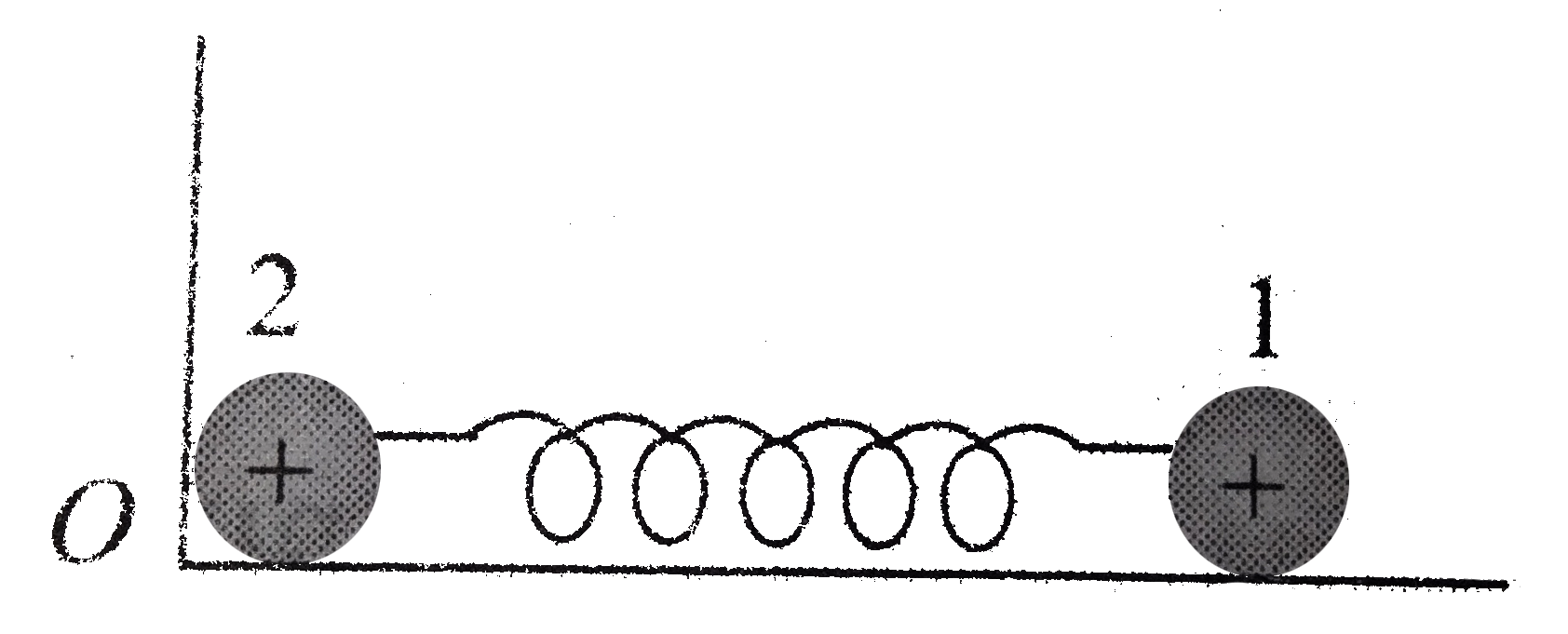
Two small identical balls lying on a horizontal plane are connected by a weightless spring. One ball (ball 2) is fixed at O, and the other (ball 1) is free. The balls are charged identically as a result of which the spring length increases `eta=2` times. Determine the change in frequency.

Text Solution

Verified by Experts

When the balls are unchangeed
`v_(0)=(1)/(2 pi)sqrt((k)/(m))`
where k is the force constant of the spring and ma is the mass of the oscillating ball (ball 1). When the balls are charged, ball 1 will oscillate about the new equilibrium position. At the equilibrium position of ball 1.
`(1)/(4 pi epsilon_(0))(q^(2))/((eta l)^(2))=k(etal-l)=k(eta-1)`
or `l^(3)=(q^(2))/(4 pi epsilon_(0)eta^(2)(eta-1)k)` ...(i)
When ball 1 is displaced by a small distance from the equilibrium position to the right. the unbalanced froce to the reight is given by
`F=(1)/(4 pi epsilon_(0))(q^(2))/((eta l+x)^(2))-k(eta l+x-1)`
From Newton law, we have
`m(d^(2)x)/(dt^(2))=(1)/(4 pi epsilon_(0))(q^(2))/(eta^(2)l^(2))[1+(x)/(eta l)]^(2)-kl(eta-1)-kx`
`=(1)/(4 pi epsilon_(0))(q^(2))/(eta^(2)l^(2))[1-(2x)/(eta l)]-kl(eta-1)-kx`
`=-[(1)/(4 pi epsilon_(0))(2q^(2))/(eta^(3)l^(3))+k]x`
From Eqs (i) and (ii), `m(d^(2)x)/(dt^(2))=-[(2(eta-1))/(eta)k+k]x=-(3 eta-2)/(eta)kx`
or `(d^(2)x)/(dt^(2))=-(3 eta-2)/(eta)(k)/(m)` or `a =-[(3eta-2 k)/(meta)]x`
Comparing with `a=-omega^(2)x`,
(i) `omega^(2)=(3 eta-2)/(eta)(k)/(m)` or `v=(1)/(2pi)sqrt(((3 eta-2)/(eta))(k)/(m))`
(ii) or `(v)/(v_(0))=sqrt((3 eta-2)/(eta))`
(iii) Thus the frequency is increased `sqrt((3 eta-2)//eta)` times . Hence `eta=2` and so frequency increases `sqrt(2)` times .
Promotional Banner

Topper's Solved these Questions

  • COULOMB LAW AND ELECTRIC FIELD

    CENGAGE PHYSICS ENGLISH|Exercise Exercises|58 Videos
  • COULOMB LAW AND ELECTRIC FIELD

    CENGAGE PHYSICS ENGLISH|Exercise Subjective Type|15 Videos
  • COULOMB LAW AND ELECTRIC FIELD

    CENGAGE PHYSICS ENGLISH|Exercise Single Answer Correct Type|22 Videos
  • CENGAGE PHYSICS DPP

    CENGAGE PHYSICS ENGLISH|Exercise subjective type|51 Videos
  • ELECTRIC CURRENT & CIRCUITS

    CENGAGE PHYSICS ENGLISH|Exercise Kirchhoff s law and simple circuits|15 Videos

Similar Questions

Explore conceptually related problems

Two identical balls each of mass m interconnected by a small light inextensible string are kept on a smooth horizontal surface. One of the balls is pushed towards the other with a speed v_(0) find the loss of K.E. of the ball. What will be the final velocities of the balls ? (e=1).

Two identical balls are dropped from the same height onto a hard surface, the second ball being released exactly when the first ball bollides with the surface. If the first ball has made two more collisions by the time the second one collides. Then the coefficient of restitution between the ball and the surface satisfies :

Two identical pith balls, each carrying charge q, are suspended from a common point by two strings of equal length l. Find the mass of each ball if the angle between the strings is 2theta in equilibrium.

Two identical uniform solid spherical balls A and B of mass m each are placed on a the fixed wedge as shown in figure. Ball B is kept at rest and it is released just before two balls collides. Ball A rolls down without slipping on inclined plane and collide elastically with ball B . The kinetic energy of ball A just after the collision with ball B is:

A box contains 3 white and 2 black balls. Two balls are drawn at random one after the other. If the balls are not replaced. what is the probability that both the balls are black ?

A spherical ball of radius 3 cm is melted and recast into three spherical balls. The radii of the two of the balls are 1.5 cm and 2 cm respectively. Determine the diameter of the third ball.

Two identical balls having like charges and placed at a certain distance apart repel each other with a certain force. They are brought in contact and then moved apart to a distance equal to half their initial separation. The force of repulsion between them increases 4.5 times in comparision with the initial value. The ratio of the initial charges of the balls is

Small identical balls with equal charges are fixed at the vertices of a regular polygon of N sides, each of length d. At a certain instant, one of the ball is released. After long time interval, the adjacent ball to the previous one is released. The difference in kinetic energies of the two released balls is K at a sufficiently long distance from the polygon.

Two identical small equally charged conducting balls are suspended from long threads secured at one point. The charges and masses of the balls are such that they are in equilibrium when the distance between them is a(the length of thread Lgtgta ). Then one of the balls is discharged. what will be the distance b(bltltL) between the balls when equilibrium is restored?

Two identical balls A and B each of mass 0.1 kg are attached to two identical mass less is springs. The spring-mass system is constrained to move inside a right smooth pipe bent in the form of a circle as shown in figure . The pipe is fixed in a horizontal plane. The center of the balls can move in a circle of radius 0.06 m . Each spring has a natural length of 0.06 pi m and force constant 0.1 N//m . Initially, both the balls are displaced by an angle theta = pi//6 radians with respect to diameter PQ of the circle and released from rest. a. Calculate the frequency of oscillation of the ball B.
