Home
Class 12
PHYSICS
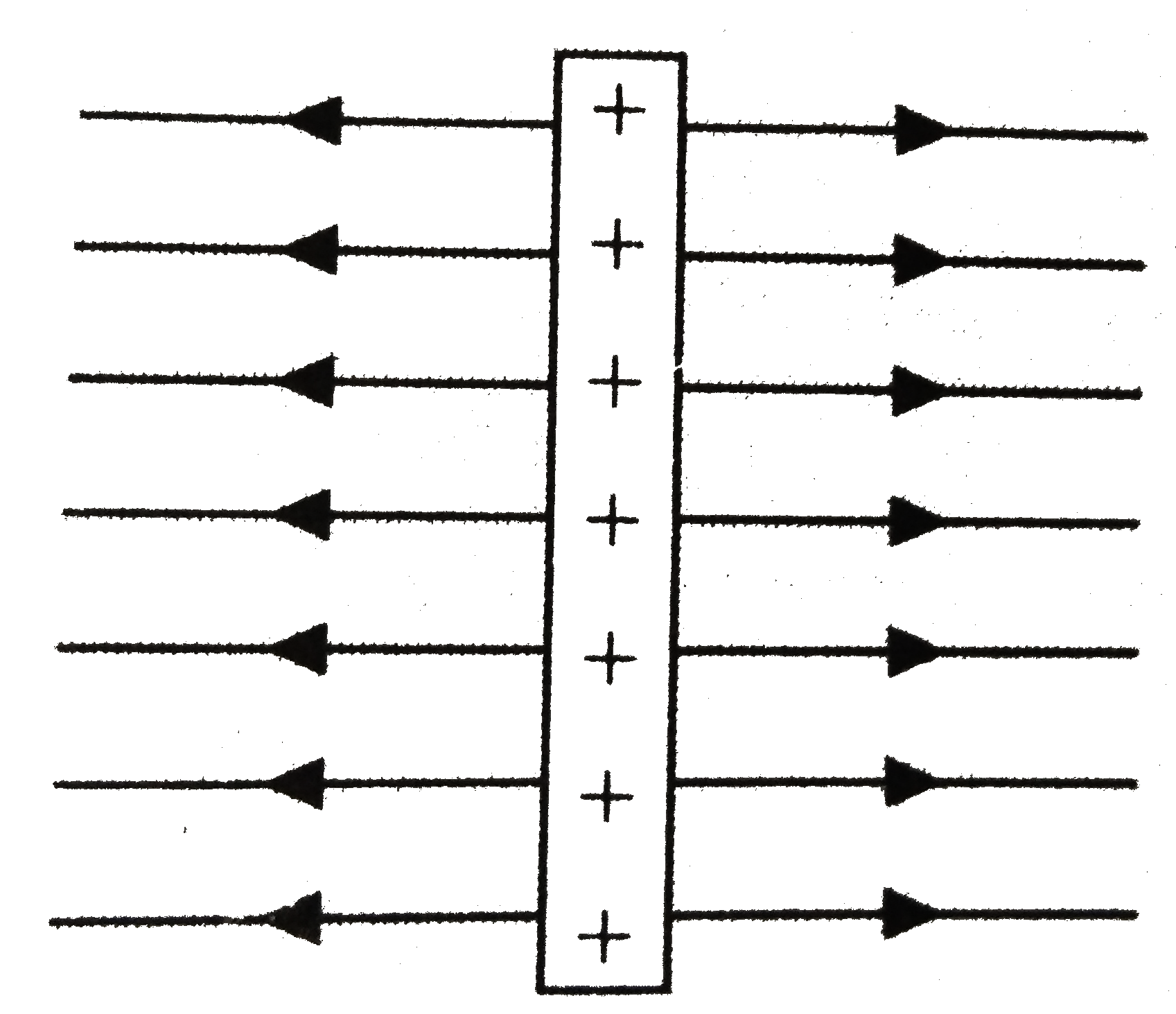
Figure shows that E has the same value f...

Figure shows that E has the same value for all points is front fo an infinitely charged sheet. Is this reasonable? One might think that the field should be stronger near the sheet because the charges are so much closer.

Text Solution

Verified by Experts
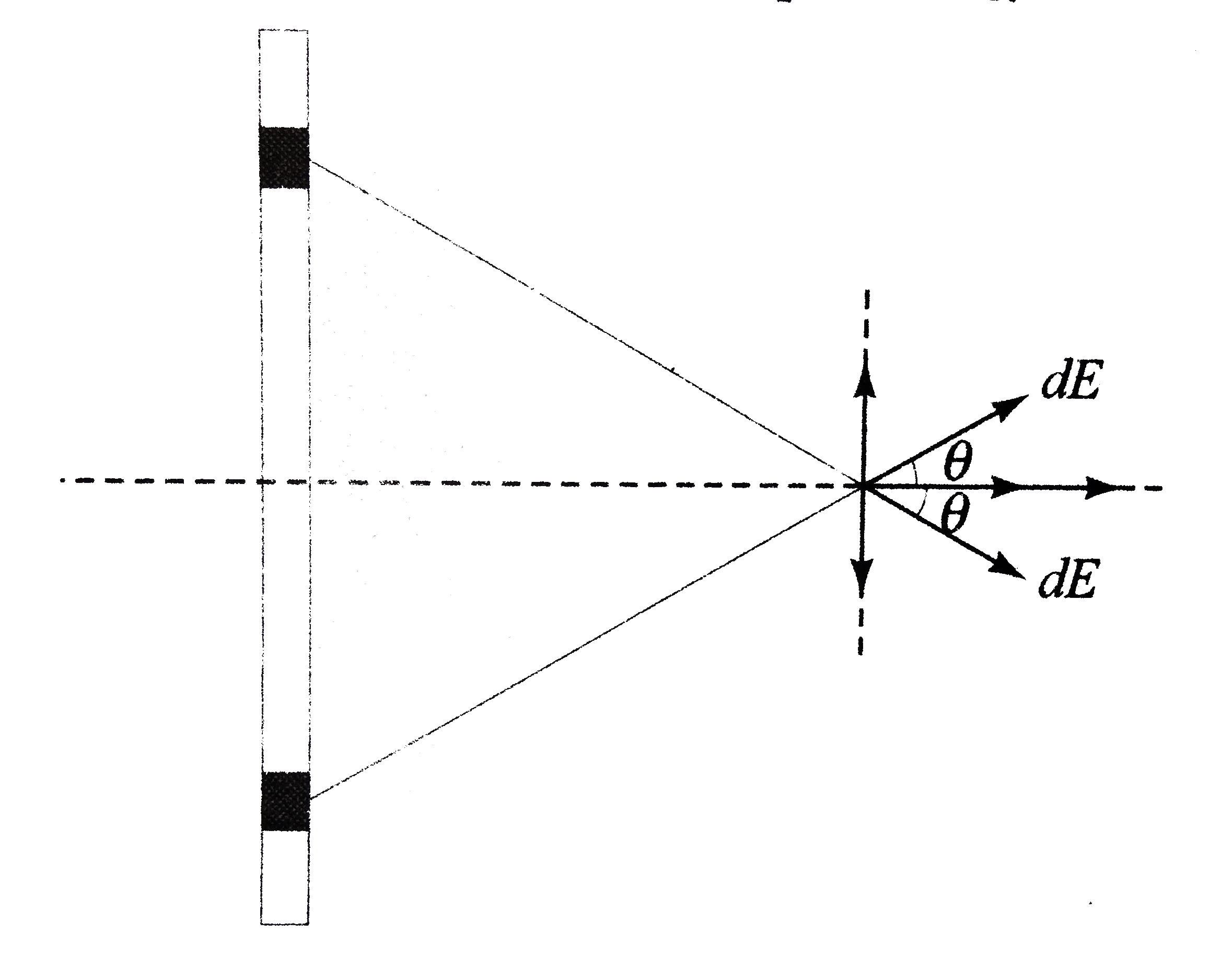
It is clear form the diagram that the components perpendicular to normal to plate will cancel each other and along the normal `dE cos theta`, they will get added. As the distance decreases, dE increases but `cos theta` also decreases in such a way that `dE cos theta` remain constant for all positions.

It can be observed that near an infinite sheet, electric fields is constant everywhere.
Promotional Banner

Topper's Solved these Questions

  • COULOMB LAW AND ELECTRIC FIELD

    CENGAGE PHYSICS ENGLISH|Exercise Subjective Type|15 Videos
  • COULOMB LAW AND ELECTRIC FIELD

    CENGAGE PHYSICS ENGLISH|Exercise Subjective|32 Videos
  • COULOMB LAW AND ELECTRIC FIELD

    CENGAGE PHYSICS ENGLISH|Exercise Solved examples|10 Videos
  • CENGAGE PHYSICS DPP

    CENGAGE PHYSICS ENGLISH|Exercise subjective type|51 Videos
  • ELECTRIC CURRENT & CIRCUITS

    CENGAGE PHYSICS ENGLISH|Exercise Kirchhoff s law and simple circuits|15 Videos

Similar Questions

Explore conceptually related problems

Three infinitely long charge sheets are placed as shown in figure. The electric field at point P is

Figure shows three cases: in all case the circular part has radius r and straight ones are infinitely long. For the same current the ratio of field B at centre P in the three case B_1:B_2:B_3 is

figure(a) shows three sheets that are large, parallel and uniformaly charged. Figure (b) gives the component of the net electric field along and x-axis through the sheets. The scale of the vertical axis is set by E_(s)= 6.0 xx10^(5)N//C what is the ratio of the charge density on sheet 3 to that on sheet 2?

(A): A electric field in front of infinite charged sheet is independent of distance of point from sheet (B): Electric field in front of finitecharged sheet is dependent on distance of point from sheet

A conductor consists of an infinite number of adjacent wires, each infinitely long & carry a current i .Show that the of B will be as represented in figure & that B for all points in front of the infinite current sheet will be given by, B=(1//2) mu_(0)ni , where n is the number of conducting wires per unit length.

Figure shows a uniformly charged hemisphere of radius R. It has a volume charge density rho . If the electric field at a point 2R, above the its center is E, then what is the electric field at the point 2R below its center?

Two infinite, non-conducting sheets of charge are parallel to each other, as shown in figure. The sheet on the left has a uniform surface charge density sigma , and the one on the right has a uniform charge density -sigma . Calculate the electric field at points (a) to the left of, (b) in between, and (c) to the right of the two sheets.

(a) Use Gauss's theorem to find the electric field due to a uniformly charged infinitely Iarge plane thin sheet with surface charge density. Sigma (b) An infinitely large thin plane sheet has a uniform surface charge density + sigma . Obtain the expression for the amount of work done in bringing a point charge q from infinity to a point , distant r, in front of the charged plane sheet.

An infinitely large layer of charge of uniform thickness t is placed normal to an existing uniform electric field. The charge on the sheet alters the electric field so that it still remains uniform on both the sides of the sheet and assumes values E_1 and E_2 as shown in figure. The charge distribution in the layer is not uniform and depends only on the distance from its faces. Find the expressions for the force F per unit experienced by the charge layer.

Figure shows two charge particles on an axis. The charges are free to move. At one point, however, a third charged particle can be placed such that all three particles are in equilibrium. (a) Is that point to the left of the first two particles to their rightm or between them? (b) should the third paricle be positively or negatively charged? (c ) Is the equilibrium stable or unstable?

CENGAGE PHYSICS ENGLISH-COULOMB LAW AND ELECTRIC FIELD-Exercises
  1. In fig, two particles, each of charge -q are arranged symmetrically ab...

    Text Solution

    |

  2. In fig. a plastic rod in the form of circular are with charge +Q unfor...

    Text Solution

    |

  3. Figure shows that E has the same value for all points is front fo an i...

    Text Solution

    |

  4. Figure shows the tracks of three charged particles in a unform electro...

    Text Solution

    |

  5. Three small spheres x,y, and z carry charges of equal magnitudes and w...

    Text Solution

    |

  6. Two identical positive charges are fixed on the y-axis, at equal dista...

    Text Solution

    |

  7. An electric field is defined in terms of q(0) a small positive charge....

    Text Solution

    |

  8. Three identical positive charges Q are arranged at the vertices of an...

    Text Solution

    |

  9. Two point charges of +5xx10^(-19)C and +20xx10^(-19)C are separated by...

    Text Solution

    |

  10. An electron (mass m(e ))falls through a distance d in a uniform electr...

    Text Solution

    |

  11. Two charged metal plates in vacuum are 10cm apart. A uniform electric ...

    Text Solution

    |

  12. Two idential point charges Q are kept at a distance r from each other....

    Text Solution

    |

  13. Two point electric charges of unknown magnitudes and signs are placed ...

    Text Solution

    |

  14. Two pieces of plasitic a full ring and a half ring, have the same radi...

    Text Solution

    |

  15. A droplet of ink in an industrial ink-jet printer carries a charge of ...

    Text Solution

    |

  16. Two particles A and B having charges 8.0 xx 10 ^(-6) C and -2.0 xx 1...

    Text Solution

    |

  17. Two point charge +-q are placed on the axis at x= -a and x= +a, as sho...

    Text Solution

    |

  18. Two point-like charge a and b whose strengths are equal in absolute va...

    Text Solution

    |

  19. An electron moving in a gravitational free space enters a unifrom elec...

    Text Solution

    |

  20. Protons are projected with an initial speed v(i)=6kms^(-1) from a file...

    Text Solution

    |

