Home
Class 12
PHYSICS
An electron (mass m(e ))falls through a ...

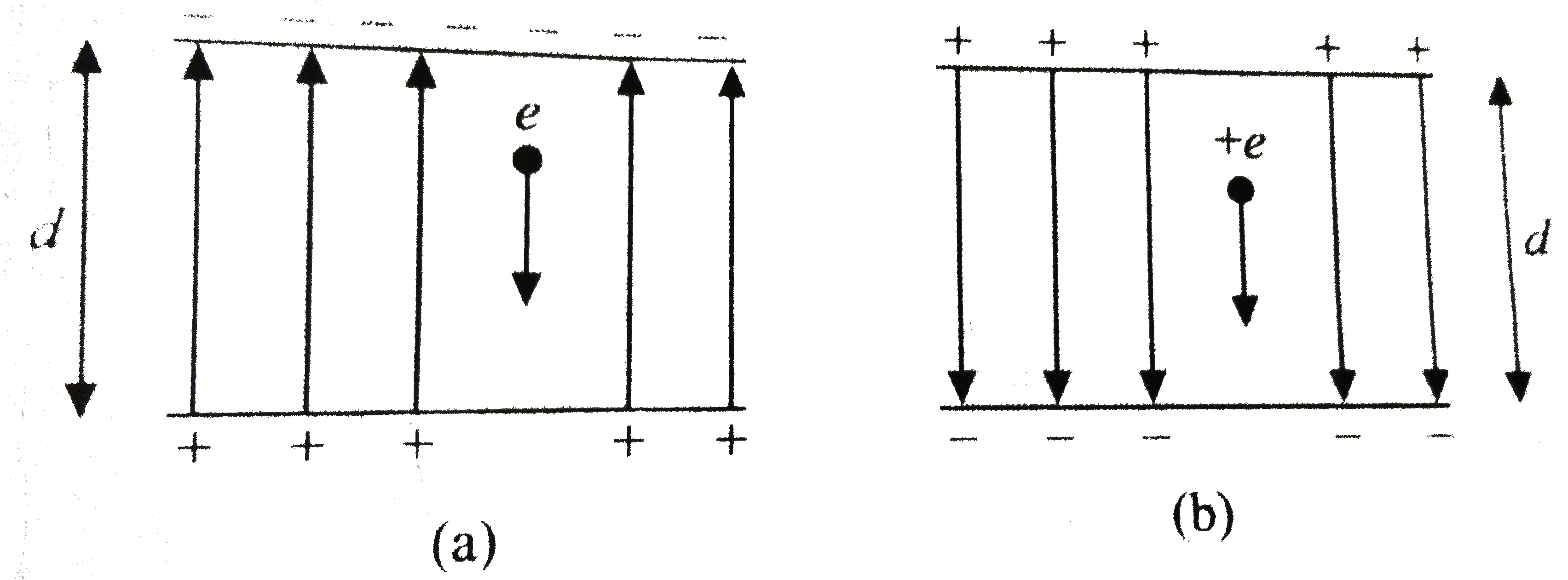
An electron (mass `m_(e )`)falls through a distance d in a uniform electric field of magnitude E.
,
The direction of the field is reversed keeping its magnitudes unchanged, and a proton(mass `m_(p)`) falls through the same distance. If the times taken by the electrons and the protons to fall the distance d is `t_("electron")` and `t_("proton")` respectively, then the ratio `t_("electron")//t_("proton")`.

Text Solution

Verified by Experts

The acceleration experienced by a charged particle under the action of an electric field E is
`a=(eE)/(m)`
If it falls through a distance h, stating form rest,
`h=(1)/(2)at^(2)` (as u=0)
or, `t^(2)=(2h)/(a)=(2h)/(eE//m)=(2mh)/(eE)`
or `t prop sqrt(m)` ...(i)
From eq (i) the time of fall will be
`(t_("electron"))/(t_("proton"))=sqrt((m_(e)/(m_(p)))`
Now since `m_(p)gtm_(e)`, so `t_(p)gtt_(e)`, i.e., time of fall through the same distance is greater for a heavier particle, which is in constrant with the situation of free fall under gravity where the time of fall is independent of the mass of the body.
Promotional Banner

Topper's Solved these Questions

  • COULOMB LAW AND ELECTRIC FIELD

    CENGAGE PHYSICS ENGLISH|Exercise Subjective Type|15 Videos
  • COULOMB LAW AND ELECTRIC FIELD

    CENGAGE PHYSICS ENGLISH|Exercise Subjective|32 Videos
  • COULOMB LAW AND ELECTRIC FIELD

    CENGAGE PHYSICS ENGLISH|Exercise Solved examples|10 Videos
  • CENGAGE PHYSICS DPP

    CENGAGE PHYSICS ENGLISH|Exercise subjective type|51 Videos
  • ELECTRIC CURRENT & CIRCUITS

    CENGAGE PHYSICS ENGLISH|Exercise Kirchhoff s law and simple circuits|15 Videos

Similar Questions

Explore conceptually related problems

An electron falls through a small distance in a uniform electric field of magnitude 2xx10^(4)NC^(-1) . The direction of the field reversed keeping the magnitude unchanged and a proton falls through the same distance. The time of fall will be

An electron falls through a small distance in a uniform electric field of magnitude 2xx10^(4)NC^(-1) . The direction of the field reversed keeping the magnitude unchanged and a proton falls through the same distance. The time of fall will be

An electron falls through a distance of 1.5 cm in a uniform electric field of magnitude 2.4xx10^(4) NC^(-1) [Fig.1.12 (a)] . The direction of the field is reversed keeping its magnitude unchagned and a proton falls through the same distance [Fig. 1.12 (b) ]. Complute the time of fall in each case. Contrast the situation (a) with that of free fall under gravity.

An electron falls from rest through a vertical distance h in a uniform and vertically upward directed electric field E. the direction of electric field is now reversed, keeping its magnitude the same. A proton is allowed to fall from rest in it through the same vertical distance h.The time of fall of the electron, in comparison to the time of flal of the proton is

An electron initially at rest falls a distance of 1.5 cm in a uniform electric field of magnitude 2 xx10^(4) N//C . The time taken by the electron to fall this distance is

An electron initially at rest falls a distance of 1.5 cm in a uniform electric field of magnitude 2 xx10^(4) N//C . The time taken by the electron to fall this distance is

An electron falls through a distance of 1.5 cm in a uniform electric field of magnitude 2.0xx10^(4)N//C(Fig.a) Calculate the time it takes to fall through this distance starting from rest. If the direction of the field is reversed (fig .b) keeping its magnitude unchanged , calculate the time taken by a proton to fall through this distance starting from rest.

A charged particle of mass m and charge q is released from rest in an electric field of constant magnitude E . The kinetic energy of the particle after time t is

An electron of mass m_(e ) initially at rest moves through a certain distance in a uniform electric field in time t_(1) . A proton of mass m_(p) also initially at rest takes time t_(2) to move through an equal distance in this uniform electric field.Neglecting the effect of gravity, the ratio of t_(2)//t_(1) is nearly equal to

An electron of mass m_(e ) initially at rest moves through a certain distance in a uniform electric field in time t_(1) . A proton of mass m_(p) also initially at rest takes time t_(2) to move through an equal distance in this uniform electric field.Neglecting the effect of gravity, the ratio of t_(2)//t_(1) is nearly equal to

CENGAGE PHYSICS ENGLISH-COULOMB LAW AND ELECTRIC FIELD-Exercises
  1. In fig. a plastic rod in the form of circular are with charge +Q unfor...

    Text Solution

    |

  2. Figure shows that E has the same value for all points is front fo an i...

    Text Solution

    |

  3. Figure shows the tracks of three charged particles in a unform electro...

    Text Solution

    |

  4. Three small spheres x,y, and z carry charges of equal magnitudes and w...

    Text Solution

    |

  5. Two identical positive charges are fixed on the y-axis, at equal dista...

    Text Solution

    |

  6. An electric field is defined in terms of q(0) a small positive charge....

    Text Solution

    |

  7. Three identical positive charges Q are arranged at the vertices of an...

    Text Solution

    |

  8. Two point charges of +5xx10^(-19)C and +20xx10^(-19)C are separated by...

    Text Solution

    |

  9. An electron (mass m(e ))falls through a distance d in a uniform electr...

    Text Solution

    |

  10. Two charged metal plates in vacuum are 10cm apart. A uniform electric ...

    Text Solution

    |

  11. Two idential point charges Q are kept at a distance r from each other....

    Text Solution

    |

  12. Two point electric charges of unknown magnitudes and signs are placed ...

    Text Solution

    |

  13. Two pieces of plasitic a full ring and a half ring, have the same radi...

    Text Solution

    |

  14. A droplet of ink in an industrial ink-jet printer carries a charge of ...

    Text Solution

    |

  15. Two particles A and B having charges 8.0 xx 10 ^(-6) C and -2.0 xx 1...

    Text Solution

    |

  16. Two point charge +-q are placed on the axis at x= -a and x= +a, as sho...

    Text Solution

    |

  17. Two point-like charge a and b whose strengths are equal in absolute va...

    Text Solution

    |

  18. An electron moving in a gravitational free space enters a unifrom elec...

    Text Solution

    |

  19. Protons are projected with an initial speed v(i)=6kms^(-1) from a file...

    Text Solution

    |

  20. Two indentical point charges having magnitude q each are placed as sho...

    Text Solution

    |

