
Home
Class 12
PHYSICS
A uniform nonconducting rod of mass ma a...

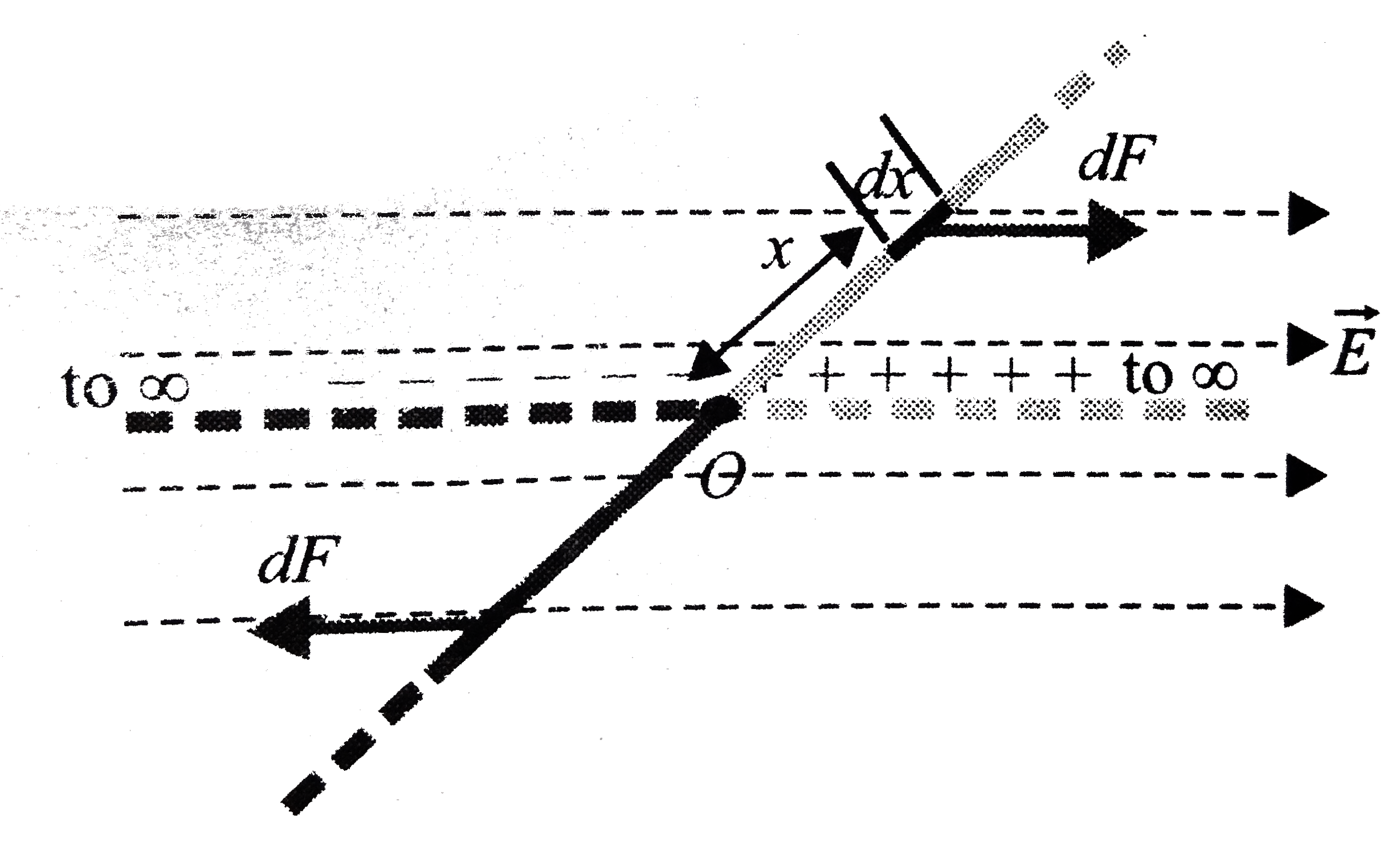
A uniform nonconducting rod of mass ma and length l, with charge density `lambda` as shown in fig. is hanged at the midpoint at origin so that it can rotate in a horizontal plane without any friction. A uniform electric field E exists parallel to x axis in the entire region. Calculated the period of small oscillation of the rod .

Text Solution

Verified by Experts

The correct Answer is:
`2pisqrt((m)/(3E lambda))`.

`tau = int_(0)^(l//2) d tau_(1)+int _(0)^(l//2) d tau_(2)`
`=2int _(0)^(l//2)E lambdadx(x sin theta)=(E lambda l^(2))/(4) sin theta`

At `theta` is small , `tau~~(E lambda l^(2))/(4) theta`
`(ml^(2))/(12)(alpha)=-(E lambda l^(2)theta)/(4)` or `omega=sqrt((3 E lambda)/(m))`
`:. T=2(pi)sqrt((m)/(3E lambda))`.
Promotional Banner

Topper's Solved these Questions

  • COULOMB LAW AND ELECTRIC FIELD

    CENGAGE PHYSICS ENGLISH|Exercise Single Correct|47 Videos
  • COULOMB LAW AND ELECTRIC FIELD

    CENGAGE PHYSICS ENGLISH|Exercise Multiple Correct|8 Videos
  • COULOMB LAW AND ELECTRIC FIELD

    CENGAGE PHYSICS ENGLISH|Exercise Subjective Type|15 Videos
  • CENGAGE PHYSICS DPP

    CENGAGE PHYSICS ENGLISH|Exercise subjective type|51 Videos
  • ELECTRIC CURRENT & CIRCUITS

    CENGAGE PHYSICS ENGLISH|Exercise Kirchhoff s law and simple circuits|15 Videos

Similar Questions

Explore conceptually related problems

A nonconducting ring of mass m and radius R, with charge per unit length lambda is shown in fig. It is then placed on a rough nonconducting horizontal plane. At time t=0, a uniform electric field vecE =E_(0)hati is switched on and the ring starts rolling without sliding. Determine the friction force (magnitude and direction ) acting on the ring.

A rod of length l rotates with a uniform angular velocity omega about its perpendicular bisector. A uniform magnetic field B exists parallel to the axis of rotation. The potential difference between the two ends of the lrod is

A rod of length l rotates with a uniform angular velocity omega about its perpendicular bisector. A uniform magnetic field B exists parallel to the axis of rotation. The potential difference between the two ends of the lrod is

A conducting rod of length 2l is rotating with constant angular speed w about its perpendicular bisector. A uniform magnetic field B exists parallel to the axis of rotation. The e.m.f. induced between two ends of the rod is

A conducting rod of length 2l is rotating with constant angular speed w about its perpendicular bisector. A uniform magnetic field B exists parallel to the axis of rotation. The e.m.f. induced between two ends of the rod is

A rod of length l rotates with a small but uniform angular velocity omega about its perpendicular bisector. A uniform magnetic field B exists parallel to the axis of rotation. The potential difference between the centre of the rod and an end is

A uniform rod of mass m and length l rotates in a horizontal plane with an angular velocity omega about a vertical axis passing through one end. The tension in the rod at a distance x from the axis is

A wire is bent an an angle theta . A rod of mass m can slide along the bended wire without friction as shown in Fig. A soap film is maintained in the frame kept in a vertical position and the rod is in equilibrium as shown in the figure. If rod is displaced slightly in vertical direction, then the time period of small oscillation of the rod is

A wire is bent an an angle theta . A rod of mass m can slide along the bended wire without friction as shown in Fig. A soap film is maintained in the frame kept in a vertical position and the rod is in equilibrium as shown in the figure. If rod is displaced slightly in vertical direction, then the time period of small oscillation of the rod is

A rod of mass M and length L is placed on a smooth horizontal surface. It is hinged at one end so that it can rotate freely in a horizontal circle about this end. There exists a uniform magnetic field vecB perpendicular, into the horizontal surface everywhere. The strength of magnetic field starts varying as B=B_(0)t. (i) Find the torque acting on the rod about its hinged end. (ii) Find the reaction produced at hinge at t = 0. (A charge Q is distributed uniformaly on the rod)

CENGAGE PHYSICS ENGLISH-COULOMB LAW AND ELECTRIC FIELD-Subjective
  1. Point chages q and -q are located at the verticles of a squre with dia...

    Text Solution

    |

  2. Two mutually perpendicular long straight conductors carrying uniformly...

    Text Solution

    |

  3. A ring of radius 0.1m is made out of thin metallic wire of area of cro...

    Text Solution

    |

  4. A charged cork ball of mass m is suspended on a light sting in the pre...

    Text Solution

    |

  5. A ring of radius R has charge -Q distributed uniformly over it. Calcul...

    Text Solution

    |

  6. Two identical small equally charged conducting balls are suspended fro...

    Text Solution

    |

  7. Two point like charges Q(1) and Q(2) are positioned at point 1 and 2. ...

    Text Solution

    |

  8. Two semicircle wires ABC, and ADC, each of radius R are lying on xy an...

    Text Solution

    |

  9. An infinte wire having linear charge density lambda is arranged as sho...

    Text Solution

    |

  10. Two similar balls, each of mass m and charge q, are hung from a common...

    Text Solution

    |

  11. Three equal negative charges, -q(1) each form the vertices of and equi...

    Text Solution

    |

  12. A ball of radius R carries a positive charges whose volume density at ...

    Text Solution

    |

  13. A uniform nonconducting rod of mass ma and length l, with charge densi...

    Text Solution

    |

  14. Electrically charged drops of nercury fall from an altitude h into a s...

    Text Solution

    |

  15. A thin rigid insulated rod of mass m and length l carrying a charge Q ...

    Text Solution

    |

  16. Two particles of chargaes and masses (+q(1),m(1)) and (+q(2),m(2)) are...

    Text Solution

    |

  17. A small beads of mass ma having charge -q is constrained to move along...

    Text Solution

    |

  18. A charged particle q of mass m is in wquilibrium at a height h from a ...

    Text Solution

    |

  19. A point charge Q(1)=-125mu C is fixed at the center of an insulated di...

    Text Solution

    |

  20. Two small balls having the same mass and charge and located on the sam...

    Text Solution

    |

