Home
Class 12
PHYSICS
A sphere of radius R has a uniform volum...

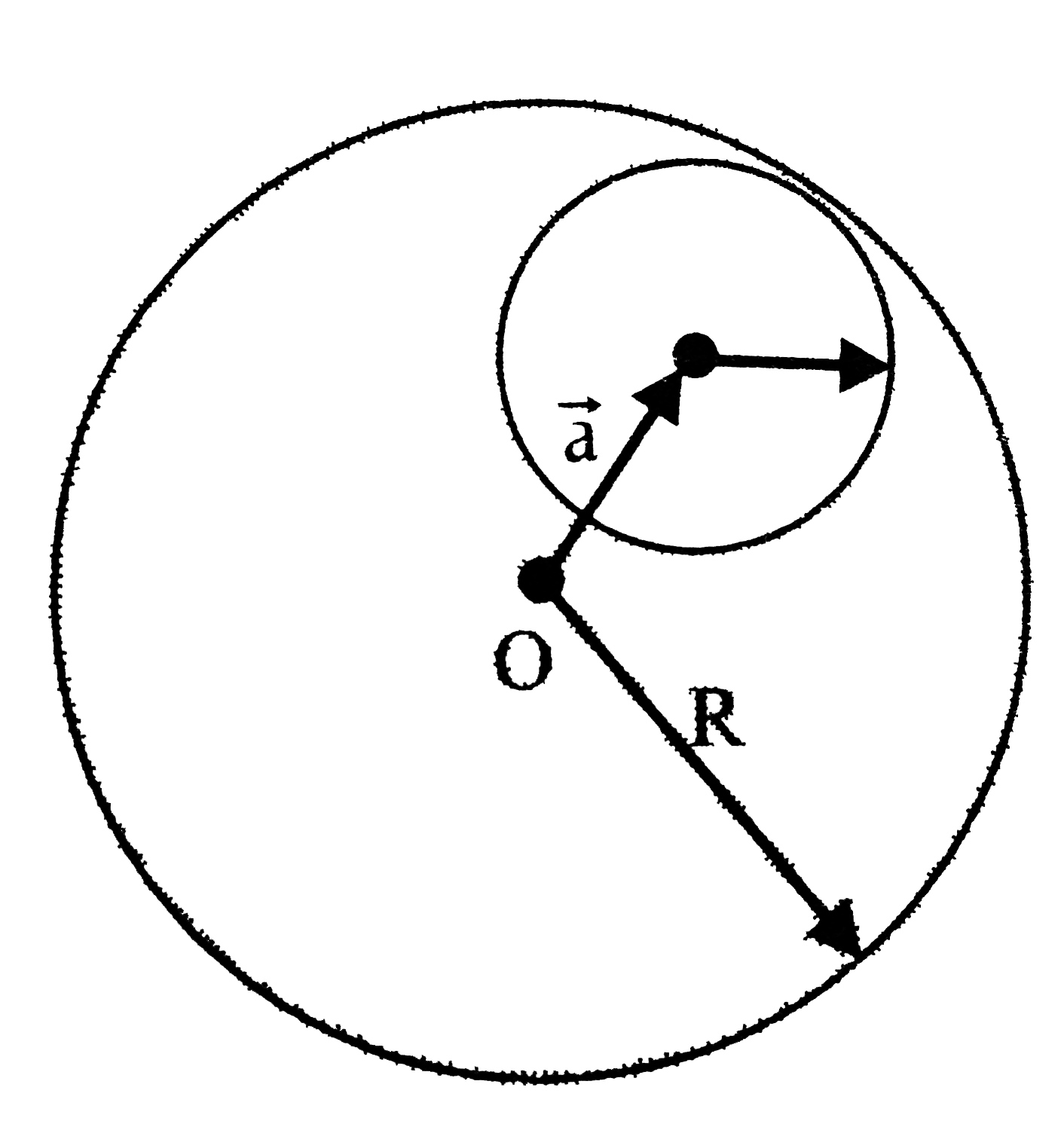
A sphere of radius R has a uniform volume density `rho`. A spherical cavity of radius b, whose center lies at `veca`, is removed from the sphere.
i. Find the electric field at any point inside the spherical cavity.
ii. Find the electric field outside the cavity
(a) at points inside the large sphere but outside the cavity and
(b) at points outside the large sphere.

Text Solution

Verified by Experts
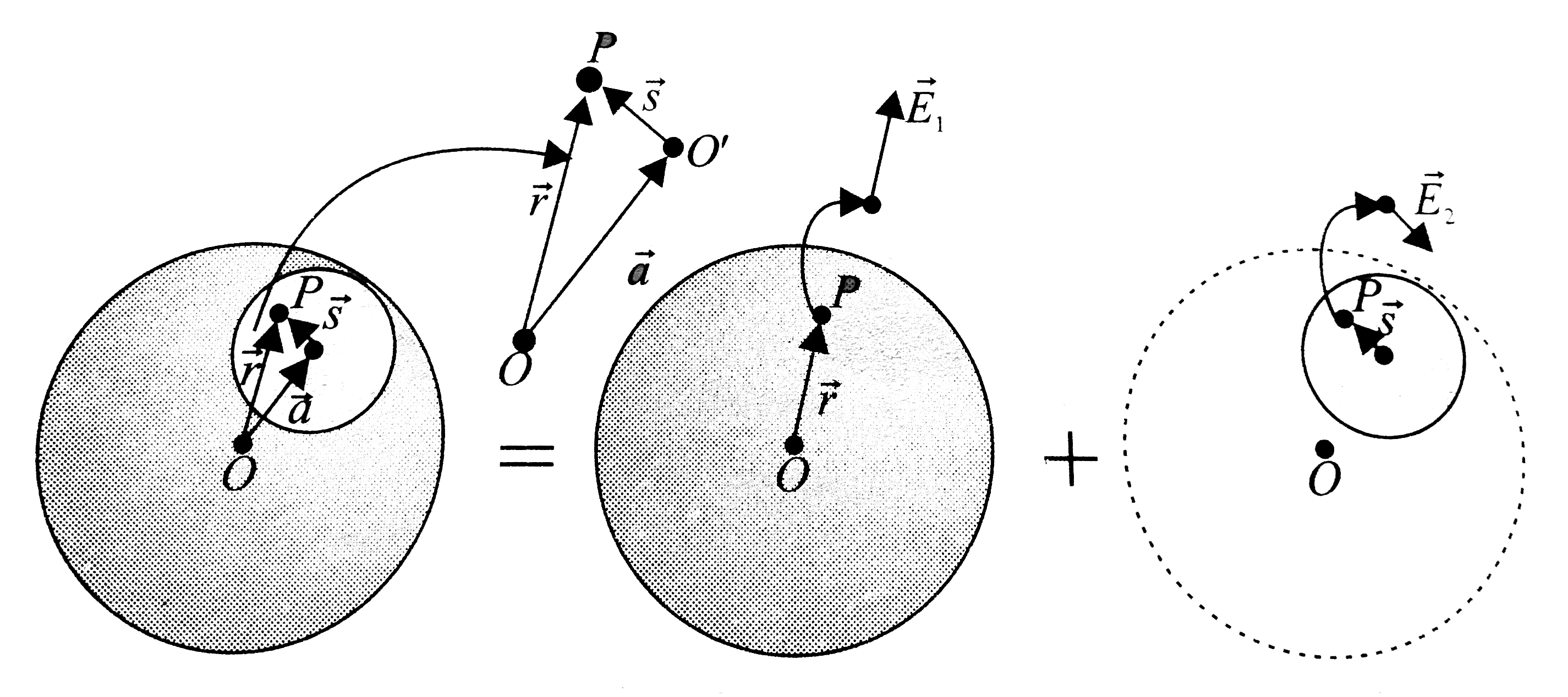
The electric field within the cavity or outside is the
superposition of the electric field due to the original
uncut sphere, plus the electric field due to a sphere of
the size of the cavity but with a uniform negative charge
density. The effective charge distribution is composed
of a uniformly charged sphere of radius R, charge
density `rho`, superposed on it is a charge density - `rho` filling
the cavity. An electric field `vecE_1` is caused by the charge
distribution `+rho` at a point `vecr` inside the spherical cavity.

`vecE_1 = (rhor)/(3epsilon_0) r^2 = (rhovecr)/(3epsilon_0)`
where `hatr` is a unit vector in radial direction. Similarly, the electric field `vecE_2` formed by the charge density `-rho`
inside the cavity is
`vecE_2 = (rho(-vecs))/(3epsilon_0)`
Here, `vecs` is the radius vector from the cavity centre to
the point P. From vector triangle
`vecr = veca + vecs or vecs = vecr - veca`
`:. vecE_2 = (-rho(vecr-veca))/(3epsilon_0)`
The resultant electric field inside the cavity is, therefore,
given by the superposition of `vecE_1 and vecE_2`. So
`vecE= vecE_1 + vecE_2 = (rhovecr)/(3epsilon_0) + [(-rho(vecr-veca))/(3epsilon_0)] = + (rhoveca)/(3epsilon_0)` = constant.
`:. vecE = (rhoveca)/(3epsilon_0)`
ii. (a) Electric field at points inside the large sphere but
outside the cavity :
`vecE_1 = (rhovecr)/(3epsilon_0)`
and `vecE_2 = 1/(4piepsilon_0) (q(-vecs))/(s^3) = -((4/3pirhob^3)(vecr - veca))/(4epsilon_0|(vecr -veca)|)`
The resultant electric field is
`vecE = vecE_1 + vecE_2 = rho/(3epsilon_0)[vecr - (b/(vecr -veca))^3 (vecr-veca)]`
(b) Electric field at points outside the large sphere,
`vecE_1 = Q_t otal)/(4piepsilon_0r^3) vecr = (4/3piR^3rho)/(4piepsilon_0r^3) vecr = (R^3rho)/(3epsilon_0r^3) vecr `
`vecE_2 = Q_(t otal)/(4piepsilon_0s^3) vecs = (-(4/3pib^3rho))/(4piepsilon_0(|vecr -veca|)^3) (vecr - veca)`
`= (-rhob^3)/(3epsilon_0(|vecr-veca|)^3 (vecr-veca)`
The resultant electric field is
`vecE = vecE_1 + vecE_2 = (rho)/(3epsilon_0) [(R/r)^3 vecr - (b/(vecr-veca))^3 (vecr-veca)]`
`:. E (vecr) = {((rhoveca)/(3epsilon_0)), (rho/(3epsilon_0)[vecr-(b/|vecr-veca|)^3 (vecr-veca)]), (rho/(3epsilon_0)[(R/r)^3vecr - (b/|vecr-veca|)^3 (vecr-veca)]`:}`
Electric field inside the cavity
Electric field outside the cavity but inside the large cavity
electric field outside the large sphere .
Promotional Banner

Topper's Solved these Questions

  • ELECTRIC FLUX AND GAUSS LAW

    CENGAGE PHYSICS ENGLISH|Exercise Exercise 2.1|16 Videos
  • ELECTRIC FLUX AND GAUSS LAW

    CENGAGE PHYSICS ENGLISH|Exercise Exercise 2.2|14 Videos
  • ELECTRIC FLUX AND GAUSS LAW

    CENGAGE PHYSICS ENGLISH|Exercise MCQ s|38 Videos
  • ELECTRIC CURRENT AND CIRCUIT

    CENGAGE PHYSICS ENGLISH|Exercise Interger|8 Videos
  • ELECTRIC POTENTIAL

    CENGAGE PHYSICS ENGLISH|Exercise DPP 3.5|15 Videos

Similar Questions

Explore conceptually related problems

A solid of radius 'R' is uniformly charged with charge density rho in its volume. A spherical cavity of radius R/2 is made in the sphere as shown in the figure. Find the electric potential at the centre of the sphere.

A nonconducting sphere of radius R is filled with uniform volume charge density -rho . The center of this sphere is displaced from the origin by vecd . The electric field vecE at any point P having position vector inside the sphere is

A positively charge sphere of radius r_0 carries a volume charge density rho . A spherical cavity of radius r_0//2 is then scooped out and left empty. C_1 is the center of the sphere and C_2 that of the cavity. What is the direction and magnitude of the electric field at point B?

A glass sphere of radius 2R and refractive index n has a spherical cavity of radius R, concentric with it. Q. When viewer is ono left side of the hollow sphere, what will be the shift in position of the object?

A solid sphere having radius R and uniform charge density rho has a cavity of radius R/2 as shown in figure.Find the value of |E_A /E_B|

A solid spherical region, having a spherical cavity whose diameter R is equal to the radius of the spherical region, has a total charge Q. Find the electric field at a point P as shown in figure .

The figure represents a solid uniform sphere of mass M and radius R . A spherical cavity of radius r is at a distance a from the centre of the sphere. The gravitational field inside the cavity is

A thick shell with inner radius R and outer radius 3R has a uniform charge density sigma c//m^(3) . It has a spherical cavity of radius R as shown in the figure. The electric field at the centre of the cavity is

A glass sphere of radius 2R and refractive index n has a spherical cavity of radius R, concentric with it. Q. When viewer is on right side of the hollow sphere, what will be apparent change in position of the object?

A solid sphere of mass M and radius R has a spherical cavity of radius R/2 such that the centre of cavity is at a distance R/2 from the centre of the sphere. A point mass m is placed inside the cavity at a distance R/4 from the centre of sphere. The gravitational force on mass m is

