Home
Class 12
PHYSICS
There are n large parallel plate conduct...

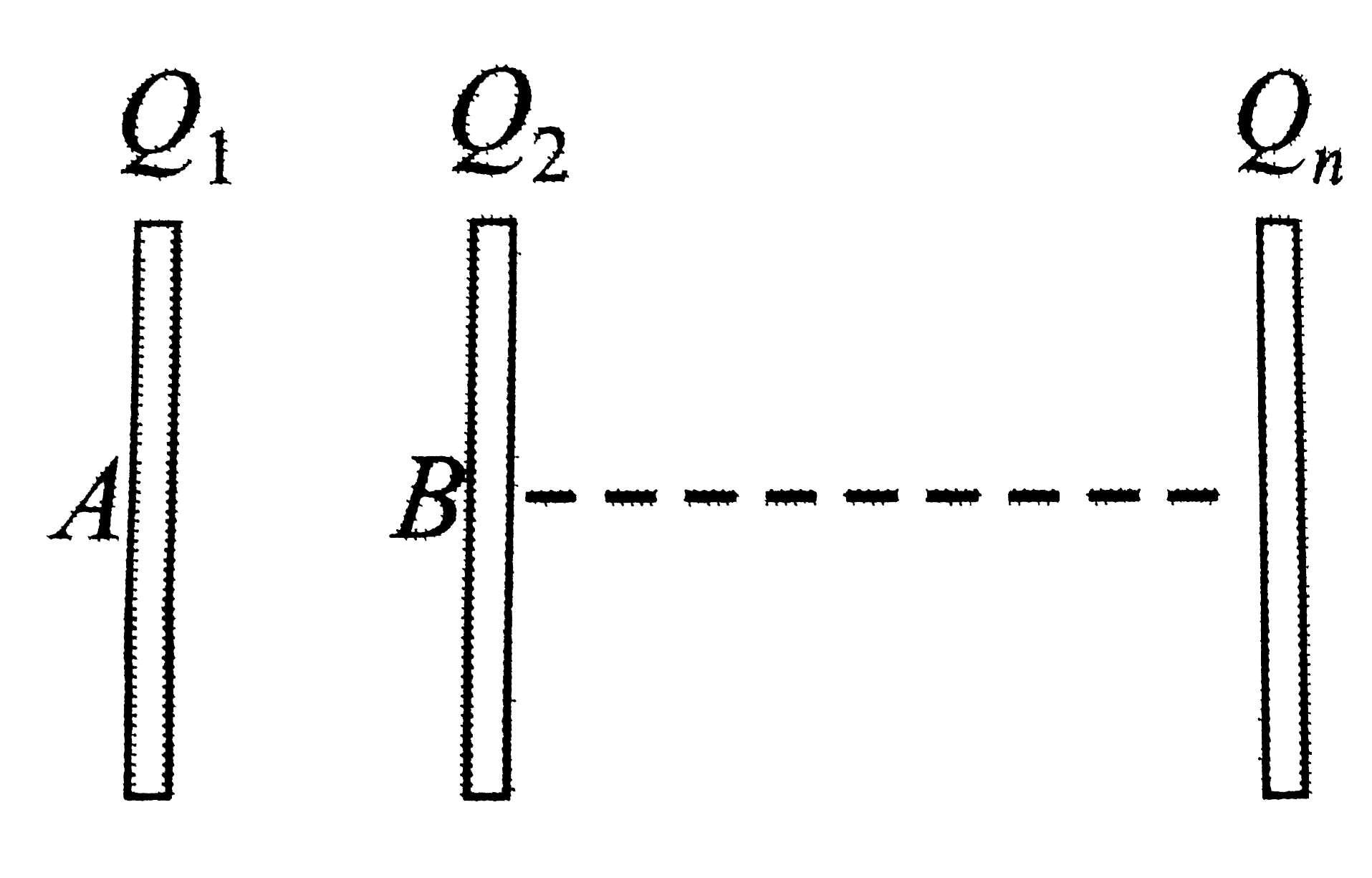
There are n large parallel plate conductors carrying charge `Q_1,Q_2,………..Q_n` respectively.

i. Find the charge induced at surface A.
ii. Find the charge induced at surface B.
iii. If the left conductor is earthed, find the magnitude of charge flowing from plate to earth.
iv. If any conductor is earthed, find the magnitude of charge flowing from plate to earth.

Text Solution

Verified by Experts
While solving the problems of multiple plates
placed parallel to each
other, the following points
should be keep in mind.
`*` Charges appearing
on the outer surfaces should be equal in
magnitudes as well as
sign.
`*` Charges appearing on the facing
surfaces should be
equal in magnitude but opposite in sign.
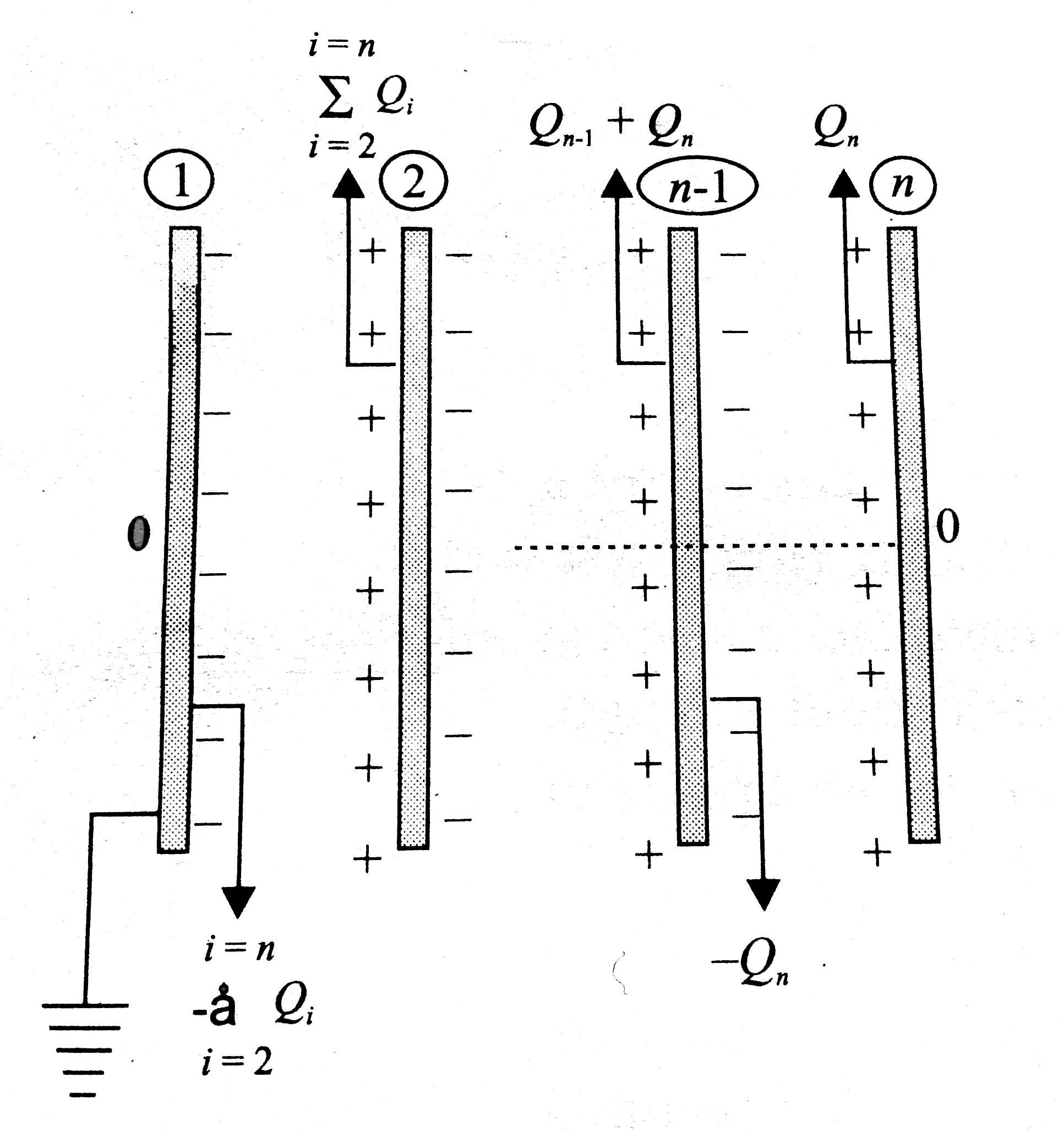
If we connect any plate (innermost or outermost) with
earth, the charge appearing on the outer surfaces will be
zero.
`*` The charges of the plates other than those connected with
earth remain conserved.
`*` The charges of the plates other than those connected with
earth remain conserved.
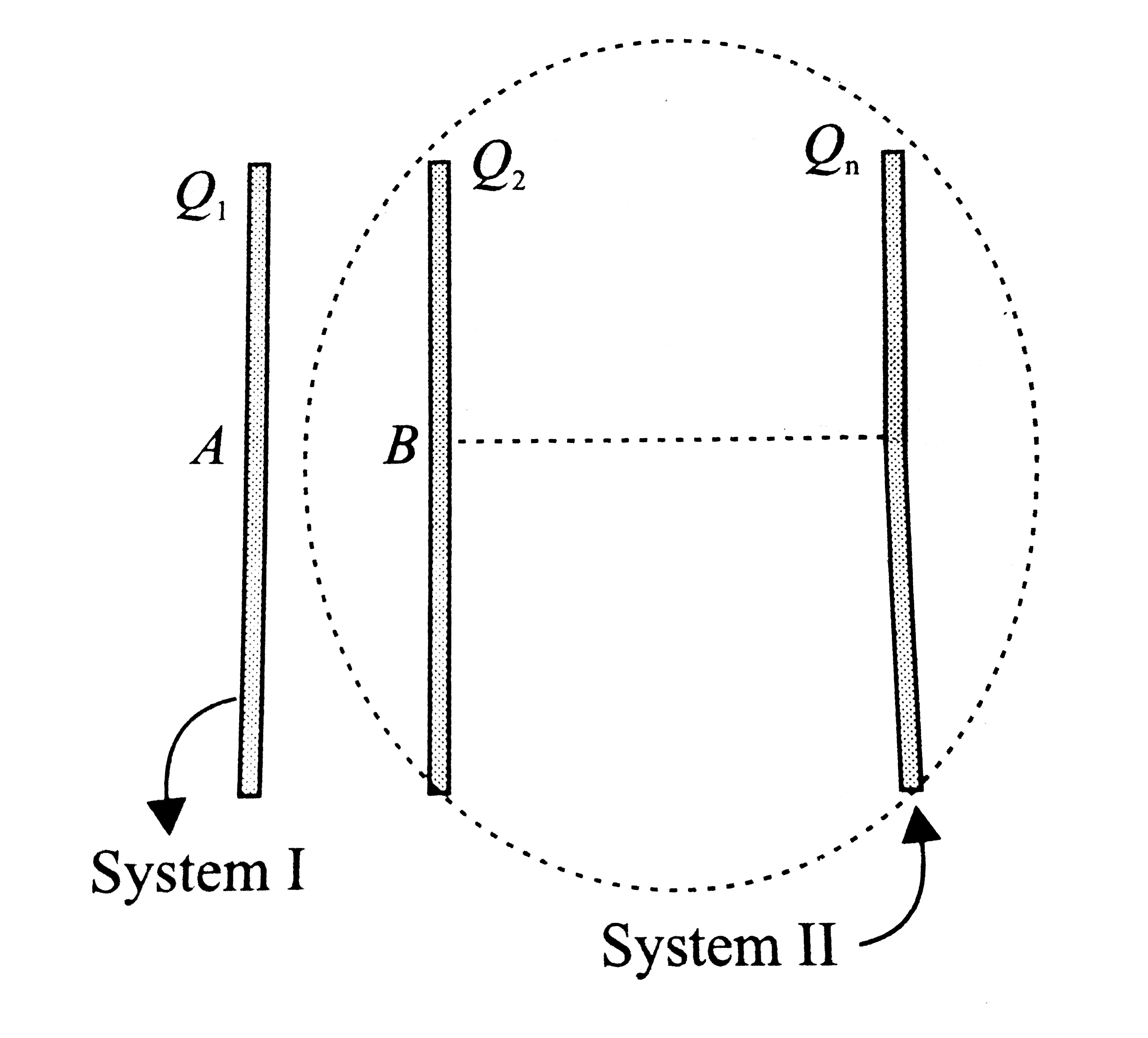
i. Charge on outermost surface A is half the summation of charges on both systems. So

`Q_(A) = (Q_1+sum_(i=2)^(i=n) Q_i)/2 = 1/2 sum_(i=1)^(i=n)Q_i`
ii. Charge on surface B is half the differenec of charge on both systems. So,
`Q_B = -(Q_1-sum_(i=2)^(i=n)Q_i)/2 = -1/2 [Q_1 - sum_(i-2)^(i=n)Q_i]`
iii. If the outer plate is connected with earth, the charge on the outermost surfaces will be zero.
Initial charge in plate 1 `=Q_1`
Final charge in plate 1 = `-sum_(i=2)^(i=n)Q_i`
Charge x flowing from plate 1 to earth is
`-sum_(i=2)^(i=n)Q_i+x = Q_1`
or `x = Q_1 + sum_(i =2)^(i=n)Q_i = sum_(i=1)^(i=n)Q_i`

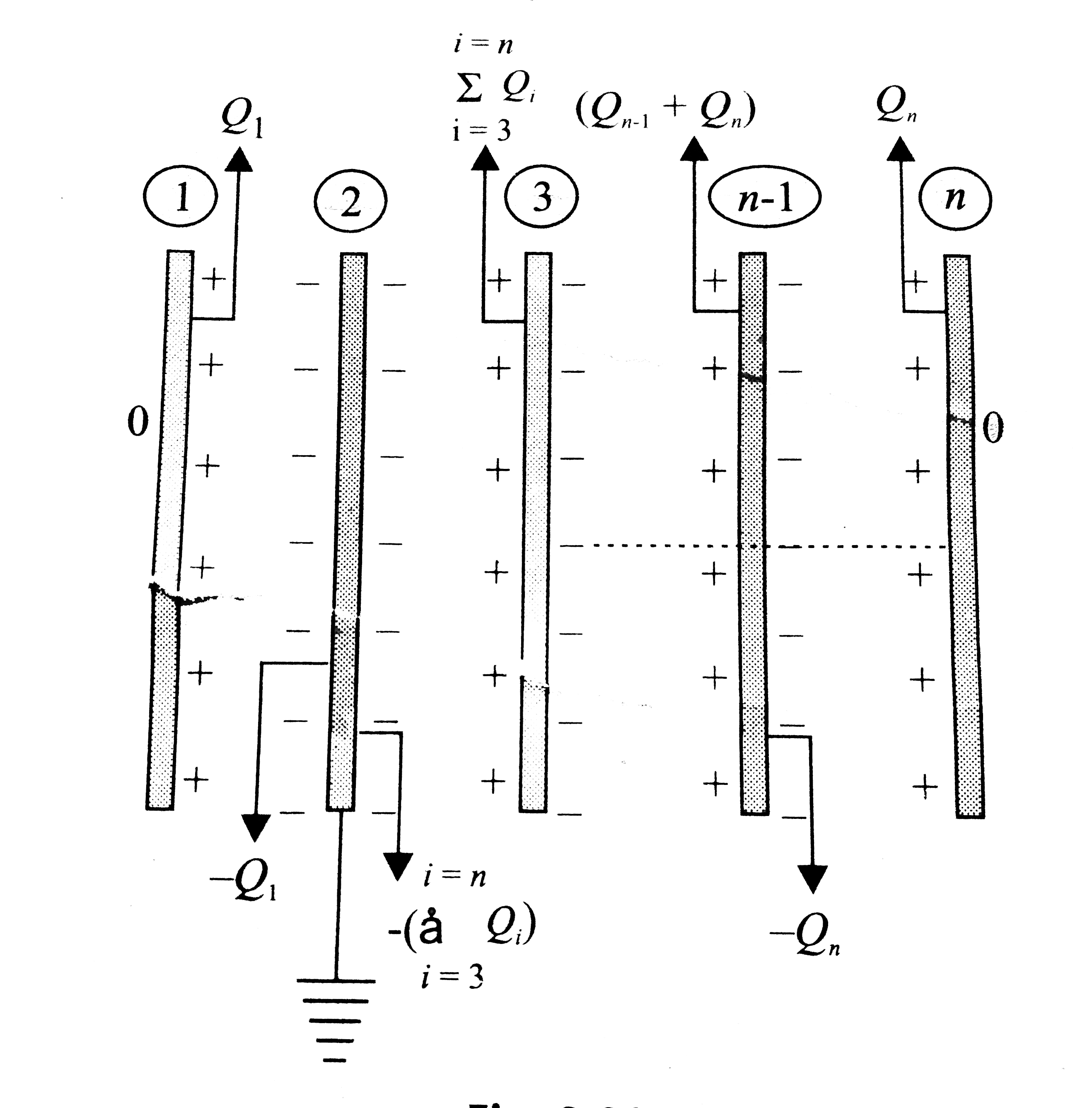
Let the second plate from the left be earthed. The
charge on the outermost surfaces of the plate should be zero.
Initial charge in plate `2 = Q_2`
Final charge in plate `2 = -Q_1-sum_(i=3)^(i=n)Q_i`
Let the charge flowing from plate to earth be y.

`:. -Q_1 - sum_(i=3)^(i=n)Q_i+y= Q_2`
or `y = Q_1+Q_2 + sum_(i=3)^(i=n)Q_i = sum_(i=1)^(i=n)Q_i`
Hence, if we connect any plate with earth, the charge
flowing from the plate to earth will be ` sum_(i=1)^(i=n)Q_i`.
Promotional Banner

Topper's Solved these Questions

  • ELECTRIC FLUX AND GAUSS LAW

    CENGAGE PHYSICS ENGLISH|Exercise Exercise 2.1|16 Videos
  • ELECTRIC FLUX AND GAUSS LAW

    CENGAGE PHYSICS ENGLISH|Exercise Exercise 2.2|14 Videos
  • ELECTRIC FLUX AND GAUSS LAW

    CENGAGE PHYSICS ENGLISH|Exercise MCQ s|38 Videos
  • ELECTRIC CURRENT AND CIRCUIT

    CENGAGE PHYSICS ENGLISH|Exercise Interger|8 Videos
  • ELECTRIC POTENTIAL

    CENGAGE PHYSICS ENGLISH|Exercise DPP 3.5|15 Videos

Similar Questions

Explore conceptually related problems

Two large plates are given the charges as shown in figure. Now, the left plane is earthed. Find the amount of charge that will flow from the earth to the plate.

Figure shows three large metallic plates with chrges -Q, 3Q and Q respectively. Determine the final charges on all the surfaces.

Figure shows three metallic plates with charges Q, 4Q, and -Q, respectively. Determine the final charges on all the surfaces.

Two large parallel conducting sheets (placed at finite distance) are given charges Q and 2Q respectively. Find out charges appearing on all the surfaces.

The nagative plate of a parallel plate capacitor is given a charge of -20 X 10^(-8) C . Find the charges appearing on the four surface of the capacitor plates.

Two large conducting plates of a parallel plate capacitor are given charges Q and 3Q respectively. If the electric field in the region between the plates is E_0 , then the force of interaction between the plates is

A parallel plate capacitor has capacitance C. If the charges of the plates are Q and -3Q , find of the i. charges at the inner surfaces of the plates ii. Potential difference between the plates iii. charge flown if the plates are connected iv. energy lost by the capacitor in (iii.) v. charge flown if any plate is earthed.

In front of an earthed conductor a point charge +q is placed a shown in figure

The charge flowing in a conductor varies with times as Q = at - bt^2. Then, the current

The charge flowing in a conductor varies with times as Q = at - bt^2. Then, the current