Home
Class 12
PHYSICS
An infinitely long line charge having a ...

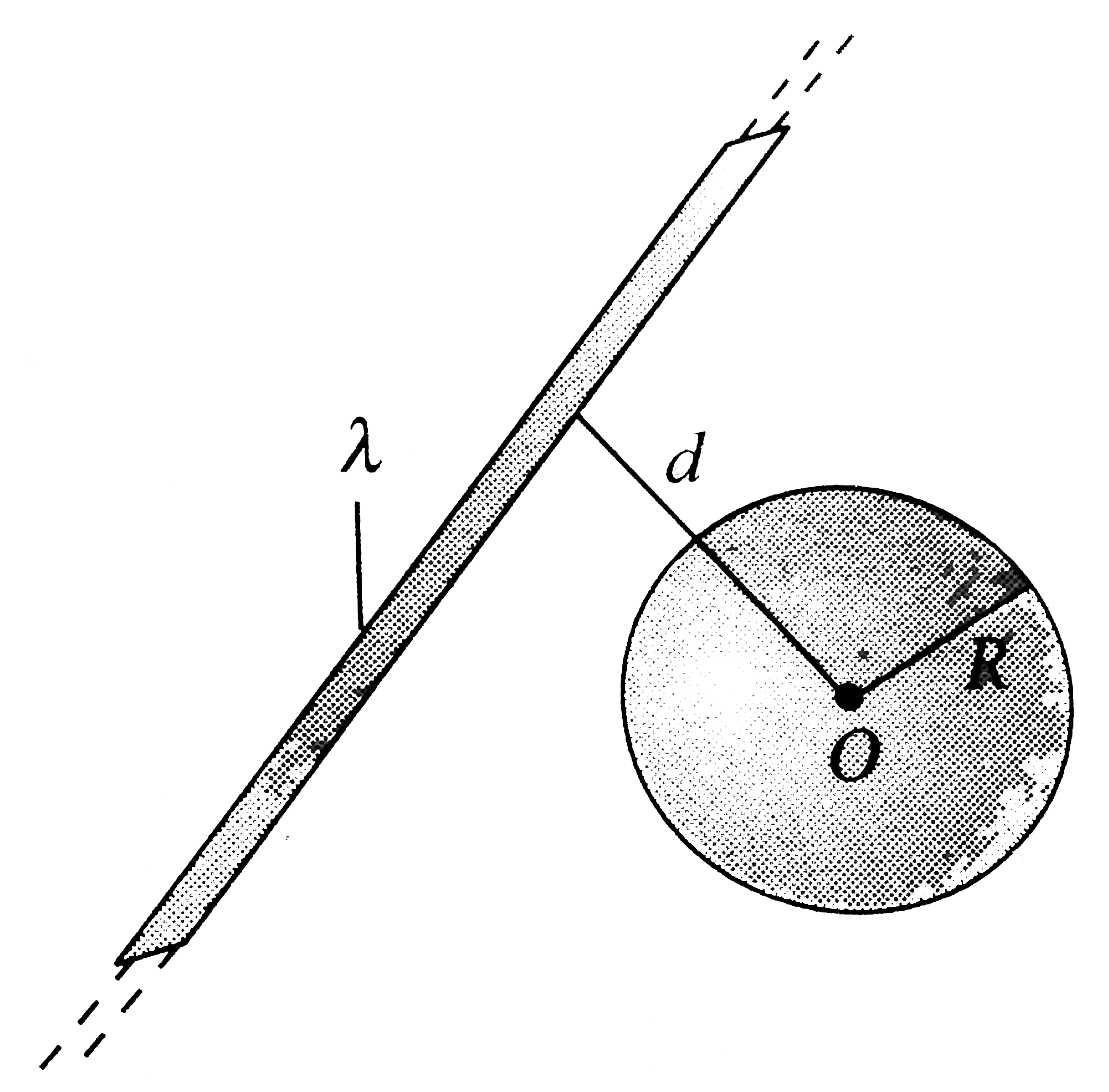
An infinitely long line charge having a uniform charge per unit length `lambda` lies at a distance d from a point O as shown in figure. Determine the total electric flux through through the surface of a sphere of radius R centered at O resulting from this line charge. Consider both cases where `Rltd` and `Rgtd`.

Text Solution

Verified by Experts

The correct Answer is:
`(2 lambda sqrt(R^(2) - d^(2)))/(epsilon_(0))`

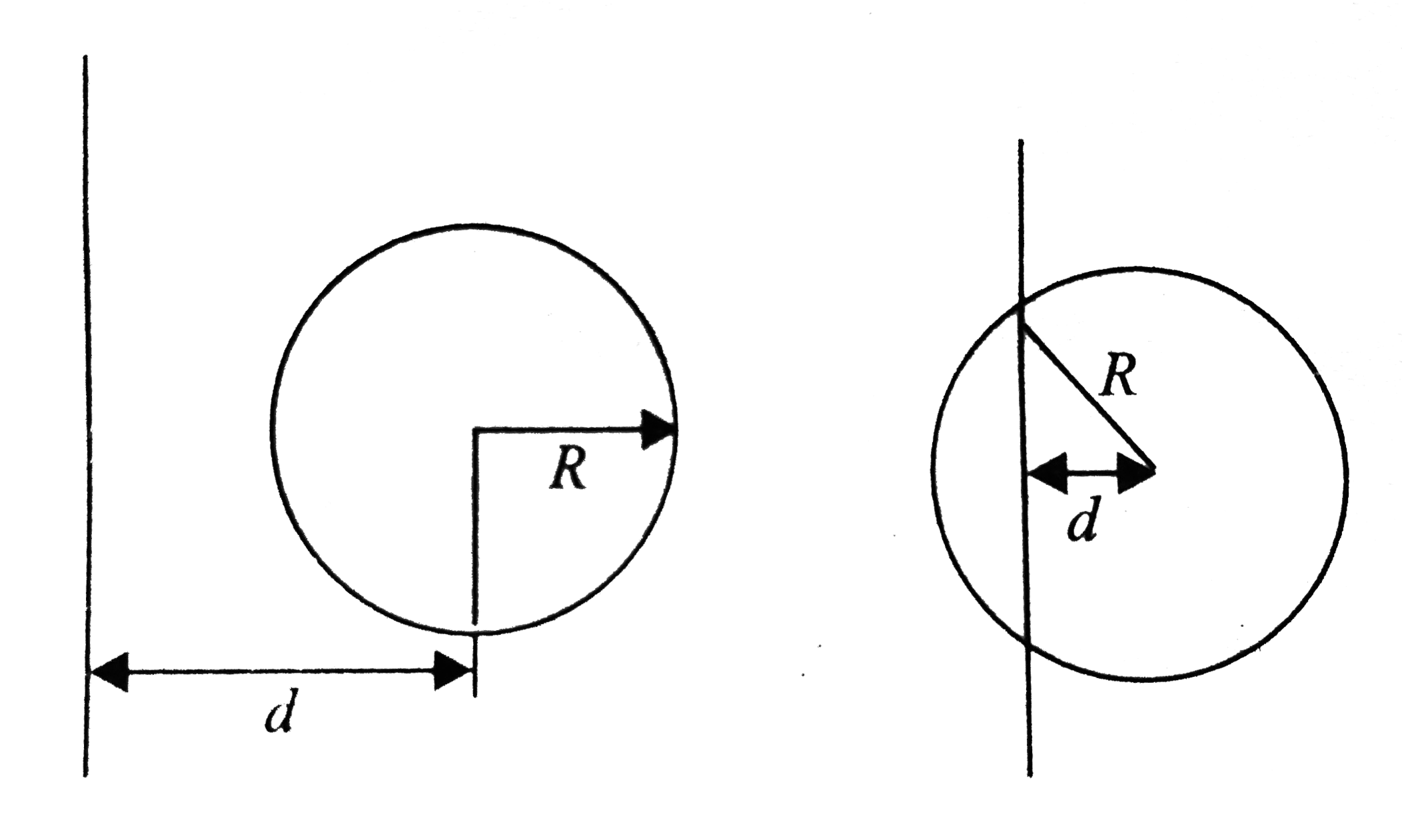
For Rltd, the flux will be zero. It is because there is no charge
line inside the sphere figure. For Rltd, the length inside the sphere is `2(sqrt(R^2-d^2))`. So the charge inside is `2lambda sqrt(R^2-d^2)`.
Thus `phi = (2lambdasqrt(R^2-d^2))/epsilon_0`
Promotional Banner

Topper's Solved these Questions

  • ELECTRIC FLUX AND GAUSS LAW

    CENGAGE PHYSICS ENGLISH|Exercise Single Correct|40 Videos
  • ELECTRIC FLUX AND GAUSS LAW

    CENGAGE PHYSICS ENGLISH|Exercise Multiple Correct|8 Videos
  • ELECTRIC FLUX AND GAUSS LAW

    CENGAGE PHYSICS ENGLISH|Exercise Exercise 2.2|14 Videos
  • ELECTRIC CURRENT AND CIRCUIT

    CENGAGE PHYSICS ENGLISH|Exercise Interger|8 Videos
  • ELECTRIC POTENTIAL

    CENGAGE PHYSICS ENGLISH|Exercise DPP 3.5|15 Videos

Similar Questions

Explore conceptually related problems

A uniformly charged and infinitely long line having a linear charge density 'lambda' is placed at a normal distance y from a point O . Consider a sphere of radius R with O as centre and Rgty . Electric flux through the surface of the sphere is

A uniformly charged and infinitely long line having a linear charge density 'lambda' is placed at a normal distance y from a point O . Consider a sphere of radius R with O as centre and Rgty . Electric flux through the surface of the sphere is

A long wire with a uniform charge density lambda is bent in two configurations shown in fig. Determine the electric field intensity at point O.

An uncharged metallic solid sphere of radius R is placed at a distance 2R from point charge Q as shown in figure. The electric field intensity due to induced charge at centre of sphere is

An infinite, uniformly charged sheet with surface charge density sigma cuts through a spherical Gaussian surface of radius R at a distance X from its center, as shown in the figure. The electric flux Phi through the Gaussian surface is .

A point charge q is placed at a distance d from the centre of a circular disc of radius R. Find electric flux flowing through the disc due to that charge

(i) Two infinitely long line charges each of linear charge density lambda are placed at an angle theta as shown in figure. Find out electric field intensity at a point P, which is at a distance x from point O along angle bisector of line charges. (ii) Repeat the above question if the line charge densities are lambda and -lambda . as shown in figure.

Two infinitely large charged planes having uniform surface change density + sigma and - sigma are placed along xy plane and yz plane resp as shown in figure. Then nature of electric lines of force in xz plane is given by

An infinity long uniform line charge distribution of charge per unit length lambda lies parallel to the y-axis in the y-z plane at z=sqrt3/2 a(see figure). If the magnitude of the flux of the electric field through the rectangular surface ABCD lying in the x-y plane with its centre at the origin is (lambdaL)/(nepsilon_0) ( epsilon_0= permittivity of free space), then the value of n is

Between two infinitely long wires having linear charge densities lambda and - lambda , there are two points A and B as shown in the figure. The amount of work done by the electric field in moving a point charge q_(0) from A to B is equal to :

