Home
Class 12
PHYSICS
Find the electric flux crossing the wire...

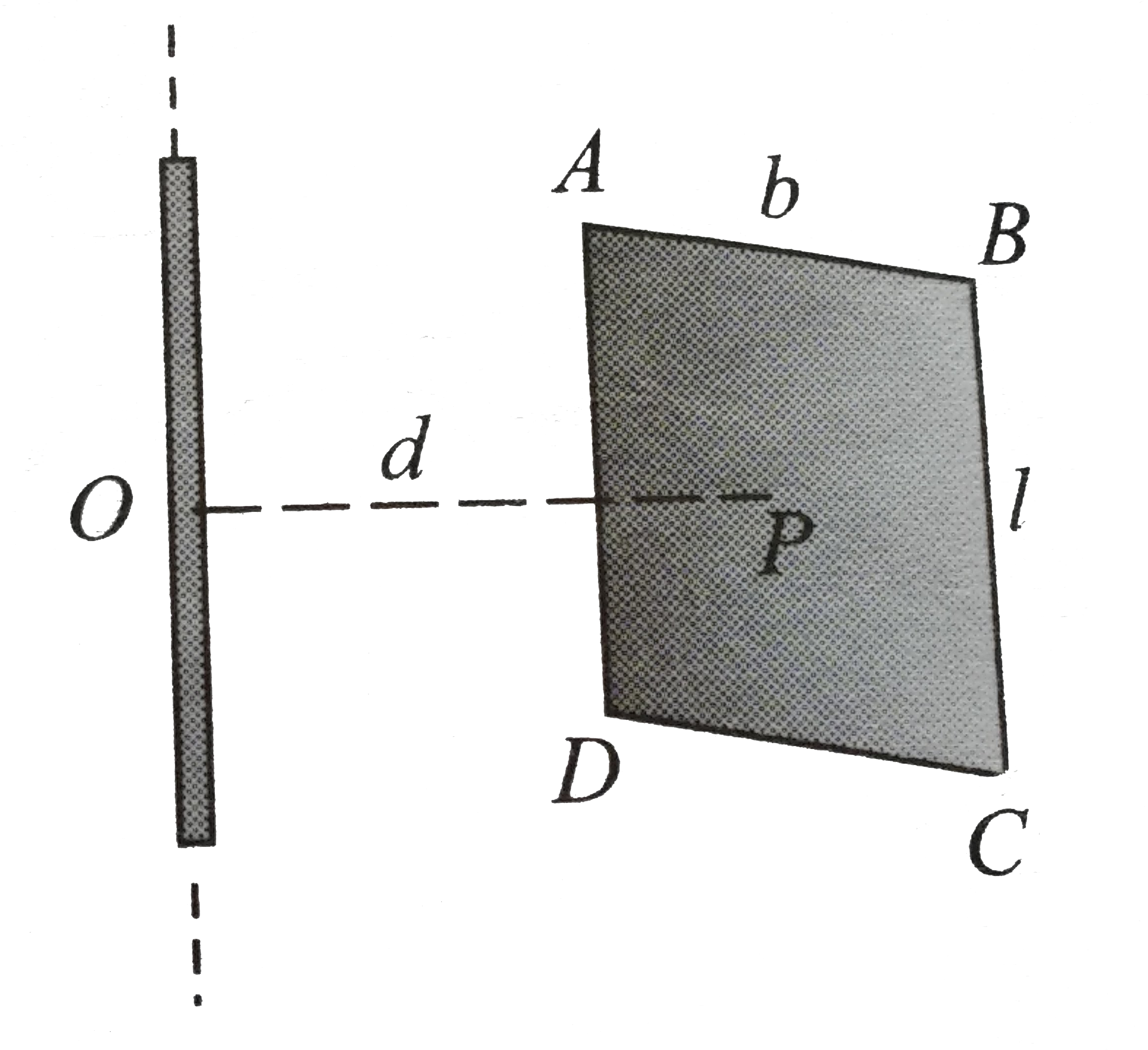
Find the electric flux crossing the wire frame ABCD of length l, width b, and center at a distance OP = d from an infinite line of charge with linear charge density `lambda`. Consider that the plane of the frame is perpendicular to the line OP

Text Solution

Verified by Experts

The correct Answer is:
`(lambda l)/( pi epsilon_(0)) tan^(-1) ((b)/( 2 d))`

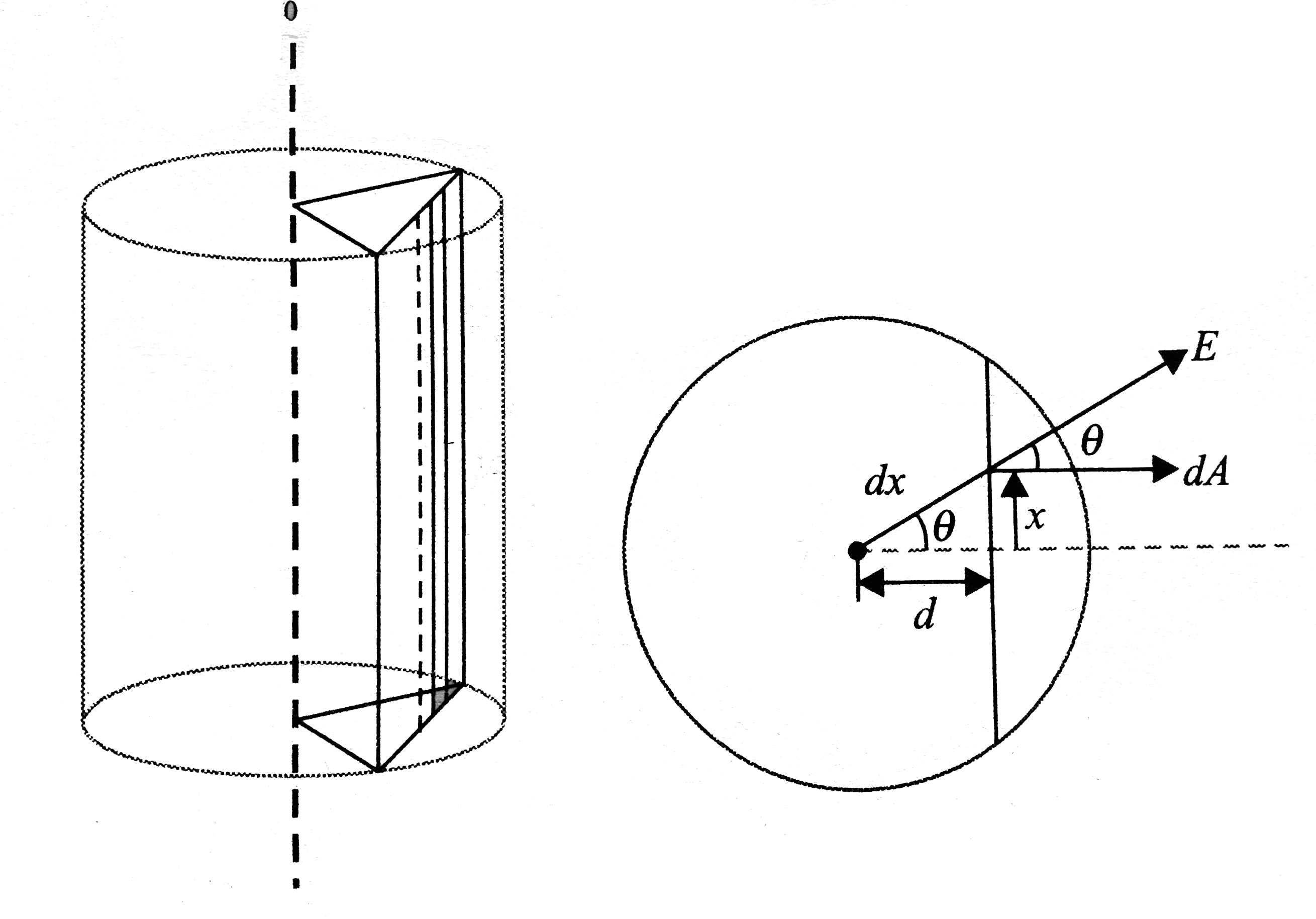
The flux passing through the strip of area dA is
`dphi = EdA cos theta`
`= lambda/(2piepsilon_0sqrt(d^2+x^2)) (ldx) d/(sqrt(d^2+x^2))`
`= (lambdadl)/(2piepsilon_0) (dx)/(d^2+x^2)`
`:. Phi = int dphi = (lambdadl)/(2piepsilon_0) int_(-b//2)^(b//2) (dx)/(d^2+x^2)`
`= (lambdadl)/(2piepsilon_0) 1/d [ tan^(-1)x/d]_(-b//2)^(b//2)`
`= (lambdal)/(2piepsilon_0) xx 2 tan^(-1) (b/(2d))`
` = (lambdal)/(piepsilon_0) tan^(-1) (b/(2d))`
.
Alternative method
The number of lines passing through a surface is proportional to the
flux passing through the surface. The number of lines passing through
the plane surface ABCD is equal to the number of lines passing
through the curved surface. The amount of flux passing through the
plane surface is equal to the line flux passing through the curved
surface.
From figure , `tan (theta/2) = (b/(2d)) or theta = 2tan^(-1) (b/(2d))`
`2pi` angle corresponds to flux `lambdal//epsilon_0`.
Hence, `theta` angle corresponds to the flux, i.e.,
`phi = theta/(2pi) ((lambdal)/(epsilon_0)) = (lambdal)/(piepsilon_0) tan^(-1) (b/(2d))`
.
Promotional Banner

Topper's Solved these Questions

  • ELECTRIC FLUX AND GAUSS LAW

    CENGAGE PHYSICS ENGLISH|Exercise Single Correct|40 Videos
  • ELECTRIC FLUX AND GAUSS LAW

    CENGAGE PHYSICS ENGLISH|Exercise Multiple Correct|8 Videos
  • ELECTRIC FLUX AND GAUSS LAW

    CENGAGE PHYSICS ENGLISH|Exercise Exercise 2.2|14 Videos
  • ELECTRIC CURRENT AND CIRCUIT

    CENGAGE PHYSICS ENGLISH|Exercise Interger|8 Videos
  • ELECTRIC POTENTIAL

    CENGAGE PHYSICS ENGLISH|Exercise DPP 3.5|15 Videos

Similar Questions

Explore conceptually related problems

Find the electric flux (in S.I. unit) through the rectangular plate abcd of length l = 2m width L and whose centre is at a distance OP = x_(0) = L/2 from an infinite line of charge with linear charge density lambda = 1/(36 pi) xx 10^(-9) Cm^(-1) . Consider that the plate of the frame is perpendicular to line OP.

The electric field at distance .r. from infinte line of charge ("having linear charge density" lambda) is

Intensity of electric field at a point at a perpendicular distance .r. from an infinite line charge, having linear charge density .lambda. is given by :

For an infinite line of charge having linear charge density lambda lying along x-axis the work done in moving a charge q form C to A along CA is

Consider an infinite line charge having uniform linear charge density and passing through the axis of a cylinder is removed.

Find the force experienced by a semicircular rod having a charge q as shown in fig. Radius of the wire is R, and the line of charge with linear charge density lambda passes through its center and is perpendicular to the plane of wire.

Intensity of electric field at a perpendicular distance of 0.5 m from an infinitely long line charge having linear charge density (lamda) is 3.6 xx 10^(3) Vm^(-1) . Find the value of lamda

Electric field at a point of distance r from a uniformly charged wire of infinite length having linear charge density lambda is directly proportional to

A charge particle q is released at a distance R_(@) from the infinite long wire of linear charge density lambda . Then velocity will be proportional to (At distance R from the wire)

A point charge q is placed at a distance r from a very long charged thread of unoform linear charge density lambda . Find out total electric force experienced by the line charge due to the point charge. (Neglect gravity).