Home
Class 12
PHYSICS
A solid insulating sphere of radius R ha...

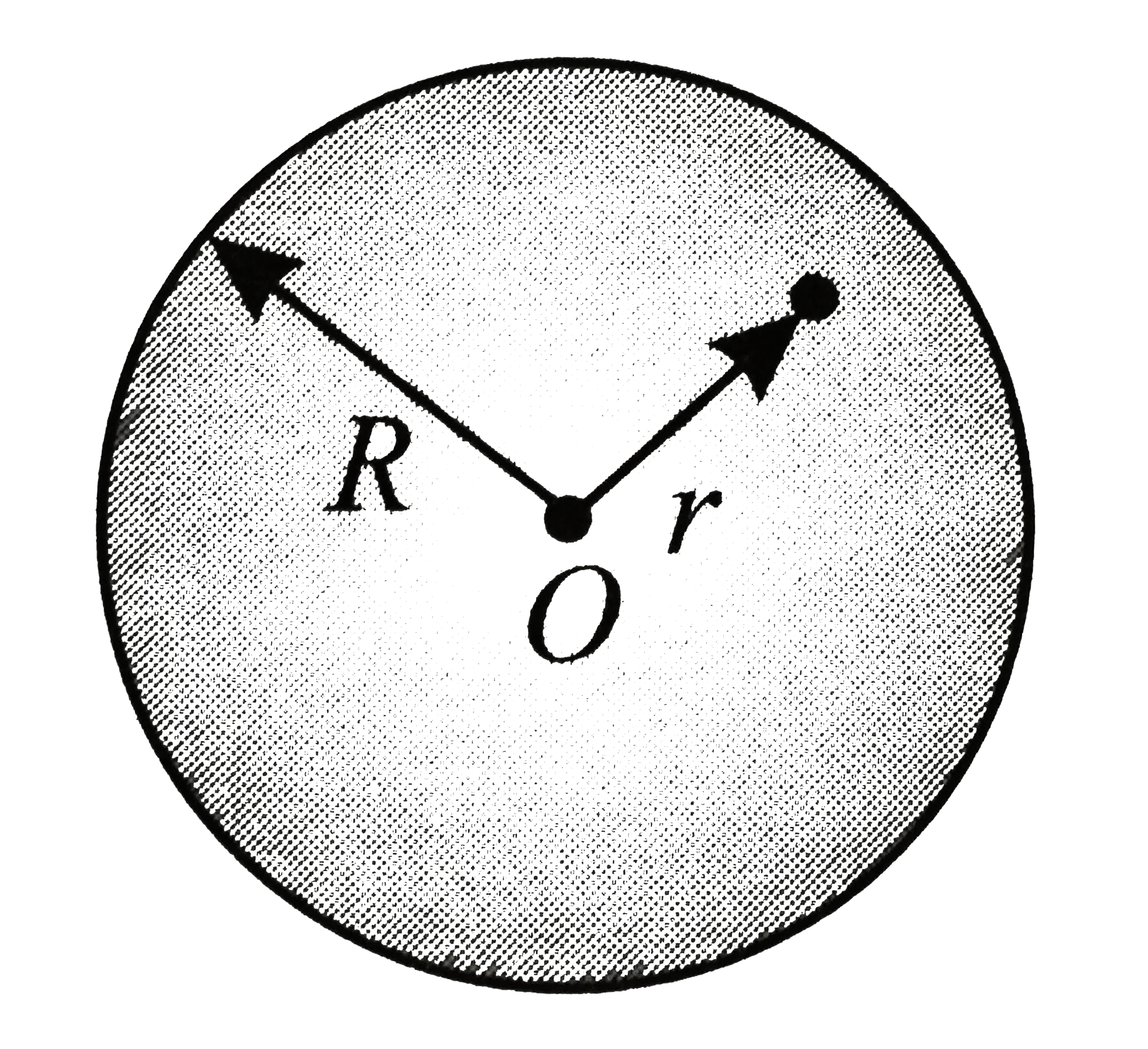
A solid insulating sphere of radius R has a nonuniform charge density that varies with r according to the expression `rho = Ar^2`, where A is a constant and `rltR` is measured from the centre of the sphere. Show that (a) the magnitude of the electric field outside `(rgtR)` the sphere is `E = AR^5//5epsilon_0r^2` and (b) the magnitude of the electric field inside `(rltR)` the sphere is `E = Ar^3//5epsilon_0`.

Text Solution

Verified by Experts
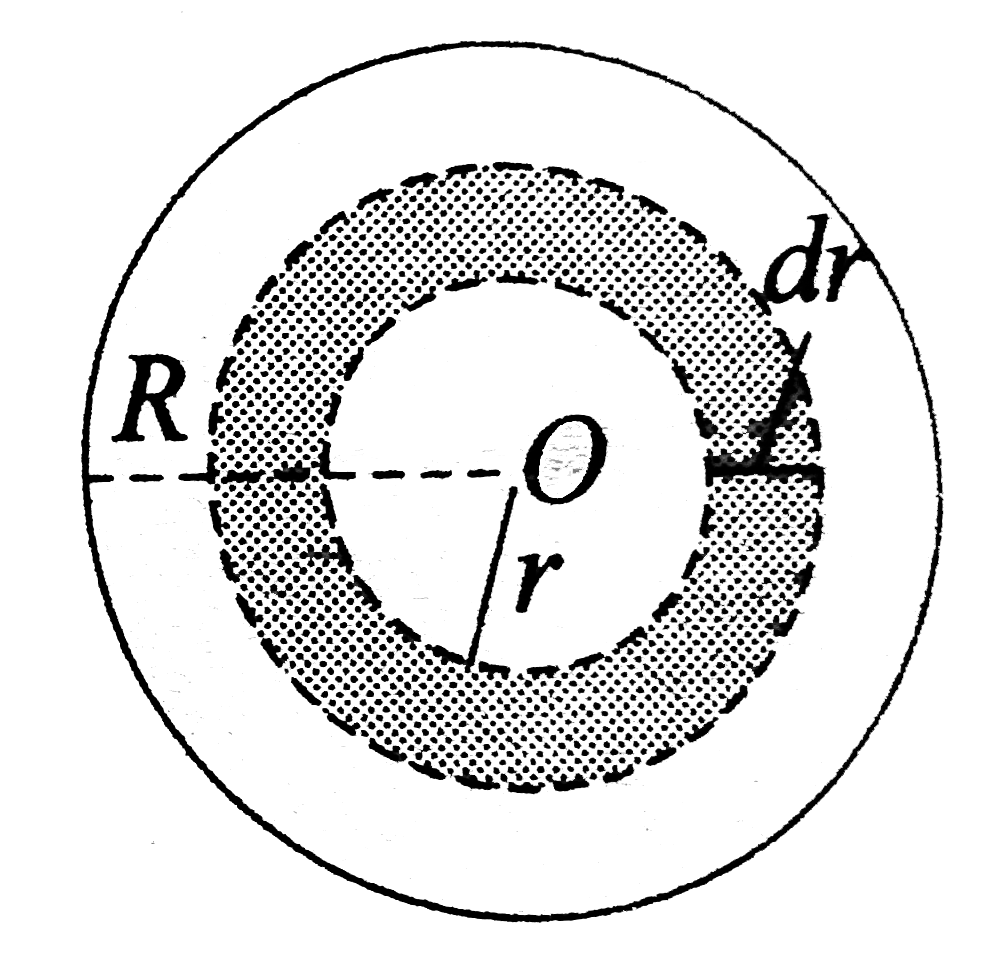
`intEdA = E(4pir^2) = q_("in")/epsilon_0`
(a) For `r gtR, q_("in") = int_(0)^® Ar^2 (4pir^2)dr = 4pi (AR^5)/5`
So `E = (AR^5)/(5epsilon_0r^2)`
(b) For rltR, `q_("in") = int_(0)^(R) Ar^2(4pir^2)dr = (4piAr^5)/5`
So `E = (Ar^3)/(5epsilon_0)`.
Promotional Banner

Topper's Solved these Questions

  • ELECTRIC FLUX AND GAUSS LAW

    CENGAGE PHYSICS ENGLISH|Exercise Single Correct|40 Videos
  • ELECTRIC FLUX AND GAUSS LAW

    CENGAGE PHYSICS ENGLISH|Exercise Multiple Correct|8 Videos
  • ELECTRIC FLUX AND GAUSS LAW

    CENGAGE PHYSICS ENGLISH|Exercise Exercise 2.2|14 Videos
  • ELECTRIC CURRENT AND CIRCUIT

    CENGAGE PHYSICS ENGLISH|Exercise Interger|8 Videos
  • ELECTRIC POTENTIAL

    CENGAGE PHYSICS ENGLISH|Exercise DPP 3.5|15 Videos

Similar Questions

Explore conceptually related problems

A solid non conducting sphere of radius R has a non-uniform charge distribution of volume charge density, rho=rho_(0)r/R , where rho_(0) is a constant and r is the distance from the centre of the sphere. Show that : (i) the total charge on the sphere is Q=pirho_(0)R^(3) (ii) the electric field inside the sphere has a magnitude given by, E=(KQr^(2))/R^(4)

A non-conducting solid sphere of radius R, has a uniform charge density. The graph representing variation of magnitude of electric field (E) as a function of distance (x) from the centre of the sphere is

A system consits of a uniformly charged sphere of radius R and a surrounding medium filled by a charge with the volume density rho=alpha/r , where alpha is a positive constant and r is the distance from the centre of the sphere. Find the charge of the sphere for which the electric field intensity E outside the sphere is independent of R.

An insulating solid sphere of the radius R is charged in a non - uniform manner such that the volume charge density rho=(A)/(r ) , where A is a positive constant and r is the distance from the centre. The potential difference between the centre and surface of the sphere is

A solid sphere of radius R has a charge Q distributed in its volume with a charge density rho=kr^a , where k and a are constants and r is the distance from its centre. If the electric field at r=(R)/(2) is 1/8 times that r=R , find the value of a.

A positively charge sphere of radius r_0 carries a volume charge density rho . A spherical cavity of radius r_0//2 is then scooped out and left empty. C_1 is the center of the sphere and C_2 that of the cavity. What is the direction and magnitude of the electric field at point B?

Let P(r)=(Q)/(piR^4)r be the charge density distribution for a solid sphere of radius R and total charge Q. For a point 'p' inside the sphere at distance r_1 from the centre of the sphere, the magnitude of electric field is:

Let rho(r)=(Qr)/(piR^(4)) be the charge density distribution for a soild sphere of radius R and total charge Q. For a point P inside the sphere at a distance r_(1) from the centre of the sphere, the magnitude of electric field is

A non-conducting solid sphere of radius R is uniformly charged. The magnitude of the electric filed due to the sphere at a distance r from its centre

A sphere of radius R carries charge such that its volume charge density is proportional to the square of the distance from the centre. What is the ratio of the magnitude of the electric field at a distance 2 R from the centre to the magnitude of the electric field at a distance of R//2 from the centre?

