Home
Class 12
PHYSICS
Consider the previous problem , let the ...

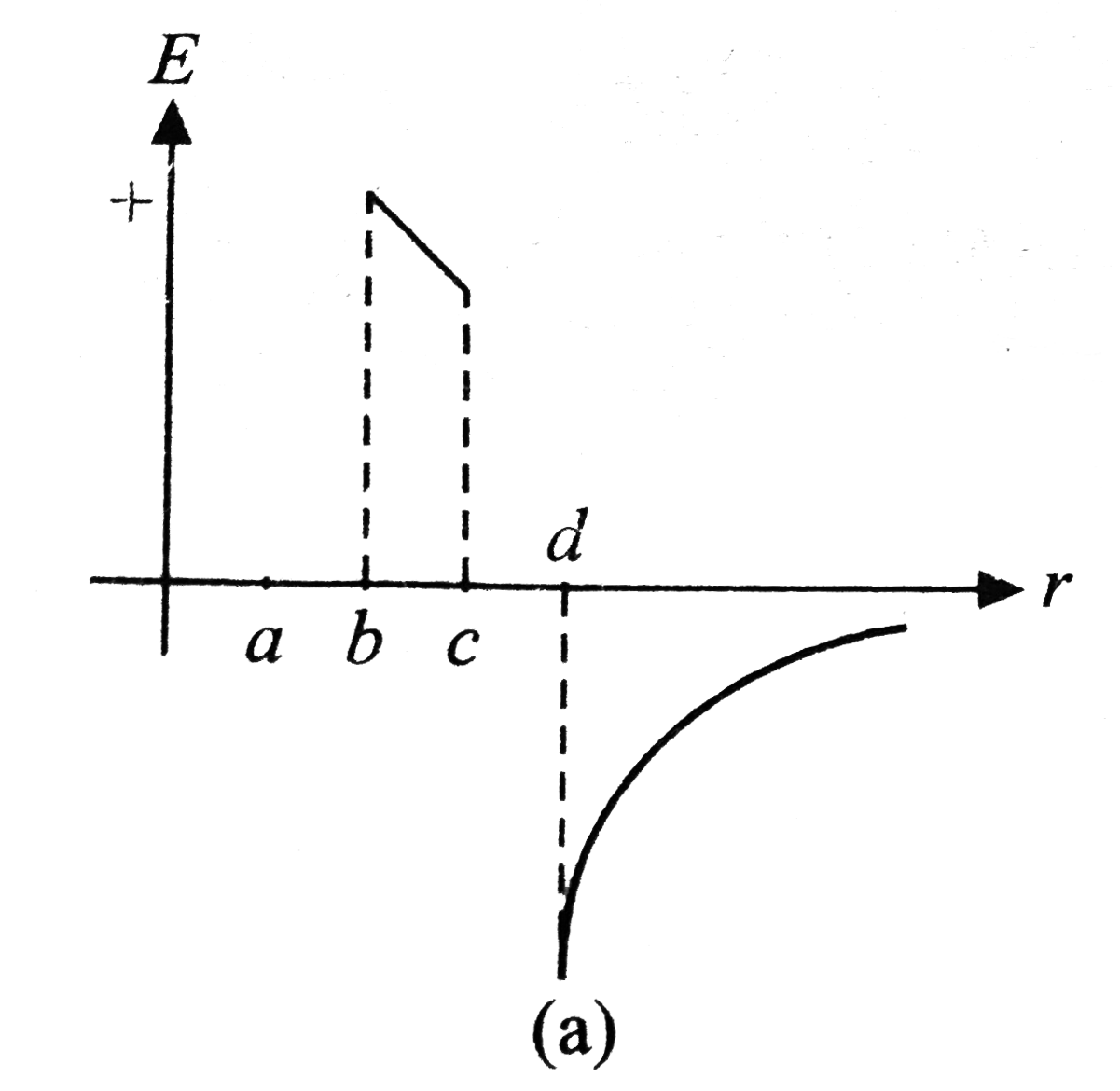
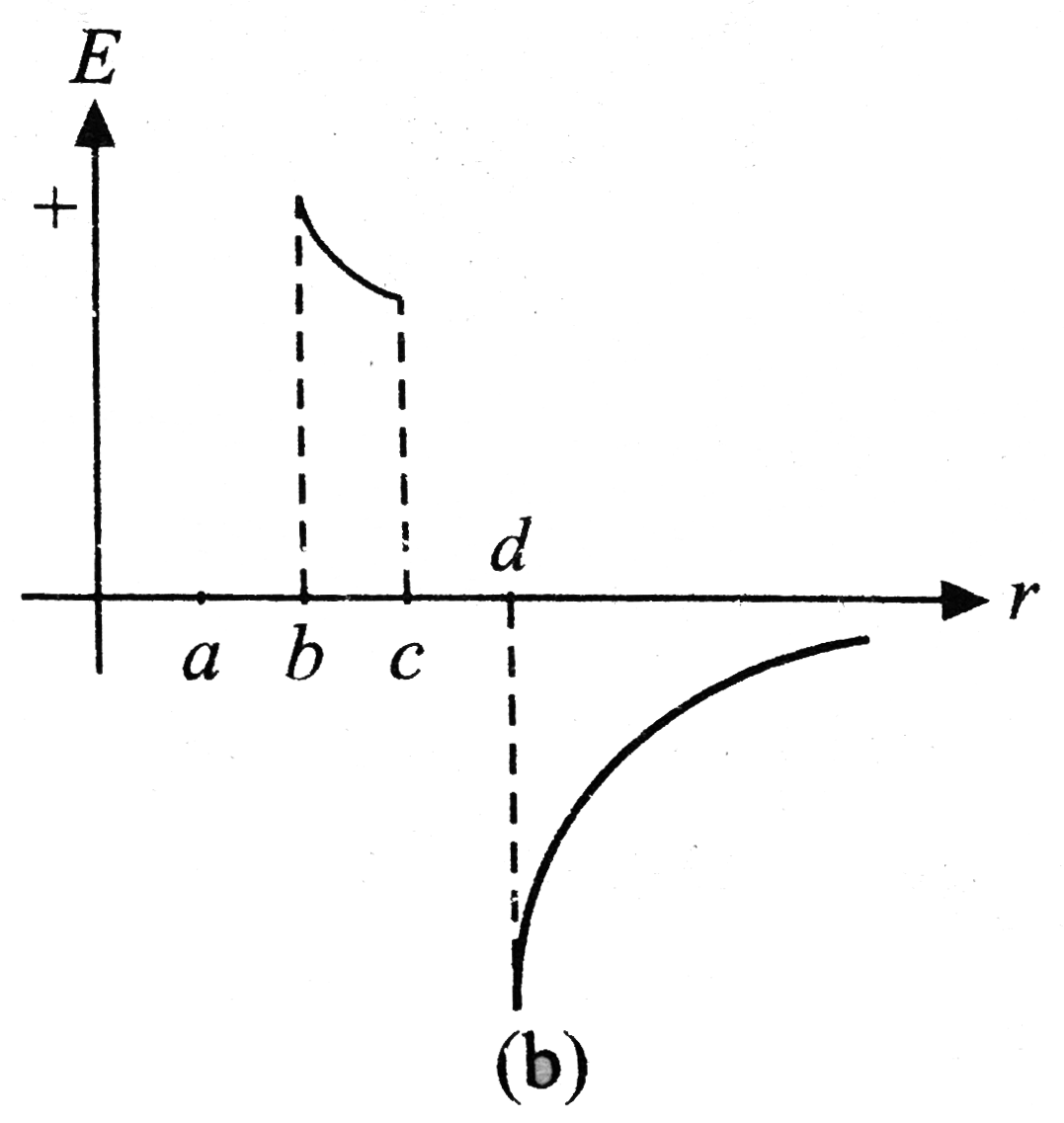
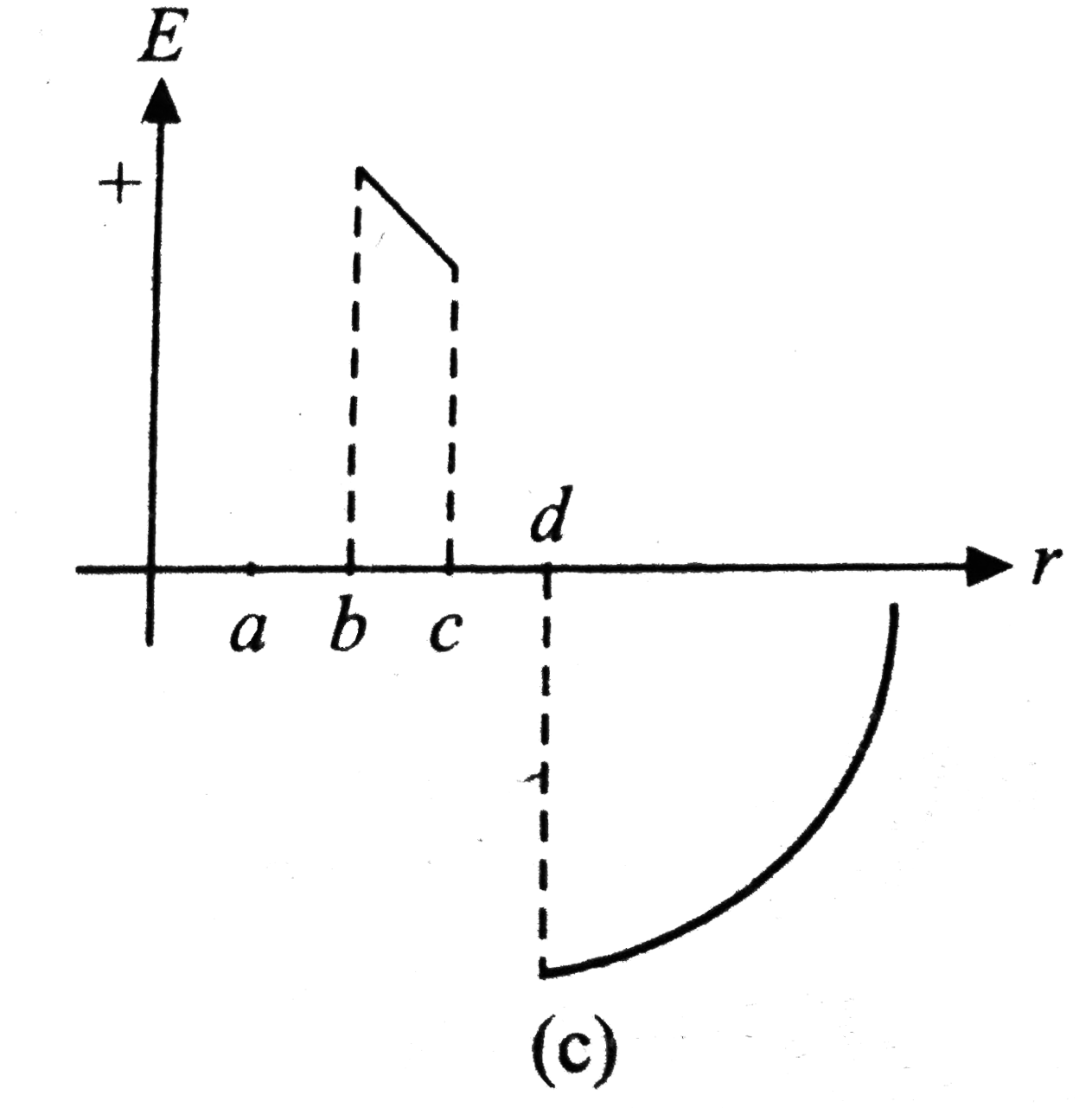
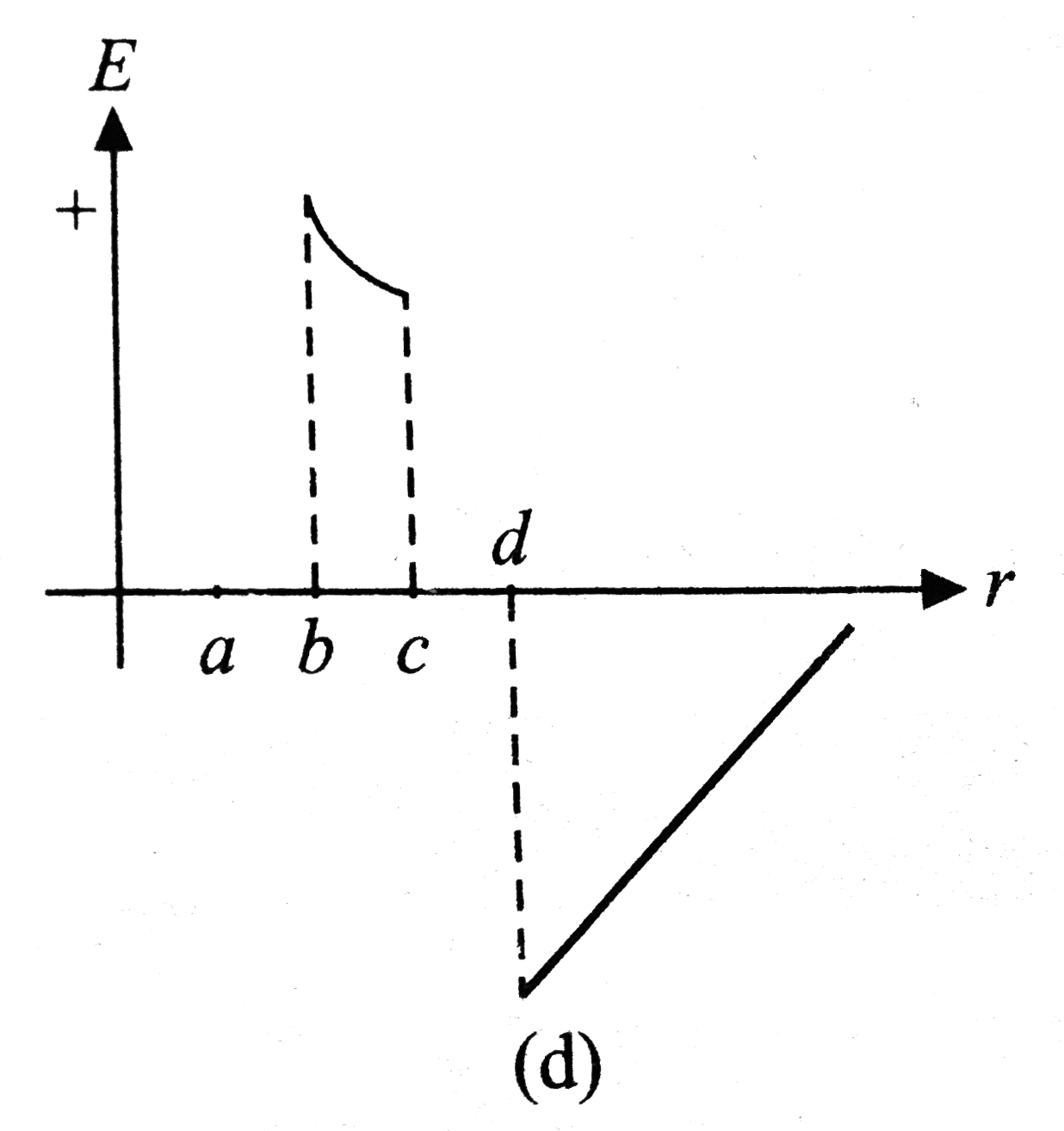
Consider the previous problem , let the outer shell have the charge ` - 4 q`. As in the above problem , the inner shell has the charge ` + 2q`. Calculate the electric field in terms of `q` and the distance `r` from the common center of the two shells for
The graph of the radial component of `E` as function of `r` will be

A

B

C

D

Text Solution

AI Generated Solution

The correct Answer is:

To solve the problem, we need to calculate the electric field \( E \) at different regions defined by the distances \( r \) from the common center of the two shells. We have two spherical shells: an inner shell with charge \( +2q \) and an outer shell with charge \( -4q \). ### Step-by-Step Solution: 1. **Identify the Regions**: We will analyze the electric field in three distinct regions: - Region I: Inside the inner shell ( \( r < R_1 \) ) - Region II: Between the inner and outer shells ( \( R_1 < r < R_2 \) ) - Region III: Outside the outer shell ( \( r > R_2 \) ) 2. **Region I: Inside the Inner Shell ( \( r < R_1 \) )**: - By Gauss's law, the electric field inside a conductor or a shell with no enclosed charge is zero. - Therefore, \( E = 0 \) for \( r < R_1 \). 3. **Region II: Between the Shells ( \( R_1 < r < R_2 \) )**: - Here, we only consider the charge of the inner shell, since the outer shell's charge does not affect the electric field in this region. - The enclosed charge \( Q_{\text{enc}} = +2q \). - Applying Gauss's law: \[ \oint \vec{E} \cdot d\vec{A} = \frac{Q_{\text{enc}}}{\epsilon_0} \] The area \( A = 4\pi r^2 \), thus: \[ E \cdot 4\pi r^2 = \frac{2q}{\epsilon_0} \] Hence, \[ E = \frac{2q}{4\pi \epsilon_0 r^2} = \frac{q}{2\pi \epsilon_0 r^2} \] 4. **Region III: Outside the Outer Shell ( \( r > R_2 \) )**: - In this region, we consider the total enclosed charge, which is the sum of the charges of both shells. - The total enclosed charge \( Q_{\text{enc}} = +2q - 4q = -2q \). - Again applying Gauss's law: \[ E \cdot 4\pi r^2 = \frac{-2q}{\epsilon_0} \] Therefore, \[ E = \frac{-2q}{4\pi \epsilon_0 r^2} = \frac{-q}{2\pi \epsilon_0 r^2} \] ### Summary of Electric Field in Different Regions: - For \( r < R_1 \): \( E = 0 \) - For \( R_1 < r < R_2 \): \( E = \frac{q}{2\pi \epsilon_0 r^2} \) - For \( r > R_2 \): \( E = \frac{-q}{2\pi \epsilon_0 r^2} \)

To solve the problem, we need to calculate the electric field \( E \) at different regions defined by the distances \( r \) from the common center of the two shells. We have two spherical shells: an inner shell with charge \( +2q \) and an outer shell with charge \( -4q \). ### Step-by-Step Solution: 1. **Identify the Regions**: We will analyze the electric field in three distinct regions: - Region I: Inside the inner shell ( \( r < R_1 \) ) - Region II: Between the inner and outer shells ( \( R_1 < r < R_2 \) ) ...
Promotional Banner

Topper's Solved these Questions

  • ELECTRIC FLUX AND GAUSS LAW

    CENGAGE PHYSICS ENGLISH|Exercise Subjective type|7 Videos
  • ELECTRIC FLUX AND GAUSS LAW

    CENGAGE PHYSICS ENGLISH|Exercise MCQ s|38 Videos
  • ELECTRIC FLUX AND GAUSS LAW

    CENGAGE PHYSICS ENGLISH|Exercise Multiple Correct|8 Videos
  • ELECTRIC CURRENT AND CIRCUIT

    CENGAGE PHYSICS ENGLISH|Exercise Interger|8 Videos
  • ELECTRIC POTENTIAL

    CENGAGE PHYSICS ENGLISH|Exercise DPP 3.5|15 Videos

Similar Questions

Explore conceptually related problems

Consider the previous problem , let the outer shell have the charge - 4 q . As in the above problem , the inner shell has the charge + 2q . Calculate the electric field in terms of q and the distance r from the common center of the two shells for r lt a

Consider the previous problem , let the outer shell have the charge - 4 q . As in the above problem , the inner shell has the charge + 2q . Calculate the electric field in terms of q and the distance r from the common center of the two shells for a lt r lt b

Consider the previous problem , let the outer shell have the charge - 4 q . As in the above problem , the inner shell has the charge + 2q . Calculate the electric field in terms of q and the distance r from the common center of the two shells for b lt r lt c

Consider the previous problem , let the outer shell have the charge - 4 q . As in the above problem , the inner shell has the charge + 2q . Calculate the electric field in terms of q and the distance r from the common center of the two shells for c lt r lt d

A small conducting spherical shell with inner radius a and outer radius b is concentric with a larger conducting spherical shell with inner radius c and outer radius d ( as shown in Fig . 2.121). The inner shell has a total charge + 2 q , and the outer shell has a total charge + 4 q . Calculate the electric field in terms of q and the distance r from the common center of the two shells for a lt r lt b

A small conducting spherical shell with inner radius a and outer radius b is concentric with a larger conducting spherical shell with inner radius c and outer radius d ( as shown in Fig . 2.121). The inner shell has a total charge + 2 q , and the outer shell has a total charge + 4 q . Calculate the electric field in terms of q and the distance r from the common center of the two shells for r lt a

A small conducting spherical shell with inner radius a and outer radius b is concentric with a larger conducting spherical shell with inner radius c and outer radius d ( as shown in Fig . 2.121). The inner shell has a total charge + 2 q , and the outer shell has a total charge + 4 q . Calculate the electric field in terms of q and the distance r from the common center of the two shells for b lt r lt c

A small conducting spherical shell with inner radius a and outer radius b is concentric with a larger conducting spherical shell with inner radius c and outer radius d ( as shown in Fig . 2.121). The inner shell has a total charge + 2 q , and the outer shell has a total charge + 4 q . Calculate the electric field in terms of q and the distance r from the common center of the two shells for c lt r ltd

A small conducting spherical shell with inner radius a and outer radius b is concentric with a larger conducting spherical shell with inner radius c and outer radius d. The inner shell has total charge +2q, and the outer shell has charge +4q. (K=(1)/(4piepsilon_(0))) Find the electric field in terms of q and the distance r from the common centre of the two shells for (i) b lt r lt c (ii) c lt r lt d

A small conducting spherical shell with inner radius a and outer radius b is concentric with a larger conducting sphereical shell with inner radius c and outer radius d. The inner shell has total charge +2q and the outer shell has charge +4q . a. Make a plot of the magnitude of the electric field versus r. b. Calculate the electric field ("magnitude and direction in terms of q") and the distance r from the common centre of the two shell for (i) rlta, (ii)altrltb, (iii) bltrltc, (iv) cltrltd , (v) rgtd . Show uour result in a graph with radial component of vecE as function of r . c. What is the total charge on the i. inner surface of the small shell, ii. outer surface of the small shell, iii. inner surface of the large shell, iv. outer surface of the large shell?

CENGAGE PHYSICS ENGLISH-ELECTRIC FLUX AND GAUSS LAW-Comprehension
  1. A small conducting spherical shell with inner radius a and outer radiu...

    Text Solution

    |

  2. Consider the previous problem , let the outer shell have the charge -...

    Text Solution

    |

  3. Consider the previous problem , let the outer shell have the charge -...

    Text Solution

    |

  4. Consider the previous problem , let the outer shell have the charge -...

    Text Solution

    |

  5. Consider the previous problem , let the outer shell have the charge -...

    Text Solution

    |

  6. Consider the previous problem , let the outer shell have the charge -...

    Text Solution

    |

  7. Consider the previous problem , let the outer shell have the charge -...

    Text Solution

    |

  8. Two spherical cavities of radii a and b are hollowed out from the inte...

    Text Solution

    |

  9. Two spherical cavities of radii a and b are hollowed out from the inte...

    Text Solution

    |

  10. Positive and negative charges of equal magnitude lie along the symmetr...

    Text Solution

    |

  11. Positive and negative charges of equal magnitude lie along the symmetr...

    Text Solution

    |

  12. There are two nonconducting spheres having uniform volume charge densi...

    Text Solution

    |

  13. There are two nonconducting spheres having uniform volume charge densi...

    Text Solution

    |

  14. Gauss's law and Coulomb's law , although expressed in different forms ...

    Text Solution

    |

  15. Gauss's law and Coulomb's law , although expressed in different forms ...

    Text Solution

    |

  16. Gauss's law and Coulomb's law , although expressed in different forms ...

    Text Solution

    |

  17. Gauss's law and Coulomb's law , although expressed in different forms ...

    Text Solution

    |

  18. A spherical conductor A contains two spherical cavities as shown in Fi...

    Text Solution

    |

  19. A spherical conductor A contains two spherical cavities as shown in Fi...

    Text Solution

    |

  20. A spherical conductor A contains two spherical cavities as shown in Fi...

    Text Solution

    |
