Home
Class 12
PHYSICS
Two spherical cavities of radii a and b ...

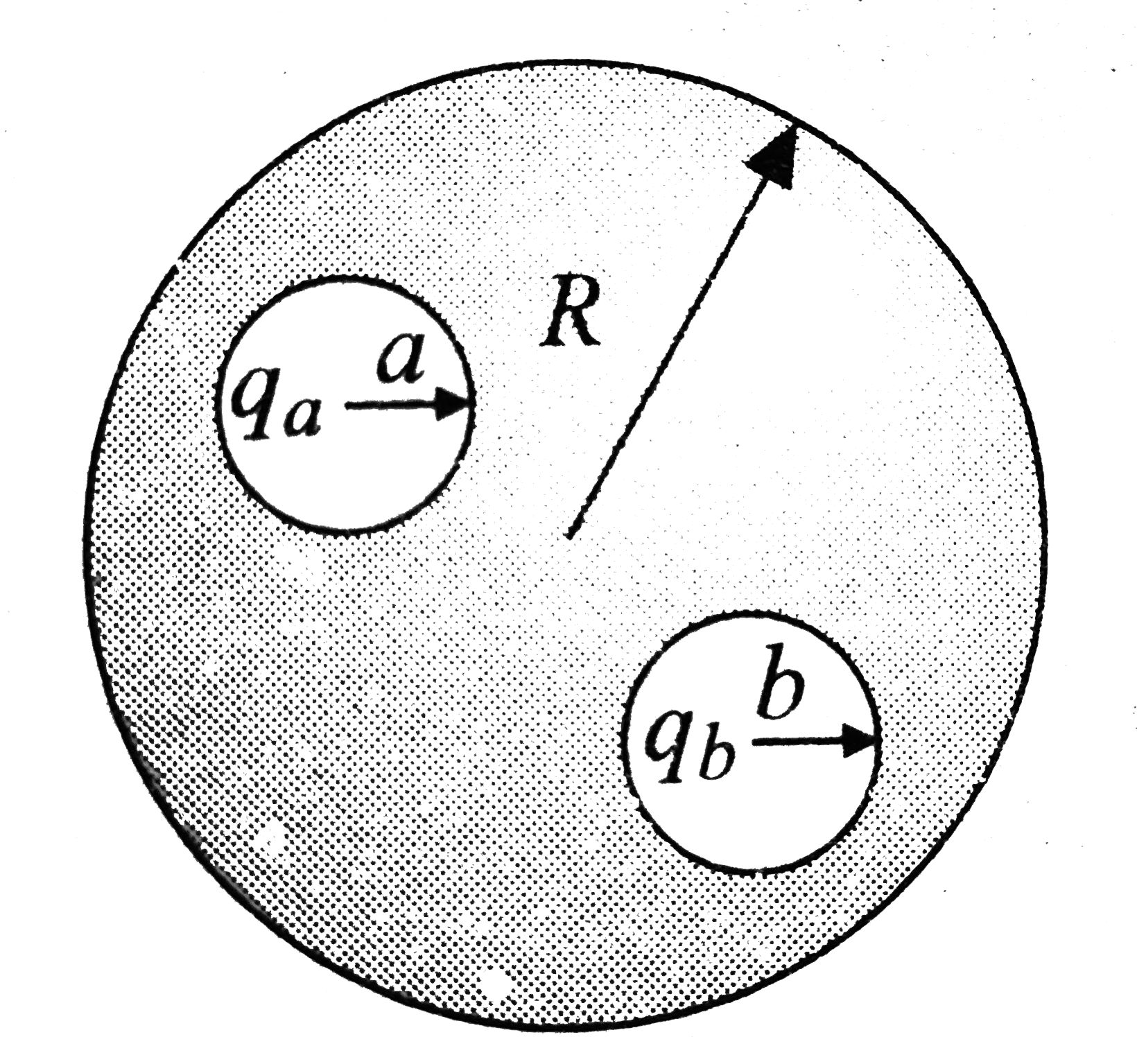
Two spherical cavities of radii `a` and `b` are hollowed out from the interior of a neutral conducting sphere of radius `R`. At the center of each cavity , a point charge is placed . Call these charges `q_(a)` and `q_(b)`.
The electric field inside the cavity of radius `a` at a distance `r` from the center of cavity is

A

`(1)/( 4 pi epsilon_(0)) (q_(a))/(r^(2))`

B

`(1)/( 4 pi epsilon_(0)) (q_(a))/(r^(2))`

C

`(1)/( 4 pi epsilon_(0)) ( q_(a) + q_(b))/( r^(2))`

D

zero

Text Solution

Verified by Experts

The correct Answer is:
A

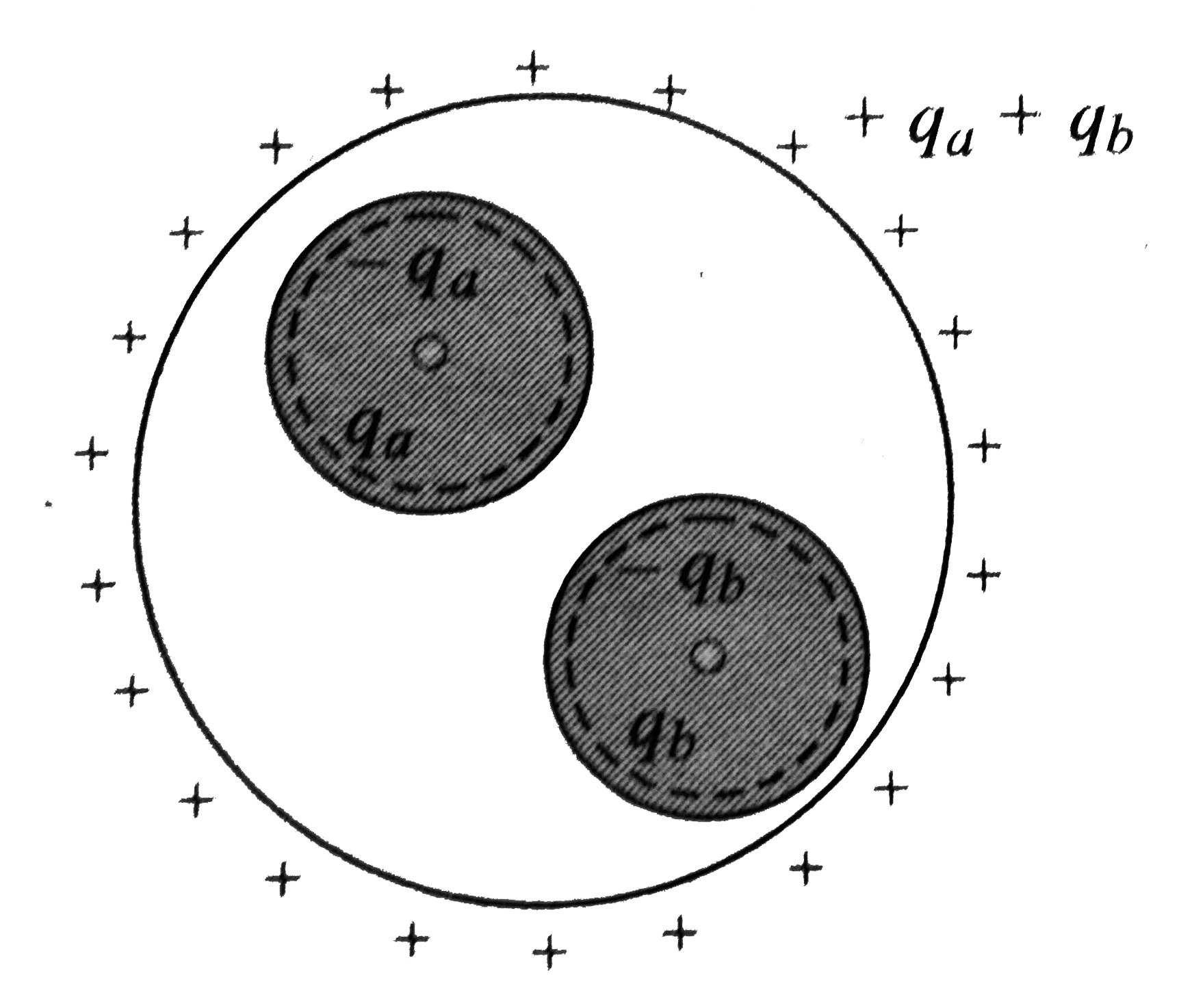
i. `sigma_(A) = ( - q_(a))/(4 pi a^(2)) , sigma_(B) = (-q_(b))/( 4 pi b^(2)) ,sigma_(R) = ( q_(a) + q_(b))/( 4 pi R^(2))`
ii. `E = (1)/( 4 pi epsilon_(0)) ( q_(a) + q_(b))/(r^(2))` ( Fig. S2.56)`
iii. `E_(a) = (1)/( 4 pi epsilon_(0)) (q_(a))/( r^(2))`
Promotional Banner

Topper's Solved these Questions

  • ELECTRIC FLUX AND GAUSS LAW

    CENGAGE PHYSICS ENGLISH|Exercise Subjective type|7 Videos
  • ELECTRIC FLUX AND GAUSS LAW

    CENGAGE PHYSICS ENGLISH|Exercise MCQ s|38 Videos
  • ELECTRIC FLUX AND GAUSS LAW

    CENGAGE PHYSICS ENGLISH|Exercise Multiple Correct|8 Videos
  • ELECTRIC CURRENT AND CIRCUIT

    CENGAGE PHYSICS ENGLISH|Exercise Interger|8 Videos
  • ELECTRIC POTENTIAL

    CENGAGE PHYSICS ENGLISH|Exercise DPP 3.5|15 Videos

Similar Questions

Explore conceptually related problems

Two spherical cavities of radii a and b are hollowed out from the interior of a neutral conducting sphere of radius R . At the center of each cavity , a point charge is placed . Call these charges q_(a) and q_(b) . The electric field at a distance r outside the conductor is

A conducting shell of radius R carries charge–Q. A point charge +Q is placed at the centre of shell. The electric field E varies with distance r (from the centre of the shell) as :

A conducting shell of radius R carries charge -Q . A point charge +Q is placed at the centre. The electric field E varies with distance r (from the centre of the shell) as

Inside a conducting hollow sphere of inner radius R_(1) and outer radius R_(2) , a point charge q is placed at a distance x from the center as shown in fig. Find. . (i) electric potential at C (ii) electric field and potential at a distance r from the center outside the shell.

Potential at a point x-distance from the centre inside the conducting sphere of radius R and charged with charge Q is

A solid, uncharged conducting sphere of radius 3a contains a concentric hollowed spherical cavitiy of radius a. A point charge +Q is placed at the center of the spheres. Taking V=0 at rto oo , the potential at positiion r=2a from the center is-

A solid sphere of mass M and radius R has a spherical cavity of radius R/2 such that the centre of cavity is at a distance R/2 from the centre of the sphere. A point mass m is placed inside the cavity at a distance R/4 from the centre of sphere. The gravitational force on mass m is

The figure represents a solid uniform sphere of mass M and radius R . A spherical cavity of radius r is at a distance a from the centre of the sphere. The gravitational field inside the cavity is

An unchanged conducting sphere of radius R is placed near a uniformly charge ring of radius R. Total charge on ring is Q. The centre of sphere lies on axis of ring and distance of centre of sphere from centre of ring is R

A spherical conductor A contains two spherical cavities as shown in Fig.2.127. The total charge on conductor itself is zero . However , there is a point charge q_(1) at the center of one cavity and q_(2) at the center of the other cavity . Another charge q_(3) is placed at a large distance r from the center of the spherical conductor. If q_(1) is displaced from its center slightly (being always inside the same cavity ), then the correct representation of field lines inside the same cavity is

CENGAGE PHYSICS ENGLISH-ELECTRIC FLUX AND GAUSS LAW-Comprehension
  1. A small conducting spherical shell with inner radius a and outer radiu...

    Text Solution

    |

  2. Consider the previous problem , let the outer shell have the charge -...

    Text Solution

    |

  3. Consider the previous problem , let the outer shell have the charge -...

    Text Solution

    |

  4. Consider the previous problem , let the outer shell have the charge -...

    Text Solution

    |

  5. Consider the previous problem , let the outer shell have the charge -...

    Text Solution

    |

  6. Consider the previous problem , let the outer shell have the charge -...

    Text Solution

    |

  7. Consider the previous problem , let the outer shell have the charge -...

    Text Solution

    |

  8. Two spherical cavities of radii a and b are hollowed out from the inte...

    Text Solution

    |

  9. Two spherical cavities of radii a and b are hollowed out from the inte...

    Text Solution

    |

  10. Positive and negative charges of equal magnitude lie along the symmetr...

    Text Solution

    |

  11. Positive and negative charges of equal magnitude lie along the symmetr...

    Text Solution

    |

  12. There are two nonconducting spheres having uniform volume charge densi...

    Text Solution

    |

  13. There are two nonconducting spheres having uniform volume charge densi...

    Text Solution

    |

  14. Gauss's law and Coulomb's law , although expressed in different forms ...

    Text Solution

    |

  15. Gauss's law and Coulomb's law , although expressed in different forms ...

    Text Solution

    |

  16. Gauss's law and Coulomb's law , although expressed in different forms ...

    Text Solution

    |

  17. Gauss's law and Coulomb's law , although expressed in different forms ...

    Text Solution

    |

  18. A spherical conductor A contains two spherical cavities as shown in Fi...

    Text Solution

    |

  19. A spherical conductor A contains two spherical cavities as shown in Fi...

    Text Solution

    |

  20. A spherical conductor A contains two spherical cavities as shown in Fi...

    Text Solution

    |

