Home
Class 12
PHYSICS
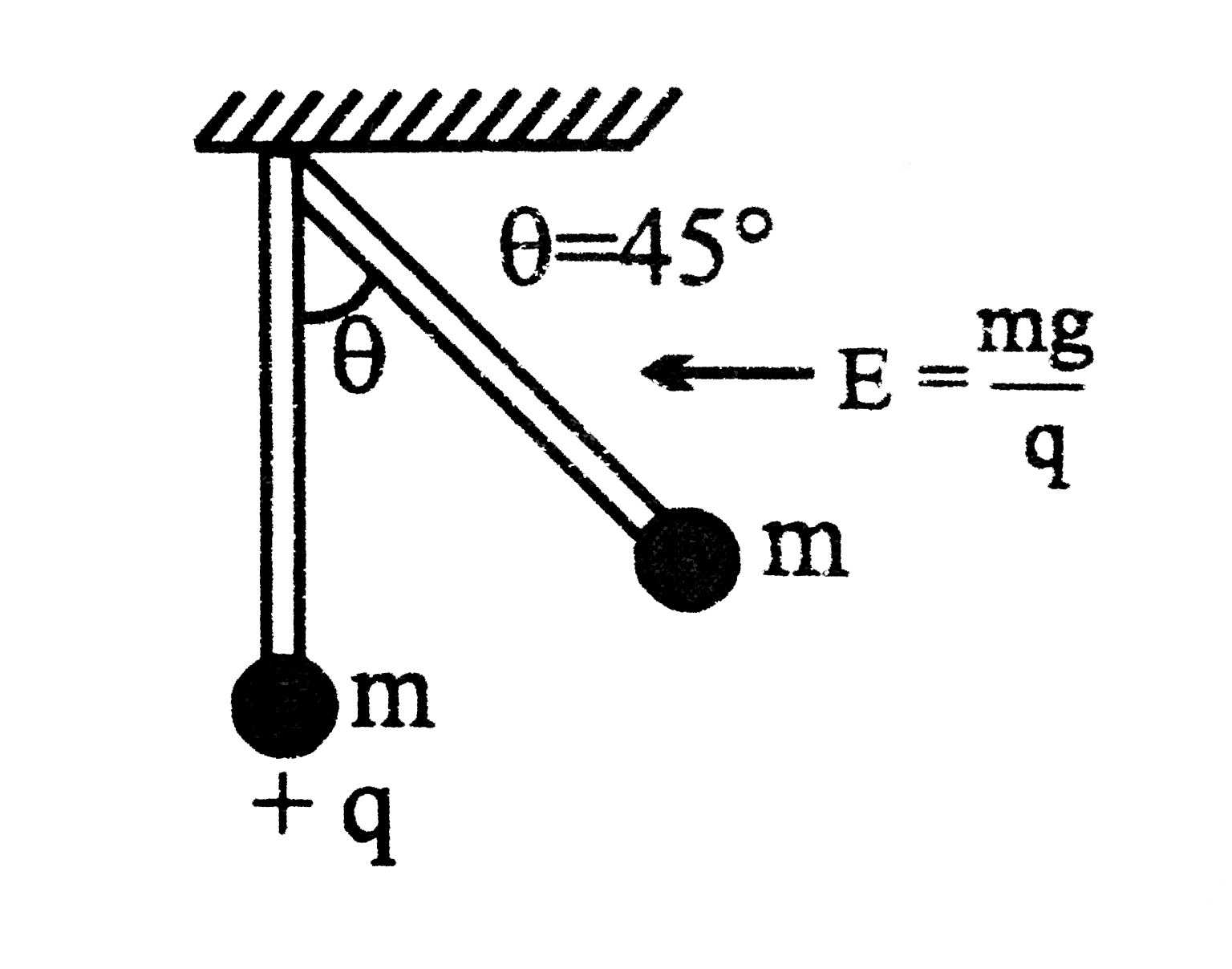
In space of horizontal EF (E = (mg)//q) ...

In space of horizontal `EF (E = (mg)//q)` exist as shown in figure and a mass m is released at the end of a light rod. If mass m is releases from the position shown in figure find the angular velocity of the rod when it passes through the bottom most position
.

Text Solution

Verified by Experts

Using conservation of mechanical energy,
`Delta K + Delta U = 0`
`Delta U = Delta U_(gravity) + Delta U_("electrical")`
`Delta U_("electrical") = q Delta V = - q(E l sin theta)`,
`Delta U_(gravity) = - mg (l - l cos theta)`
`Delta K = (1)/(2) m v^2 - 0` (i)
`q E l sin theta + mg (l - l cos theta) = (1)/(2) m v^2`
Fromn Eq. (i)
`mg l sin theta + mg l - mg l cos theta = (mv^2)/(2)`
`(g l)/(sqrt(2)) + g l - (g l)/(sqrt(2)) = (1)/(2) m v^2 or V= sqrt(2 g l)`
`omega = V/(l) = sqrt(2 g l)/(l) = sqrt((2 g)/(l)) or omega = sqrt((2 g)/(l))`.
(##BMS_V03_C03_S01_018_S01##).
Promotional Banner

Topper's Solved these Questions

  • ELECTRIC POTENTIAL

    CENGAGE PHYSICS ENGLISH|Exercise Examples|9 Videos
  • ELECTRIC POTENTIAL

    CENGAGE PHYSICS ENGLISH|Exercise Exercise 3.1|23 Videos
  • ELECTRIC FLUX AND GAUSS LAW

    CENGAGE PHYSICS ENGLISH|Exercise MCQ s|38 Videos
  • ELECTRICAL MEASURING INSTRUMENTS

    CENGAGE PHYSICS ENGLISH|Exercise M.C.Q|2 Videos

Similar Questions

Explore conceptually related problems

Fig. shows a ball having a charge q fixed at a point A. Two identical balls of mass m having charge +q and -q are attaached to the end of a light rod of length 2a. The system is released from the situation shown in fig. Find the angular velocity of the rod when the rod turns through 90^(@)

A uniform thin rod of length l and mass m is hinged at a distance l//4 from one of the end and released from horizontal position as shown in Fig. The angular velocity of the rod as it passes the vertical position is

A uniform disc of mass M and radius R is pivoted about the horizontal axis through its centre C A point mass m is glued to the disc at its rim, as shown in figure. If the system is released from rest, find the angular velocity of the disc when m reaches the bottom point B.

A block of mass m is released from a wedge of mass m as shown in figure . Find the time taken by the block to reach the end of the wedge.

A point particle of mass m is released from a distance sqrt(3)R along the axis of a fixed ring of mass M and radius R as shown in figure. Find the speed of particle as it passes through the centre of the ring.

A rod of length L is hinged from one end. It is brought to a horizontal position and released. The angular velocity of the rod, when it is in vertical position, is

A rigid rod of mass m & length l is pivoted at one of its ends. If it is released from its horizontal position, find the speed of the centre of mass of the rod when it becomes vertical.

A ball of mass m and radius r rolls inside a hemispherical shell of radius R . It is released from rest from point A as shown in figure. The angular velocity of centre of the ball in position B about the centre of the shell is. .

A simple pendulum A and a homogeneous rod B hinged at its enda are released from horizontal position as shown in figure.

If a street light of mass M is suspended from the end of a uniform rod of length L in different possible patterns as shown in figure, then:

CENGAGE PHYSICS ENGLISH-ELECTRIC POTENTIAL-DPP 3.5
  1. In space of horizontal EF (E = (mg)//q) exist as shown in figure and a...

    Text Solution

    |

  2. In the figure shown a conducting sphere of inner radius 'a' and outer ...

    Text Solution

    |

  3. A point charge Q is situated (outside) at a distance r from the centre...

    Text Solution

    |

  4. Find the electric field potentail and strength at the centre of a hem...

    Text Solution

    |

  5. There are three concentric conducting spherical shells. All of them ar...

    Text Solution

    |

  6. Both the ring and the conducting sphere are given the same charge Q. D...

    Text Solution

    |

  7. A solid sphere of radius 'R' has a cavity of radius (R)/(2). The solid...

    Text Solution

    |

  8. A thibn spherical conducting shell of radius R has a charge q. Another...

    Text Solution

    |

  9. An arc of radius r carries charge. The linear density of charge is lam...

    Text Solution

    |

  10. Two identical thin rings, each of radius R, are coaxially placed at a...

    Text Solution

    |

  11. If the electric potential of the inner metal shell is 10 V and that of...

    Text Solution

    |

  12. Potential difference beween centre and surface of the sphere of radius...

    Text Solution

    |

  13. A mercury drop has potential 'V' on its surface. 1000 such drops combi...

    Text Solution

    |

  14. A solid conducting sphere of radius 'a' is surrounded by a thin unchar...

    Text Solution

    |

  15. A solid conducting sphere of radius 'a' is surrounded by a thin unchar...

    Text Solution

    |

  16. A solid conducting sphere of radius 'a' is surrounded by a thin unchar...

    Text Solution

    |

