Home
Class 12
PHYSICS
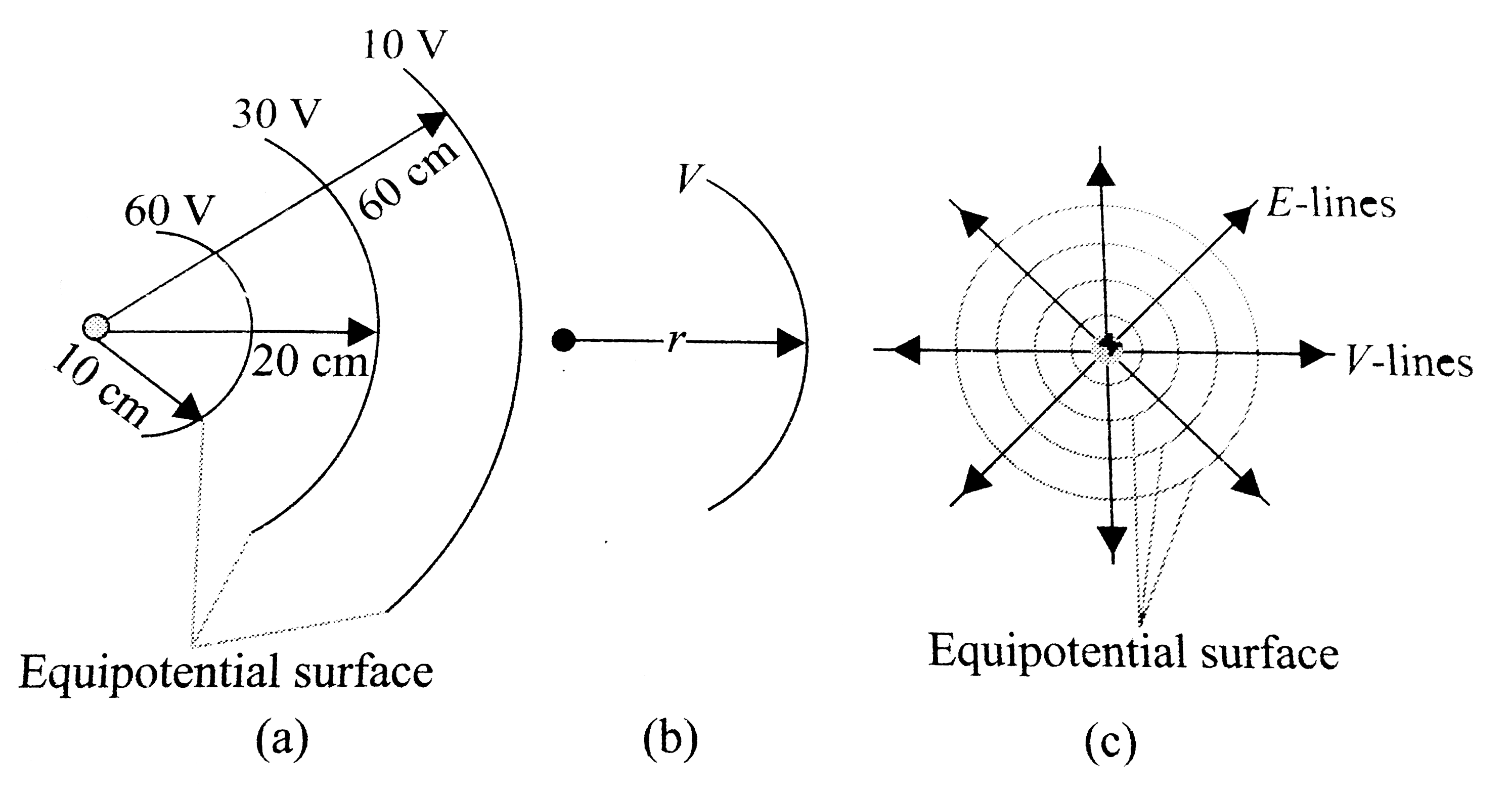
Referring to the spherical equipotential...

Referring to the spherical equipotential lines in (Fig. 3.36)A, find
(i) `vec E = f ( r)`
(ii) `vec E` - pattern.
a. .
b. .
c. .

Text Solution

Verified by Experts

(a) For the first equipotential
`60 V xx (10)/(100) (m) = 6 Vm`
For the second equipotential
`30 V xx (20)/(100) (m) = 6 Vm`
For the third equipotential
`10 V xx (60)/(100) (m) = 6 Vm`
We can understand that are product of potential (V) and radial distance (r) of equipotential lines [ as in Fig 3.36 B] is equal to `6 Vm^-1`. Hence, general relation of potential (V) and radial distance (r) can be written as
`V = (6)/ ( r) Vm^-1`
Since `vec E - (del V)//(del r) hat r`, substituting `V = 6//r`, we have
`vec E = - (del)/(del r) (- (6)/( r)) hat r Vm^-1`
or `vec E = (6)/(r^2) hat r Vm^-1`
(b) Since `vec E` is directed in `hat r` - direction and obeys inverse square law, E must be outward [as shown in Fig. 3.36 C].
The above E - field must be caused by a positive point charge.
Promotional Banner

Topper's Solved these Questions

  • ELECTRIC POTENTIAL

    CENGAGE PHYSICS ENGLISH|Exercise Examples|9 Videos
  • ELECTRIC POTENTIAL

    CENGAGE PHYSICS ENGLISH|Exercise Exercise 3.1|23 Videos
  • ELECTRIC FLUX AND GAUSS LAW

    CENGAGE PHYSICS ENGLISH|Exercise MCQ s|38 Videos
  • ELECTRICAL MEASURING INSTRUMENTS

    CENGAGE PHYSICS ENGLISH|Exercise M.C.Q|2 Videos

Similar Questions

Explore conceptually related problems

If V=2r^(2) then find (i) vec(E) (1, 0, -2) (ii) vec(E) (r=2)

(Figure 3.27) shows equipotential surfaces. What is the direction of electric field vec E at P and R? .

Which of the following is/are correct? (a)If vec a= hat i+ hat j and vec b=2 hat i- hat k then the point of intersection of the lines vec r x vec a = vec b x vec a and vec a x vec b = vec a x vec b is 3 vec i + vec j - veck (b)( vec r dot hat i )( hat i x vec r )+( vec r dot hat j )( hat j x vec r )+( vec r dot hat k )( hat k x vec r )= vec0 (c)If | vec a|=3,| vec b|=5,| vec c|=7 and vec a+ vec b+ vec c= vec0 then the angle between vec aa n d vec b is pi/3 (d)If the vectors vec a , vec b& vec c from the sides B C ,C A&A B respectively of a triangle A B C , then vec a x vec b = vec b x vec c x vec a

The angles of triangle, two of whose sides are represented by vectors sqrt(3)( vec axx vec b) \a n d \ vec b-( hat adot vec b) hat a ,w h e r e vec b is a non zero vector and hat a is unit vector in the direction of vec a , are

A vector vec d is equally inclined to three vectors vec a= hat i+ hat j+ hat k , vec b=2 hat i+ hat ja n d vec c=3 hat j-2 hat kdot Let vec x , vec y ,a n d vec z be three vectors in the plane of vec a , vec b ; vec b , vec c ; vec c , vec a , respectively. Then a. vec x. vec d=-1 b. vec y. vec d=1 c. vec z. vec d=0 d. vec r. vec d=0,w h e r e vec r=lambda vec x+mu vec y+delta vec z

Write the equation of the plane containing the lines vec r= vec a+lambda vec b\ a n d\ vec r= vec a+mu vec c

From the following graph, find the value of ( vec(E )) at r = 3.5

ABCDE is a pentagon. Prove that the resultant of force vec A B , vec A E , vec B C , vec D C , vec E D and vec A C ,is 3 vec A C .

A charged particle goes undeflected in a region containing electric and magnetic field. It is possible that (i) vec(E) || vec(B). vec(v) || vec(E) (ii) vec(E) is not parallel to vec(B) (iii) vec(v) || vec(B) but vec(E) is not parallel to vec(B) (iv) vec(E)||vec(B) but vec(v) is not parallel to vec(E)

Vectors vec Aa n d vec B satisfying the vector equation vec A+ vec B= vec a , vec Axx vec B= vec ba n d vec A*vec a=1,w h e r e vec aa n d vec b are given vectors, are a. vec A=(( vec axx vec b)- vec a)/(a^2) b. vec B=(( vec bxx vec a)+ vec a(a^2-1))/(a^2) c. vec A=(( vec axx vec b)+ vec a)/(a^2) d. vec B=(( vec bxx vec a)- vec a(a^2-1))/(a^2)

CENGAGE PHYSICS ENGLISH-ELECTRIC POTENTIAL-DPP 3.5
  1. Referring to the spherical equipotential lines in (Fig. 3.36)A, find ...

    Text Solution

    |

  2. In the figure shown a conducting sphere of inner radius 'a' and outer ...

    Text Solution

    |

  3. A point charge Q is situated (outside) at a distance r from the centre...

    Text Solution

    |

  4. Find the electric field potentail and strength at the centre of a hem...

    Text Solution

    |

  5. There are three concentric conducting spherical shells. All of them ar...

    Text Solution

    |

  6. Both the ring and the conducting sphere are given the same charge Q. D...

    Text Solution

    |

  7. A solid sphere of radius 'R' has a cavity of radius (R)/(2). The solid...

    Text Solution

    |

  8. A thibn spherical conducting shell of radius R has a charge q. Another...

    Text Solution

    |

  9. An arc of radius r carries charge. The linear density of charge is lam...

    Text Solution

    |

  10. Two identical thin rings, each of radius R, are coaxially placed at a...

    Text Solution

    |

  11. If the electric potential of the inner metal shell is 10 V and that of...

    Text Solution

    |

  12. Potential difference beween centre and surface of the sphere of radius...

    Text Solution

    |

  13. A mercury drop has potential 'V' on its surface. 1000 such drops combi...

    Text Solution

    |

  14. A solid conducting sphere of radius 'a' is surrounded by a thin unchar...

    Text Solution

    |

  15. A solid conducting sphere of radius 'a' is surrounded by a thin unchar...

    Text Solution

    |

  16. A solid conducting sphere of radius 'a' is surrounded by a thin unchar...

    Text Solution

    |

