Home
Class 12
PHYSICS
A positive charge +Q is fixed at a point...

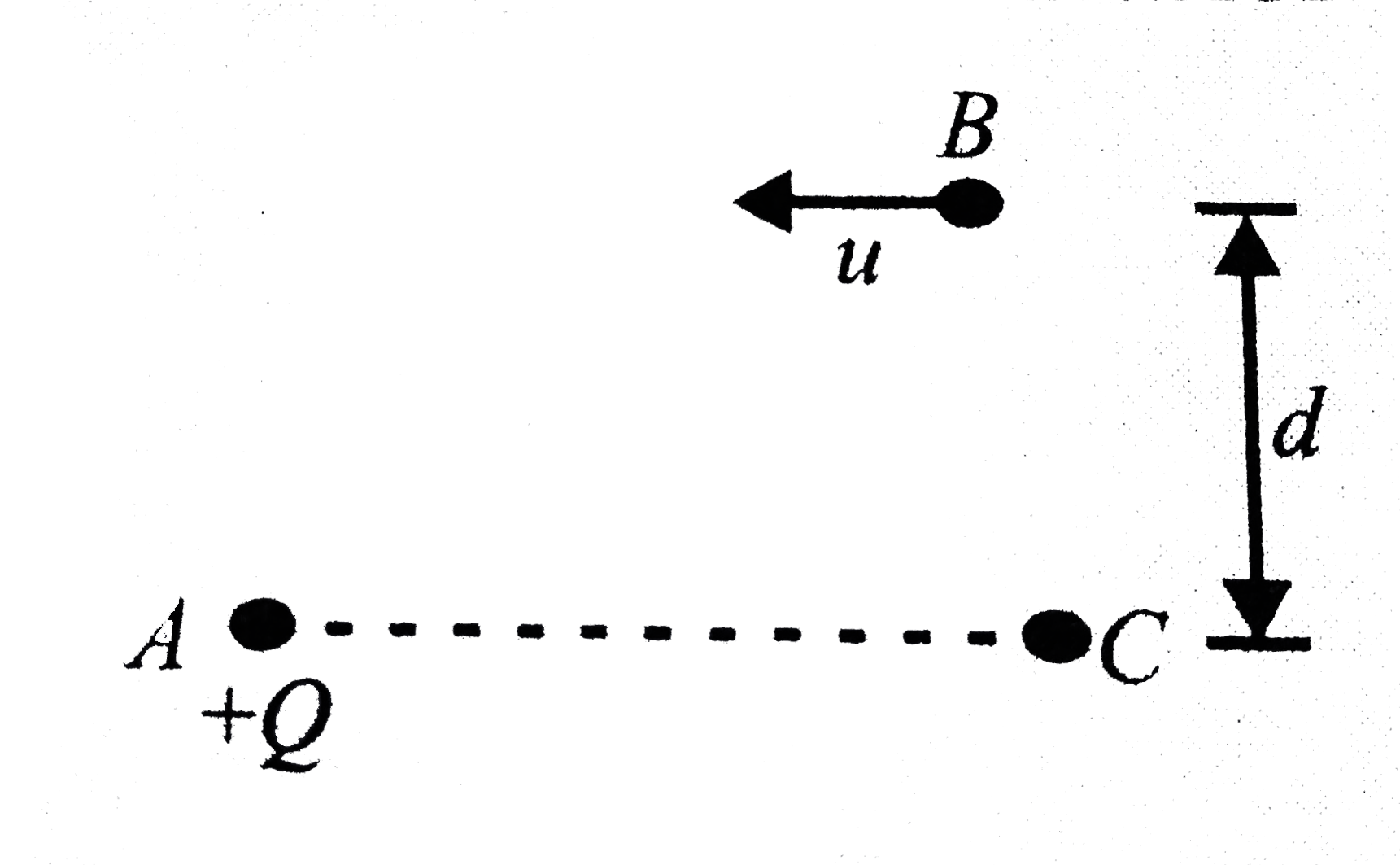
A positive charge `+Q` is fixed at a point A. Another positively charged particle of mass m and charge +q is projected from a point B with velocity u as shown in (Fig. 3.103). Point B is at a large distance from A and at distance d from the line A C. The initial velocity is parallel to the line A C. The point C is at a very large distance from A. Find the minimum distance (in meter) of +q from +Q during the motion. Take `Q q = 4 pi epsilon_0 m u^2 d` and `d (sqrt(2) - 1) m`.
.

Text Solution

Verified by Experts

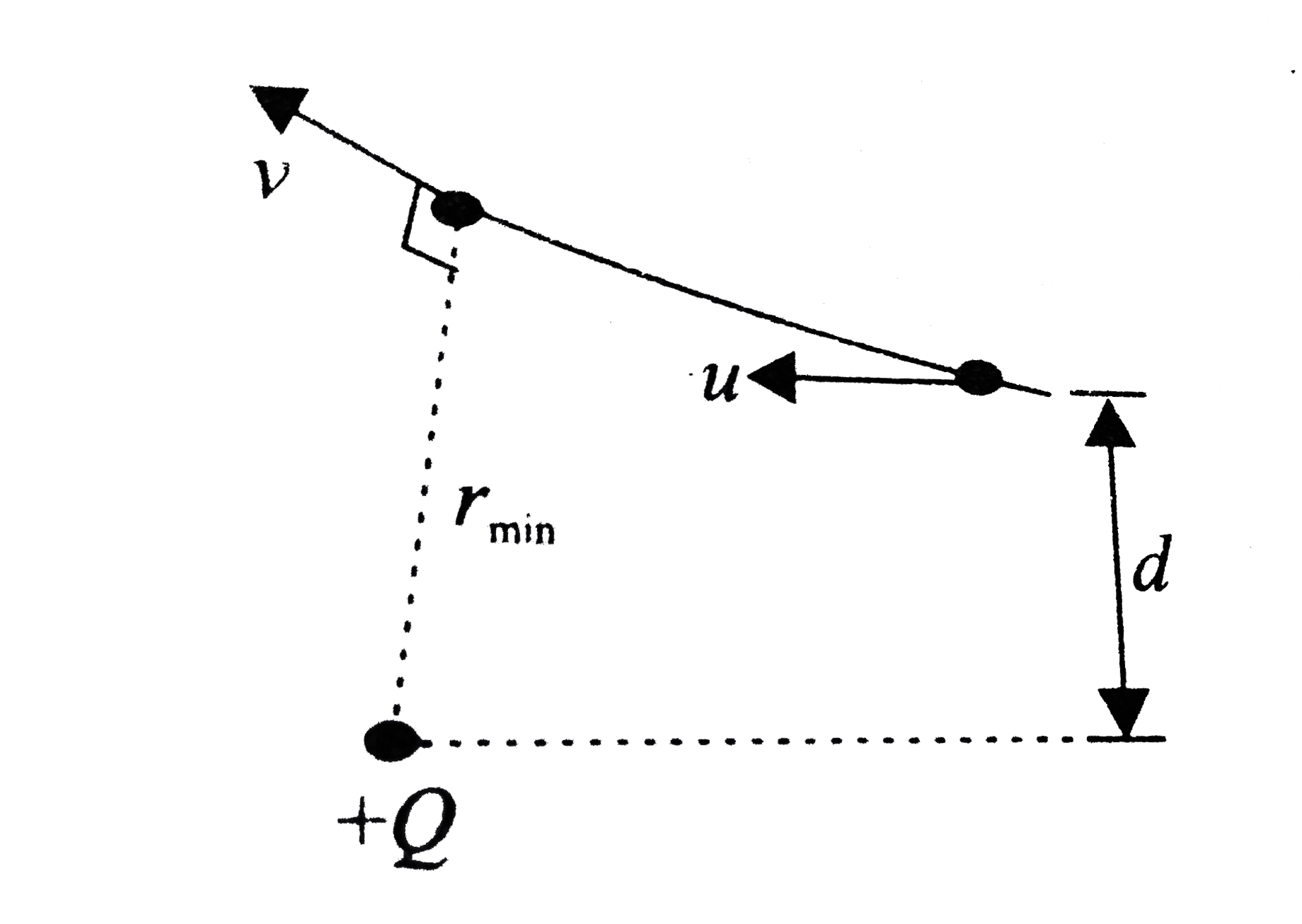
The path of the particle will be as shown in (fig. 3.104). At the point of minimum distance D, the velocity the particle will be `_|_` to its position vector with respect to +Q. Applying conservation of angular momentum, we get
.
`m u d = mvr_(min) or vr_(min) = u d`
Now by conservation of energy
`(1)/(2) m u^2 + 0 = (1)/(2) m v^2 + (K Q q)/(r_(min))`
or `(1)/(2) m u^2 (1 - (d^2)/(r_(min)^2) = (m u^2 d)/(r_(min))`
`[because KQ q = m u^2 d (given)]`
or `r_(min)^2 - 2r_(min) d - d^2 = 0`
or `r_(min) = (2 d +-sqrt(4 d^2 + 4 d^2))/(2) = d (1 +- sqrt(2))`
Since distance cannot be negative
`r_(min) = d (1 + sqrt(2))`.
Promotional Banner

Topper's Solved these Questions

  • ELECTRIC POTENTIAL

    CENGAGE PHYSICS ENGLISH|Exercise Exercise 3.1|23 Videos
  • ELECTRIC POTENTIAL

    CENGAGE PHYSICS ENGLISH|Exercise Exercise 3.2|9 Videos
  • ELECTRIC POTENTIAL

    CENGAGE PHYSICS ENGLISH|Exercise DPP 3.5|15 Videos
  • ELECTRIC FLUX AND GAUSS LAW

    CENGAGE PHYSICS ENGLISH|Exercise MCQ s|38 Videos
  • ELECTRICAL MEASURING INSTRUMENTS

    CENGAGE PHYSICS ENGLISH|Exercise M.C.Q|2 Videos

Similar Questions

Explore conceptually related problems

A particle of charge q is projected from point P with velocity v as shown. Choose the correct statement from the following.

A positive charge particle of mass m and charge q is projected with velocity v as shown in Fig. If radius of curvature of charge particle in magnetic field region is greater than d, then find the time spent by the charge particle in magnetic field.

A charge particle of mass m and charge q is released from rest in uniform electric field. Its graph between velocity (v) and distance travelled (x) will be :

A charge particle of mass m and charge q is released from rest in uniform electric field. Its graph between velocity (v) and distance travelled (x) will be :

Two charges +Q each are fixed at points C and D. Line AB is the bisector line of CD. A third charge +q is moves from A to B, then from B to C

A point charge +q is placed at origin O . The work done in taking another point charge -q from the point A to point B along the circular arc as shown in the figure is .

A positive point charge q_(1) is placed at (a,0) and another positive point charge q_(2) is placed at (0,a) . Find the force acting on q_(1) .

A point charge +q, is placed at a distance d from an isolated conducting plane. The field at a point P on the other side of the plane is

A non-relativistic charge q of mass m originates at a point A lying on x-axis and moves with velocity v at an angle to the x-axis. A screen is located at a distance l from A. Find the distance r from the x-axis to the point on the screen into which the charge strikes.

A positive charge particle of charge q and mass m enters into a uniform magnetic field with velocity v as shown in Fig. There is no magnetic field to the left of PQ. Find (a) time spent, (b) distance travelled in the magnetic field, (c) impulse of magnetic force.