Home
Class 12
PHYSICS
(Figure 3.114) shows three concentric sp...

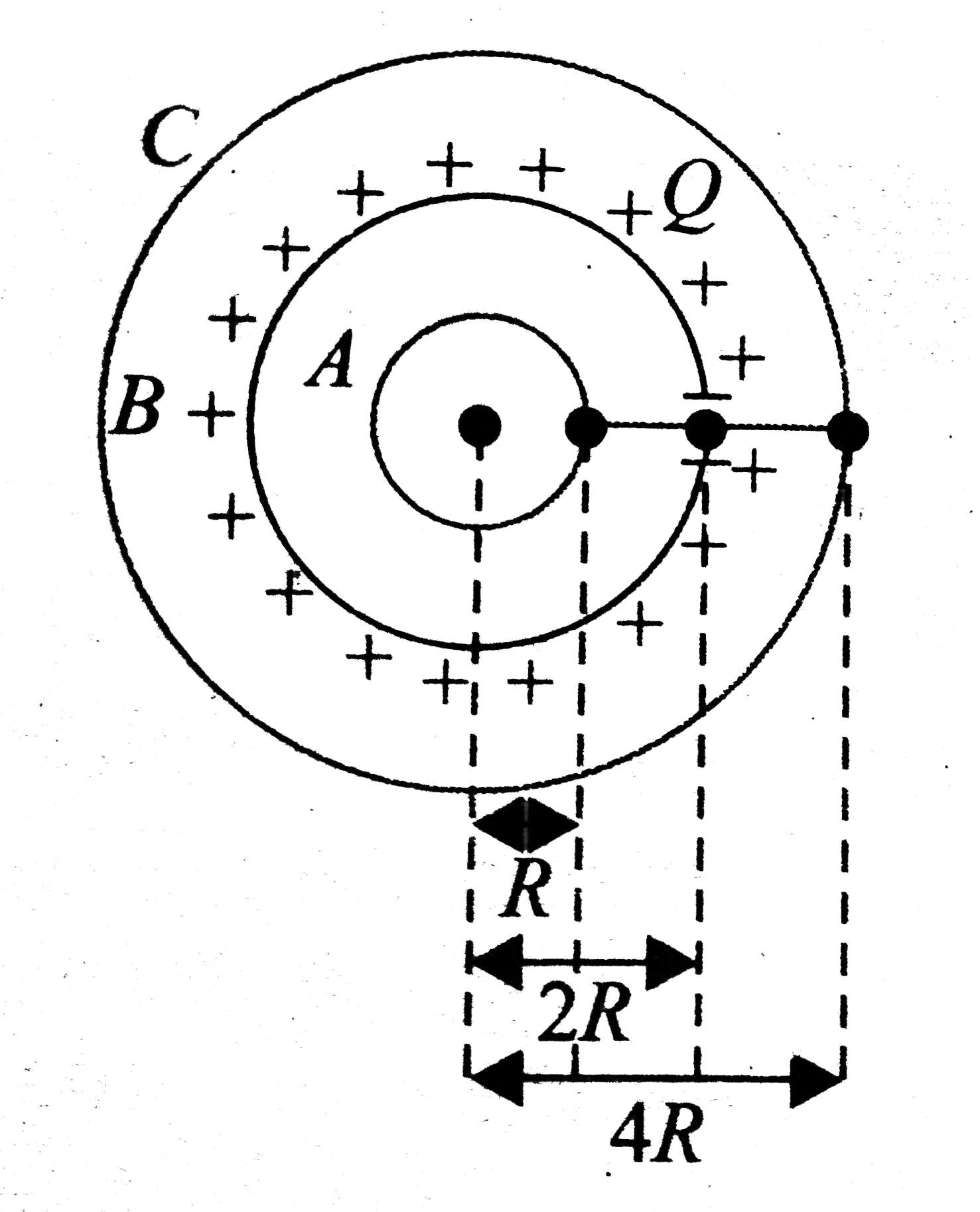
(Figure 3.114) shows three concentric spherical conductors `A, B, and C` with radii `R, 2R`, and `4R`, respectively. A and C are connected by a conducting wire, and `B` is uniformly charged `("charge" = +Q)`. Find
.
a. charges on conductors A and C, and
b. potentials of A and B.

Text Solution

Verified by Experts

The correct Answer is:
a. `q_A = -Q/(3) ; q_B = Q/(3)`
b. `V_A = Q/(16 pi epsilon_0 R) ; V_B (5 Q)/(48 pi epsilon_0 R)`

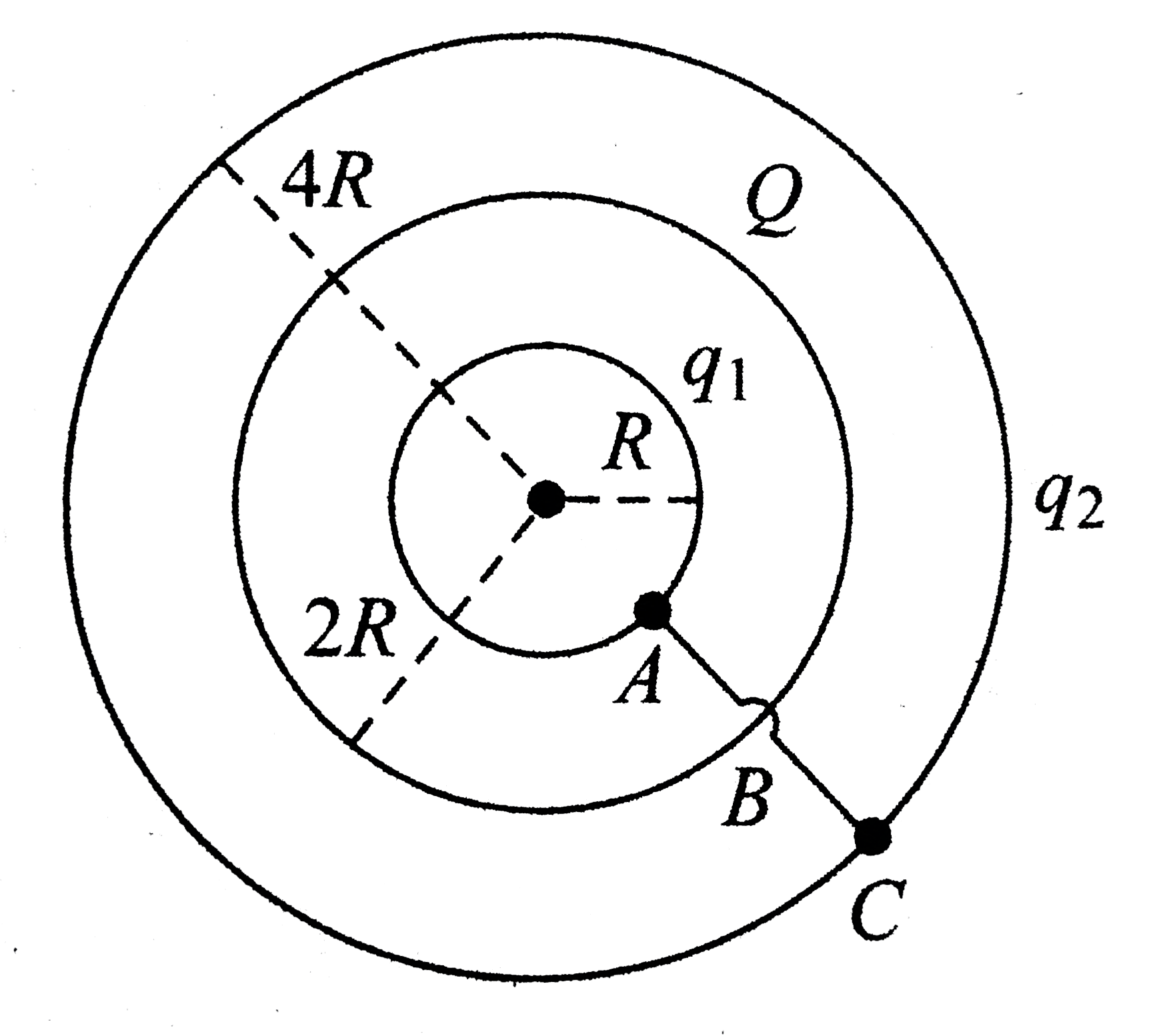
a. Let the charges on `A` and `C` be `q_1` and `q_2`, respectively (Fig. S3. 21). From conservation of charge, we have `q_1 + q_2 = 0`.
.
Hence, `q_1 = -q_2`. Since `A` and `C` are connected by a conducting wire, so they have the same potential.
`V_A` = potential of A
=`(1)/(4 pi epsilon_0) q_(1)/(R) + (1)/(4 pi epsilon_0) Q/(2 R) + (1)/(4 pi epsilon_0) q_(2)/(4 R)`
`V_C` = potential of C
=`(1)/(4 pi epsilon_0) q_(1)/(4 R) + (1)/(4 pi epsilon_0) Q/(4 R) + (1)/ (4 pi epsilon_0) q_(2)/(4 R)`
Equalizing the potentials of `A` and `C`, i.e., `V_A = V_C`, we get
`q_(1)/( R) + Q/(2 R) + q_(2)/(4 R) = q_(1)/(4 R) + Q/(4 R) + q_(2)/(4 R)`
or `4 q_1 + 2 Q = q_1 + Q`
or `q_1 = -Q//3`
Hence, `q_2 = Q//3`.
b. `V_A = (1)/(4 pi epsilon_0 R) [(-Q)/(3) + Q/(2) + Q/(12)] = Q/(16 pin epsilon_0 R)`
`V_B = (1)/(4 pi epsilon_0) q_(1)/(2 R) + (1)/(4 pi epsilon_0) Q/(2 R) + (1)/ (4 pi epsilon_0) q_(2)/(4 R)`
=`(1)/(8 pi epsilon_0 R)[(-Q)/(3) + Q + Q/(6)] = (5 Q)/(48 pi epsilon_0 R)`.
Promotional Banner

Topper's Solved these Questions

  • ELECTRIC POTENTIAL

    CENGAGE PHYSICS ENGLISH|Exercise Single Correct|56 Videos
  • ELECTRIC POTENTIAL

    CENGAGE PHYSICS ENGLISH|Exercise Multiple Correct|10 Videos
  • ELECTRIC POTENTIAL

    CENGAGE PHYSICS ENGLISH|Exercise Exercise 3.3|9 Videos
  • ELECTRIC FLUX AND GAUSS LAW

    CENGAGE PHYSICS ENGLISH|Exercise MCQ s|38 Videos
  • ELECTRICAL MEASURING INSTRUMENTS

    CENGAGE PHYSICS ENGLISH|Exercise M.C.Q|2 Videos

Similar Questions

Explore conceptually related problems

Three concentric spherical conductors A, B, and C of radii r, 2R, and 4R, respectively. A and C is shorted and B is uniformly charged (charge +Q). Charge on conductor A is

Three concentric spherical conductors A, B, and C of radii r, 2R, and 4R, respectively. A and C is shorted and B is uniformly charged (charge +Q). Potential at B is

Three concentric spherical conductors A, B, and C of radii r, 2R, and 4R, respectively. A and C is shorted and B is uniformly charged (charge +Q). Potential at A is

Figure shows three concentric thin spherical shells A, B and C of radii a, b, and c. The shells A and C are given charge q and -q, respectively, and shell B is earthed. Then,

Figure shows three concentric thin spherical shells A, B and C of radii a, b and c respectively. The shells A and C are given charges q and -q respectively and the shell B is earthed. Find the charges appearing on the surfaces of B and C.

Figure shows three concentric thin spherical shells A, B and C of radii a, b and c respectively. The shells A and C are given charges q and -q respectively and the shell B is earthed. Find the charges appearing on the surfaces of B and C.

Two concentric spherical conducting shells of radii r and R (r lt R ) carry charges q and Q respectively . The two shells are now connected by a conducting wire. The final charge on the inner shell is

Three conducting spheres A, B and C are shown in figure. The radii of the spheres are a, b and c respectively. A and B connected by a conducting wire. The capacity of the system is

(Figure 3.78) shows three thin concentric spherical shells A, B and C with initial charges on A , B, and C as 3 Q, 2Q, and -Q, respectively. The shells A amd C are connected by a wire such that it does not touch B. Shell B is earthed. Determine the final charges q_A, q_B, "and" q_C . .

Two concentric spherical conducting shells of radii R and 2R are carrying charges q and 2q, respectively. Both are now connected by a conducting wire. Find the change in electric potential (inV) on the outer shell.

CENGAGE PHYSICS ENGLISH-ELECTRIC POTENTIAL-Subjective
  1. Two identical thin rings, each of radius R, are coaxially placed at a...

    Text Solution

    |

  2. Three conducting spherical shells have radii (a, b, and c) such that a...

    Text Solution

    |

  3. (Figure 3.114) shows three concentric spherical conductors A, B, and C...

    Text Solution

    |

  4. Two concentric shells of radii R and 2 R are shown in (Fig. 3.115). In...

    Text Solution

    |

  5. Three charges each of value q are placed at the corners of an equilate...

    Text Solution

    |

  6. A small ball of mass 2 xx 10^-3 kg, having a charge 1 mu C, is suspend...

    Text Solution

    |

  7. Two fixed charges -2Q and +Q are located at points (-3a,0) and (+3a,0)...

    Text Solution

    |

  8. A point charge q is located at the centre O of a spherical uncharged c...

    Text Solution

    |

  9. Four point charges +8muC-1muC,-1muC and +8muC are fixed at the points ...

    Text Solution

    |

  10. Charges +q and -q are located at the corners of a cube of side as show...

    Text Solution

    |

  11. Two uniformly charged large plane sheets S1 and S2 having charge densi...

    Text Solution

    |

  12. (Figure 3.118) shows two dipole moments parallel to each other and pla...

    Text Solution

    |

  13. Two dipoles p1 and p2 are placed along the same axis at a distance x a...

    Text Solution

    |

  14. A short dipole is placed along the x - axis at x = x (Fig. 3.120). ....

    Text Solution

    |

  15. For the eletrostatic charge system as shown in (Fig. 3.121), find . ...

    Text Solution

    |

  16. Four charge particles each having charge Q=1 C are fixed at the corner...

    Text Solution

    |

  17. Three identical dipoles with charges q and -q, and separation A betwee...

    Text Solution

    |

  18. A radioactive source, in the form of a metallic sphere of radius 10^(-...

    Text Solution

    |

  19. Three point charges of 0.1 C each are placed at the corners of an equi...

    Text Solution

    |

  20. When a small uncharged conducting ball of radius a = 1 cm and mass m =...

    Text Solution

    |

