Home
Class 12
PHYSICS
Three charges each of value q are placed...

Three charges each of value q are placed at the corners of an equilateral triangle. A fourth charge Q is placed at the center of the triangle.
a. Find the net force on charge q.
b. If `Q = -q`, will the charges at the corners move toward the center or fly away from it ?
c. For what value of Q at O will the charges remain stationary ?
d. In situation (c), how much work is done in removing the charges to infinity?

Text Solution

Verified by Experts

The correct Answer is:
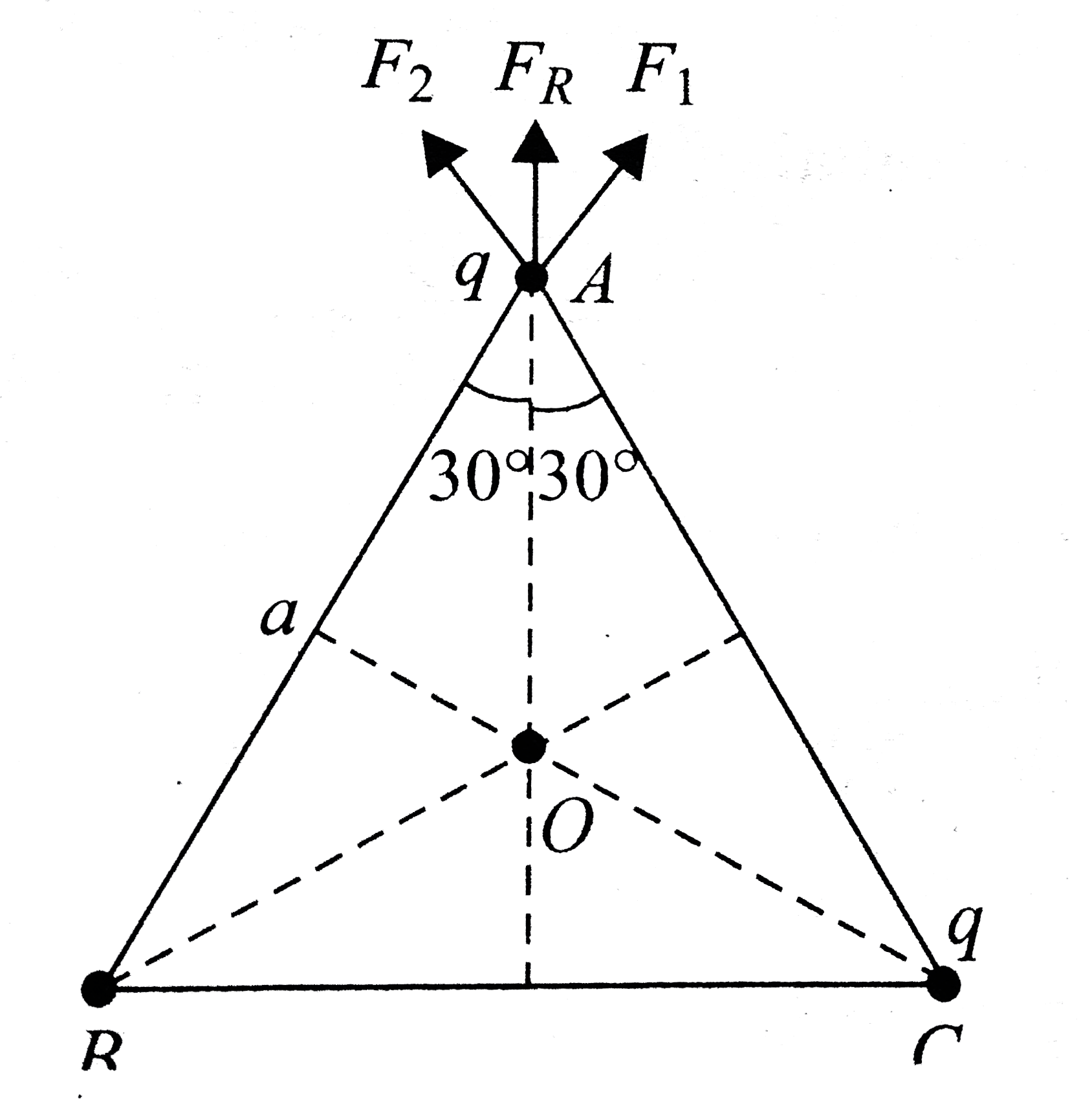
a. `F_R = q/(4 pi epsilon_0 a^2) [sqrt(3) q + 3 Q]` along `vec(O A)`
b. the charges `q` at corners A,B and C will move towards the center `O`.
c. `Q = -(q/sqrt(3))`
d. zero

A If `Q` is a positive charge, the resultant force on q at A will be
`vec F _R = vec F _1 + vec F_2 + vec F_3`
Here, `F_1 = F_2 = (1)/(4 pi epsilon_0) (q^2)/(a^2)`
So, `(vec F_1 + vec F_2) = 2 xx (1)/(4 pi epsilon_0) (q^2)/(a^2) cos 30^(@) = (sqrt(3 q^2))/(4 pi epsilon_0 a^2)` along `vec(O A)`
while `vec F_3 = (1)/(4 pi epsilon_0) (q Q)/((a // sqrt(3))^2) = (3 q Q)/(4 pi epsilon_0 a^2)` along `vec( O A)`
.
So, `F_R = q/(4 pi epsilon_0 a^2) [sqrt(3) q + 3 Q]` along `vec(O A)` .... (i)
b. For `Q = -q`,
`F_R = q/(4 pi epsilon_0 a^2) [sqrt(3)q - 3 a]` along `vec(O A)`
=`(sqrt(3) q)/(4 pi epsilon _0 a^2) [sqrt(3) - 1]` along `vec(A O)`
i.e., the charges `q` at corners A, B and C will move toward the center O.
c. Charges will remain stationary if `F_R = 0`, which Eq. (i) is possible only if
`[(sqrt(3)) q + 3 Q] = 0`, i,e., `Q = -(q/sqrt(3))`
d. Potential energy of the system
`U = (1)/(2) xx (1)/(4 pi epsilon_0) sum_(i ne j)(q_(i)q_(j))/r_(ij) = (1)/(4 pi epsilon_0) [3(q xx q)/a + (3 q(- q // sqrt(3)))/((a//sqrt(3)))] = 0`
And for finite charges, distribution potential energy at infinity is always zero. So
`W = U_F - U_I= 0 - 0 = 0`.
Promotional Banner

Topper's Solved these Questions

  • ELECTRIC POTENTIAL

    CENGAGE PHYSICS ENGLISH|Exercise Single Correct|56 Videos
  • ELECTRIC POTENTIAL

    CENGAGE PHYSICS ENGLISH|Exercise Multiple Correct|10 Videos
  • ELECTRIC POTENTIAL

    CENGAGE PHYSICS ENGLISH|Exercise Exercise 3.3|9 Videos
  • ELECTRIC FLUX AND GAUSS LAW

    CENGAGE PHYSICS ENGLISH|Exercise MCQ s|38 Videos
  • ELECTRICAL MEASURING INSTRUMENTS

    CENGAGE PHYSICS ENGLISH|Exercise M.C.Q|2 Videos

Similar Questions

Explore conceptually related problems

Three equal charges, each +q are placed on the corners of an equilatreal triangel . The electric field intensity at the centroid of the triangle is

Five equal charges each of value q are placed at the corners of a regular pentagon of side a. The electric field at the centre of the pentagon is

Three charges 2q, -q, and -q are located at the vertices of an equilateral triangle. At the center of the triangle,

Three charges +q, -q and +q are kept at the corners of an equilateral triangle of side d. Find the resultant electric force on a charge +q placed at the centroid O of the triangle.

Three equal charge q_(0) each are placed at three corners of an equilateral triangle of side 'a'. Find out force acting on one of the charge due to other two charges ?

Three poistive charges of equal value q are placed at the vertices of an equilateral triangle. The resulting lines of force should be sketched as in

Electric charges q, q, –2q are placed at the corners of an equilateral triangle ABC of side l. The magnitude of electric dipole moment of the system is

Electric charges q, q, –2q are placed at the corners of an equilateral triangle ABC of side l. The magnitude of electric dipole moment of the system is

Consider the charges q,q and -q placed at the vertices of an equilateral triangle of each side l. What is the force on each charge ?

Three charges, each equal to q, are placed at the three. corners of a square of side a . Find the electric field at. the fourth corner.

CENGAGE PHYSICS ENGLISH-ELECTRIC POTENTIAL-Subjective
  1. Two identical thin rings, each of radius R, are coaxially placed at a...

    Text Solution

    |

  2. Three conducting spherical shells have radii (a, b, and c) such that a...

    Text Solution

    |

  3. (Figure 3.114) shows three concentric spherical conductors A, B, and C...

    Text Solution

    |

  4. Two concentric shells of radii R and 2 R are shown in (Fig. 3.115). In...

    Text Solution

    |

  5. Three charges each of value q are placed at the corners of an equilate...

    Text Solution

    |

  6. A small ball of mass 2 xx 10^-3 kg, having a charge 1 mu C, is suspend...

    Text Solution

    |

  7. Two fixed charges -2Q and +Q are located at points (-3a,0) and (+3a,0)...

    Text Solution

    |

  8. A point charge q is located at the centre O of a spherical uncharged c...

    Text Solution

    |

  9. Four point charges +8muC-1muC,-1muC and +8muC are fixed at the points ...

    Text Solution

    |

  10. Charges +q and -q are located at the corners of a cube of side as show...

    Text Solution

    |

  11. Two uniformly charged large plane sheets S1 and S2 having charge densi...

    Text Solution

    |

  12. (Figure 3.118) shows two dipole moments parallel to each other and pla...

    Text Solution

    |

  13. Two dipoles p1 and p2 are placed along the same axis at a distance x a...

    Text Solution

    |

  14. A short dipole is placed along the x - axis at x = x (Fig. 3.120). ....

    Text Solution

    |

  15. For the eletrostatic charge system as shown in (Fig. 3.121), find . ...

    Text Solution

    |

  16. Four charge particles each having charge Q=1 C are fixed at the corner...

    Text Solution

    |

  17. Three identical dipoles with charges q and -q, and separation A betwee...

    Text Solution

    |

  18. A radioactive source, in the form of a metallic sphere of radius 10^(-...

    Text Solution

    |

  19. Three point charges of 0.1 C each are placed at the corners of an equi...

    Text Solution

    |

  20. When a small uncharged conducting ball of radius a = 1 cm and mass m =...

    Text Solution

    |

