Home
Class 12
PHYSICS
Find the potential difference V(a)-V(b) ...

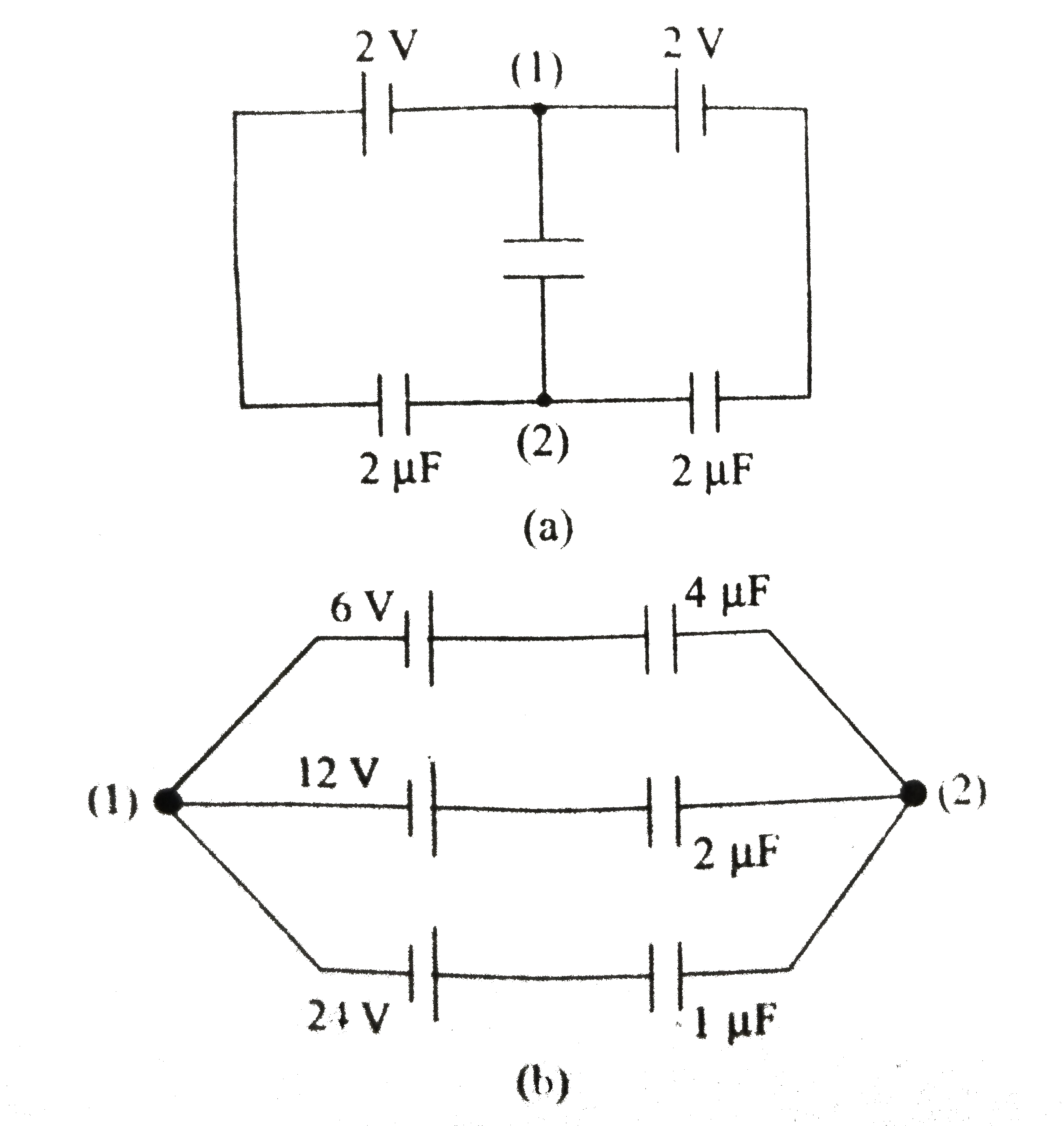
Find the potential difference `V_(a)-V_(b)` between the points (1) and (2) shown in each part of Fig.

Text Solution

Verified by Experts
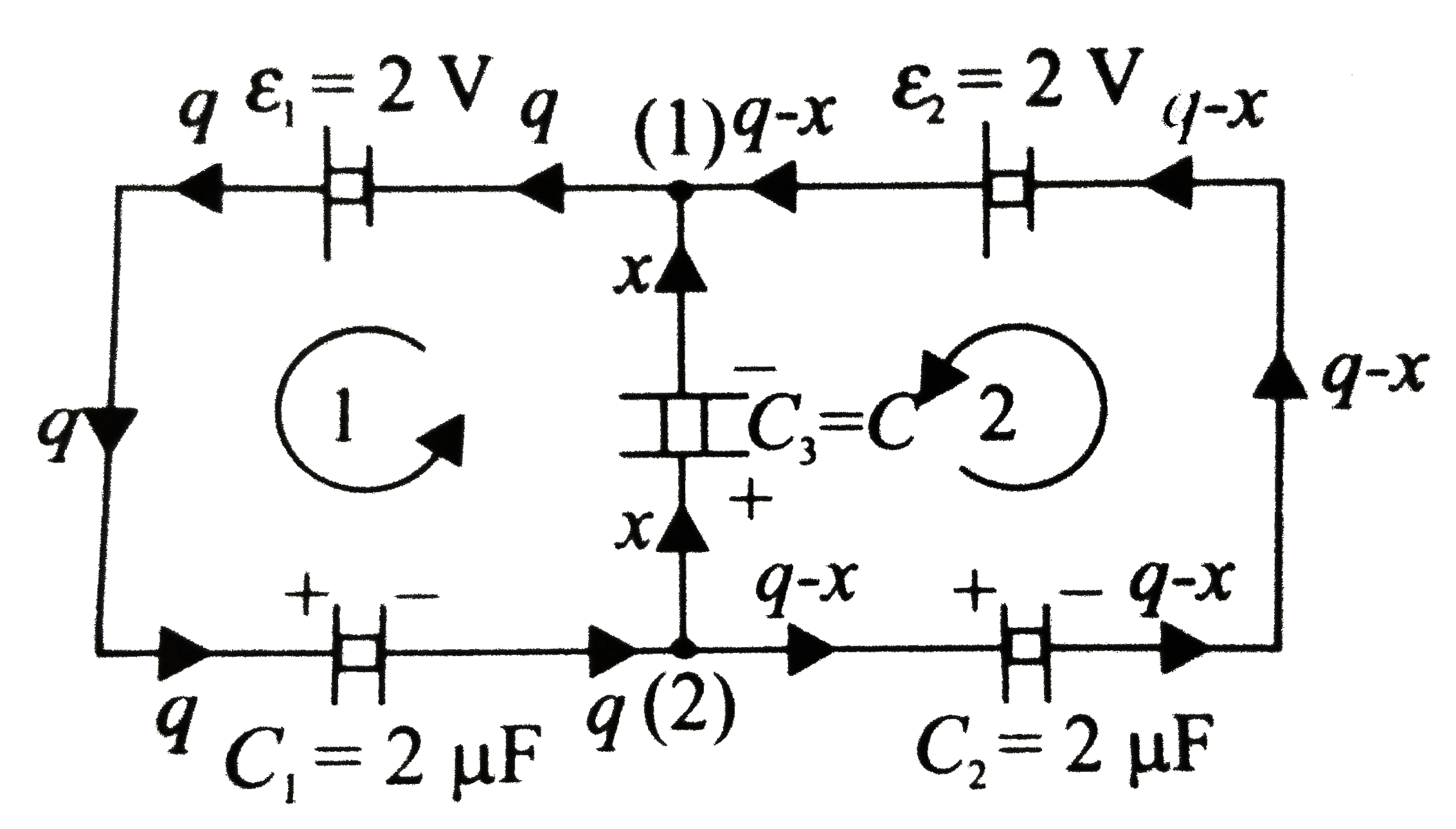
(a) We first distribute the charges on different capacitors and branches keeping in mind Kirchhoff's junction rule .We can start from any battery. In this case, We start from battery `epsilon_(1)`. Let battery `epsilon_(1)` supply a charge `q` The charge on the left plate of capacitor `C_(1)` wil be `q` as this plate is receiving the charge. Now charge `q` reches junction `b` where it is divided into two Paths. Let charge `x` go to capacitor `C_(3)`, then the remaining charge `q-x` will go to capacitor `C_(2)`. In juncation `a`, we can verify Kirchoeff's juncation rule, i.e., the incoming charge is equal to the outgoing charge. Now we write the loop equations.
For loop `1`
`2 - (q)/(2) - (x)/(C) = 0`
For loops `2`
`2 + (x)/(C) - ((q-x))/(2) = 0` (i)
or `2 + (x)/(C) - (q)/(2) + (x)/(2) = 0` ......(ii)
From `(i)` and `(ii)`
`(2x)/(C) + (x)/(2) = 0`
or `x ((2)/(C) + (1)/(2)) = 0`
or `x = 0`(since `(2)/(C) + (1)/(2) ne 0`)
No charge will go to the capacitor connected across `(1)-(2)`. A there is no charge in the capacitor connected across `(1)` and `(2)`, the potential difference across `(1)` and `(2)` should be zero.

(b) In this case also, we will first distribute the charges. Let us start from the `24 V` battery. Let this battery supply a charge `q`, which is divided into two paths after reaching juncation `(2)`. Let `x` charge move toward the `2 muF` capacitor, then the reminaning charge `q - x` will move toward the `4 muF` capacitor, as per Kirchhoff's juncation rule. Now we write the loop equations.

In the upper closed loop
`+6+((q-x))/(4)-(x)/(2)-12=0` or `(q)/(4)-x=6`....(i)
In the lower closed loop
`12+(x)/(2)+(q)/(1)-24=0` or `q + (x)/(2) = 12`.....(ii)
From `(i)` and `(ii)`,
`x = (-8)/(3) mu C`
Moving from `(1)` to `(2)` through middle path
`V_(a) + 12 - (8//3)/(2) = V_(b)`
or `V_(a) - V_(b) = (4)/(3) - 12 = (-32)/(3) V`
Promotional Banner

Topper's Solved these Questions

  • CAPACITOR AND CAPACITANCE

    CENGAGE PHYSICS ENGLISH|Exercise Solved Examples|10 Videos
  • CAPACITOR AND CAPACITANCE

    CENGAGE PHYSICS ENGLISH|Exercise Exercise 4.1|13 Videos
  • ATOMIC PHYSICS

    CENGAGE PHYSICS ENGLISH|Exercise ddp.4.3|15 Videos
  • CENGAGE PHYSICS DPP

    CENGAGE PHYSICS ENGLISH|Exercise subjective type|51 Videos

Similar Questions

Explore conceptually related problems

Find the potential difference V_(a)-V_b , between the points a and b shown in each part of the figure.

Find the potential difference V_a -V_b between the points a and b shown in each part of the figure.

Find the potential differnce V_(A)-V_(B) between points A and B of the circuit shown in. .

An infinite thin non - conducting sheet has uniform surface charge density sigma . Find the potential difference V_(A)-V_(B) between points A and B as shown in the figure. The line AB makes an angle of 37^(@) with the normal to the sheet. (sin 37^(@)=(3)/(5))

Find the potential difference V_(a)-V_(b) in the circutis shown in figure

Find the potential difference (inV) between points A and B shown in the circuit.

Find the potential difference V_(A)- V_(B) between points A and B of the circuit shown in figure.

The potential difference (V_(A) - V_(B)) between the point A and B in the given figure is

The potential difference (V_(A) - V_(B)) between the point A and B in the given figure is

Consider . The potential difference V_(A)-V_(B) is.

