Home
Class 12
PHYSICS
Two capacitors A and B with capacities 3...

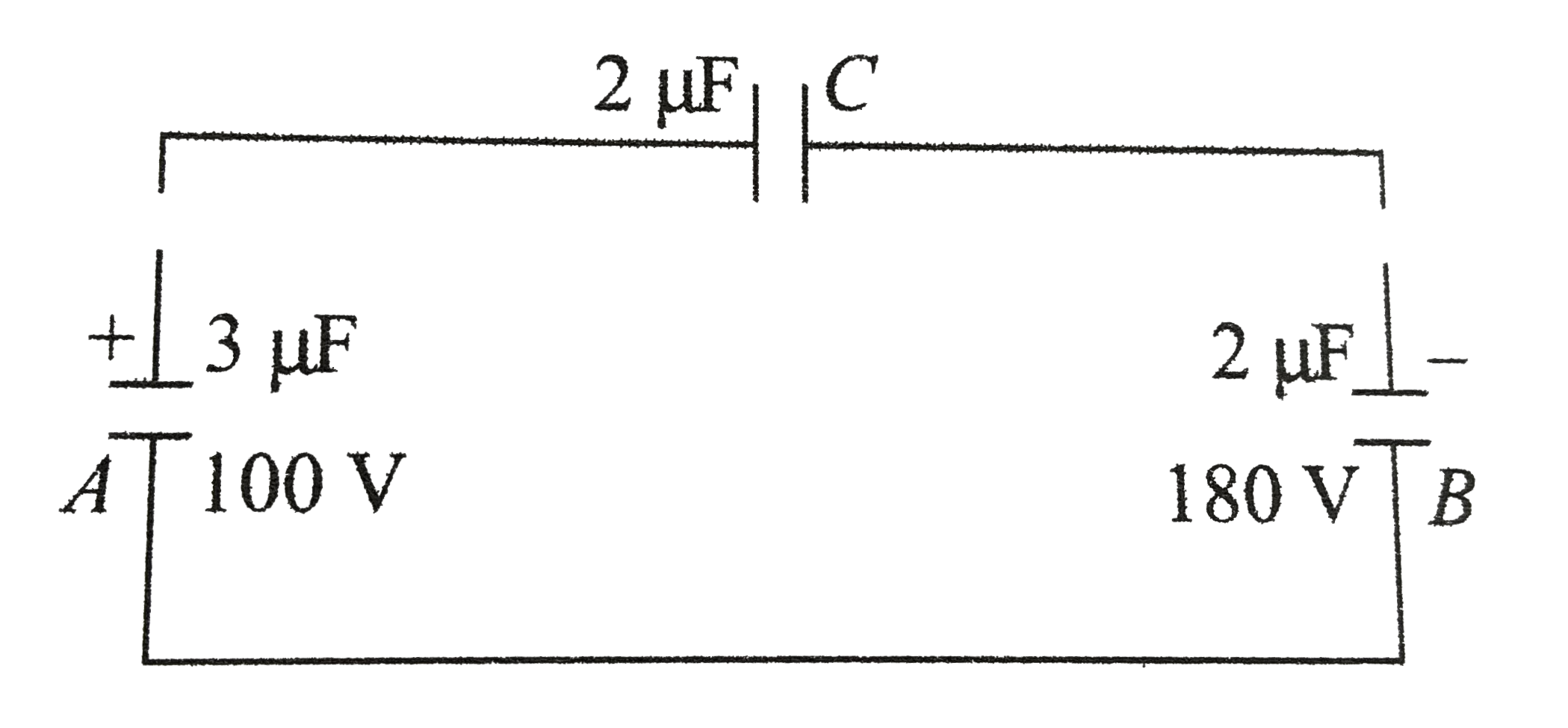
Two capacitors A and B with capacities `3 muF` and `2 muF` are charged to a potential differece of `100 V` and `180 V`, respectively. The plates ot the capacitors are connected as shown in, with one wire free from each capacitor. The upper plate of A is positive and that of B is negative An uncharged `2muF` capacitor C with lead wires falls on the free ends to complete the circuit.
i. Calculate the final charge on the three capacitors,
ii. Find the amount of electrostatic energy stored in the system before and after the completion of the circuit.
.

Text Solution

Verified by Experts

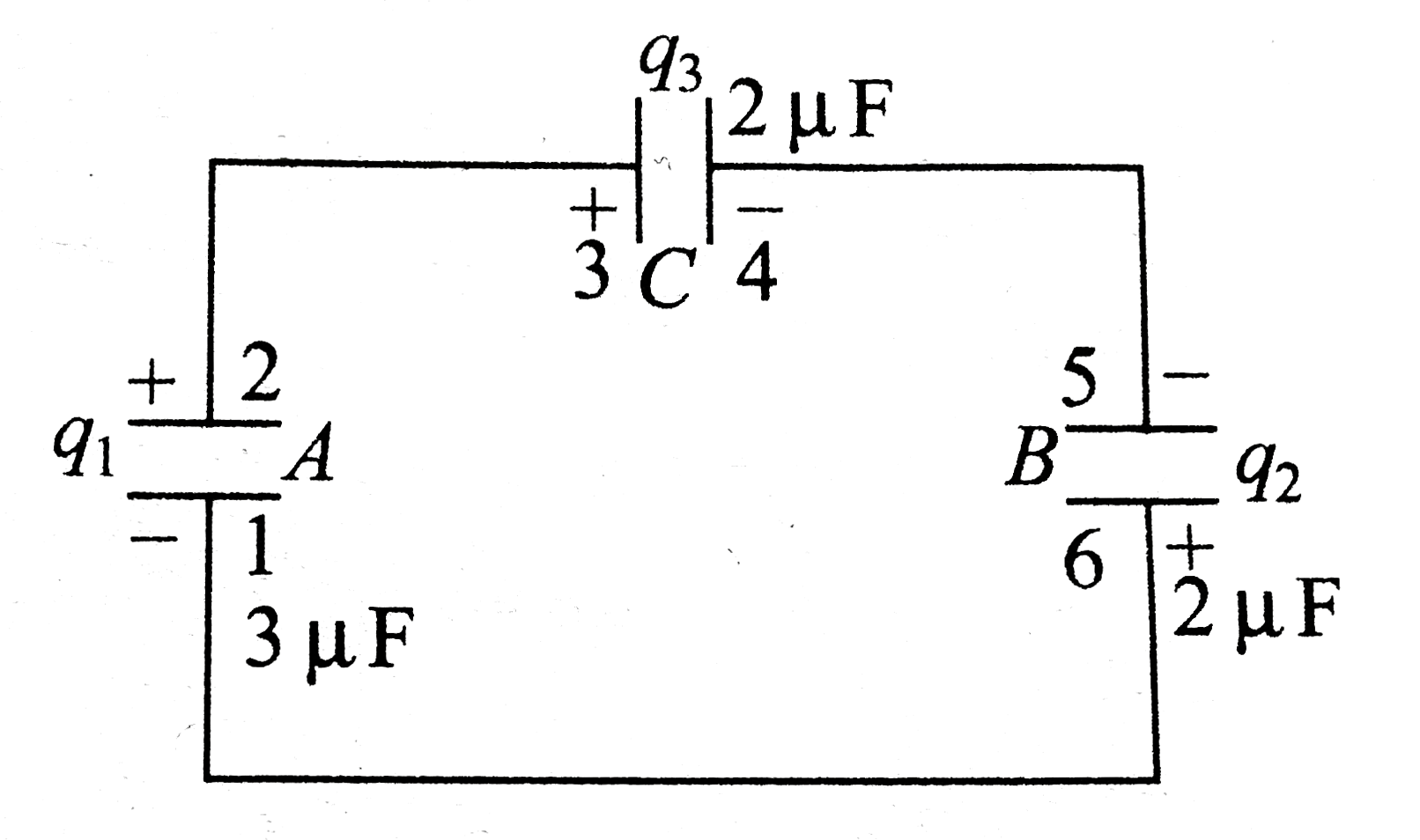
(i) Method 1 : Initial charge on capacitor `A` is `q_(A) = 3 xx 100 = 300 mu C`. Initial charge on capacitor `B` is `q_(B) = 2 xx 180 = 360 muC`. After completing the circuit, let the charge on capacitor `A` be `q_(1)`, on `B` be `q_(2)`, and on `C` be `q_(3)` with polarities as shown in. Applying conservation of charge for plates `2` and `3`, we get
`q_(1) + q_(3) = -360 + 0 = 300` (i)
Applying conservation of charge for plates `4` and `5`, we get
`-q_(2) - q_(3) = -360 + 0` or `q_(2) + q_(3) = 360` (ii)
Applying Kirchhoff's law in the whole cirucuit, we get
`(q_(1))/(3)- (q_(3))/(2) + (q_(2))/(2) = 0` (iii)
On solving, we get `q_(1) = 90 muC, q_(2) = 150 mu C`, and `q_(3) = 210 mu C`

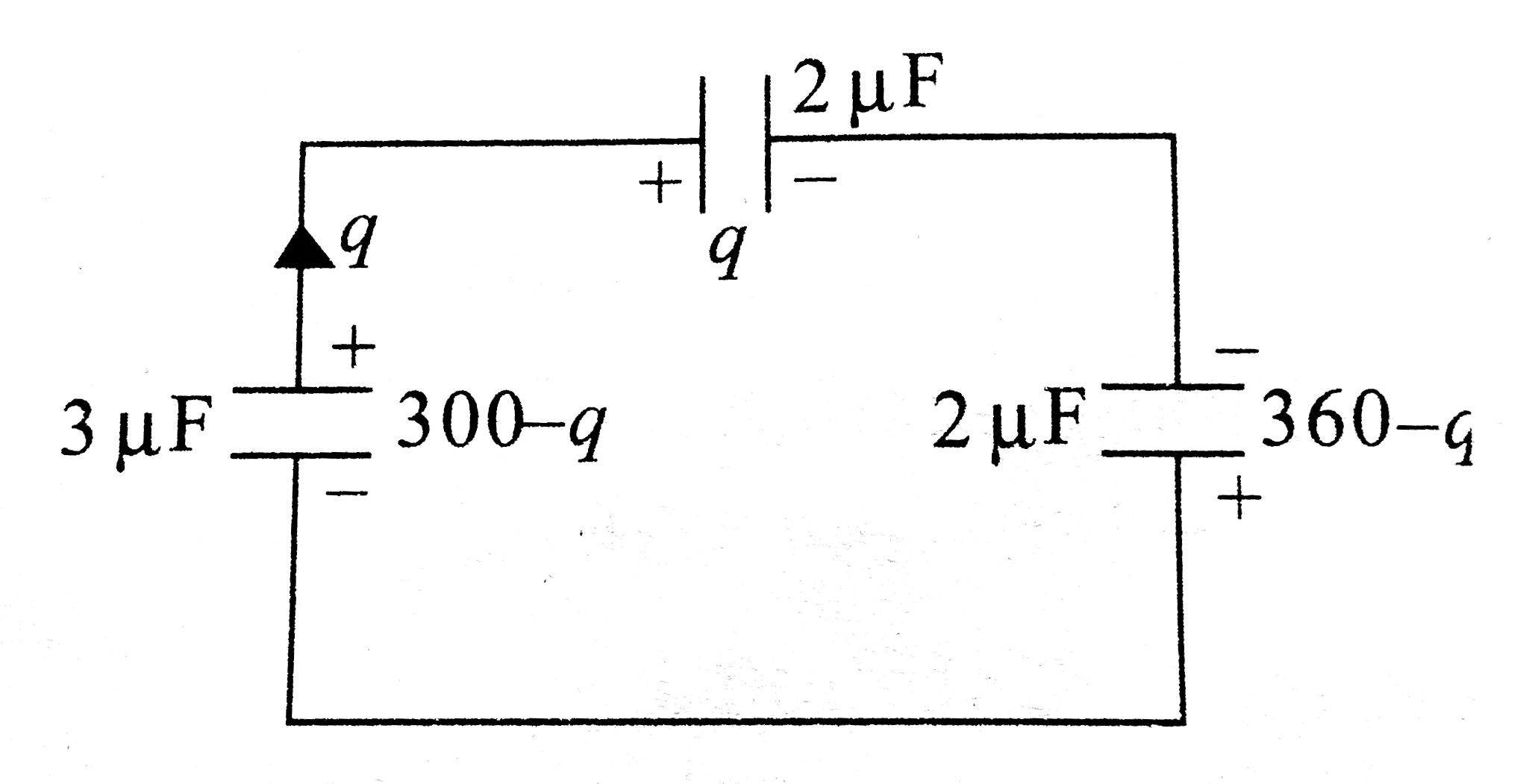
Method 2 : After completing the circuit, let the charge `q` flow in the circuit in the clockwise direction. Then the final charges on the capacitors will be as shown in.

Applying Kirchhoff's law, we get
`(300 - q)/(3) - (q)/(2) + (360 - q)/(2) = 0` or `q = 210 mu C`
Now charge on all three capacitors can be found.
(ii) Initially, energy stored is
`U_(i) = (1)/(2) xx 3 xx 10^(-6) xx (100)^(2)+(1)/(2)xx2xx10^(-6)(180)^(2)`
`= 4.74 xx 10^(-2) J`
Finally, the energy stored is
`U_(f) = ((90 xx 10^(-6))^(2))/(2 xx 3 xx 10^(-6))+((150 xx 10^(-6))^(2))/(2 xx 2 xx 10^(-6)) + ((210 xx 6^(-6))^(2))/(2 xx 2 xx 10^(-6))`
`= 1.8 xx 10^(-2) J`
Promotional Banner

Topper's Solved these Questions

  • CAPACITOR AND CAPACITANCE

    CENGAGE PHYSICS ENGLISH|Exercise Exercise 4.1|13 Videos
  • CAPACITOR AND CAPACITANCE

    CENGAGE PHYSICS ENGLISH|Exercise Exercise 4.2|32 Videos
  • CAPACITOR AND CAPACITANCE

    CENGAGE PHYSICS ENGLISH|Exercise Integer|5 Videos
  • ATOMIC PHYSICS

    CENGAGE PHYSICS ENGLISH|Exercise ddp.4.3|15 Videos
  • CENGAGE PHYSICS DPP

    CENGAGE PHYSICS ENGLISH|Exercise subjective type|51 Videos

Similar Questions

Explore conceptually related problems

Two capacitors A and B with capacities 3muF and 2muF are charged to a potential difference of 100 V and 180V , respectively. The plates of the capacitors are connected as show in figure with one wire of each capacitor free. The upper plate of A is positive and that of B is negastive. An uncharged 2muF capcitor C with lead wires falls on the free ends to complete the circuit. Calculate a. the final charge on the three capacitors. b. the amount of electrostatic energy stored in the system before and after completion of the circuit.

Two capacitors A and B with capacities C_1 and C_2 are charged to potential difference of V_1 and V_2 respectively. The plates of the capacitors are connected as shown in the figure with one wire free from each capacitor. The upper plate of A is positive and that of B is negative. An uncharged capacitor of capacitance C_3 and lead wires falls on the free ends to complete circuit, then

If the two plates of the charged capacitor are connected by a wire, then

Two capacitors of 2muF and 3muF are charged to 150 V and 120 V , respectively. The plates of capacitor are connected as shown in the figure. An uncharged capacitor of capacity 1.5muF falls to the free end of the wire. Then

Two capacitors of 2muF and 3muF are charged to 150 V and 120 V , respectively. The plates of capacitor are connected as shown in the figure. An uncharged capacitor of capacity 1.5muF falls to the free end of the wire. Then

Two cellls, two resistance and two capacitors are connected as shown in figure. The charge on 2muF capacitors is

Two capacitors of capacitance 2muF and 5muF are charged to a potential difference 100V and 50 V respectively and connected such that the positive plate of one capacitor is connected to the negative plate of the other capacitor after the switch is closed, the initial current in the circuit is 50 mA. the total resistance of the connecting wires is (in Ohm):

Two parallel plates capacitors A and B having capacitance of 1 muF and 5 muF are charged separately to the same potential of 100 V. Now, the positive plate of A is connected to the negative plate of B and the negative plate of A to the positive plate of B. Find the final charges on each capacitors.

The capacitor of capacitance 4 muF and 6 muF are connected in series. A potential difference of 500 volts applied to the outer plates of the two capacitor system. Then the charge on each capacitor is numerically